Rad Geek People's Daily

official state media for a secessionist republic of one

Posts filed under Smash the State

Cognitive Dissonance of the Non-Libertarian Left

Pam Martens’ recent article in CounterPunch looks at the rickety finance sector and the role that CDOs–complex securities that tap into the cash flow from a multilayered portfolio of debt obligations–have played in the money barons’ recent woes. Her piece is, oddly, titled The Free Market Myth Dissolves into Chaos. I say it’s odd, because here is what we find by the second and third paragraph from the top:

Given that these big Wall Street players now own some of our largest, taxpayer insured, depositor banks (courtesy of a legislative gift from Congress called the Gramm-Leach-Bliley Act) and the Federal Reserve is shoveling tens of billions of our dollars into some very big black holes, …

… The Bush administration is spinning the mess as a subprime mortgage problem lest the public figure out that a $1 Trillion unregulated market has blown up under the free market noses of this administration.

— Pam Martens (2008-01-03): The Free Market Myth Dissolves into Chaos

There are many kinds of manipulation and jobbery that go on actually existing capital and finance markets that deserve criticism, and the Left, including Martens, have some wise and insightful things to say on this point. The mystery is where the terms unregulated market and free market come into the picture. When one directly mentions government-imposed, tax-funded deposit insurance, and government cartelization of the entire banking industry under the auspices of a government-created, government-controlled central bank, one would expect at least a little recognition of the fact that we are dealing with a market rigged by government interventions to insulate and direct high finance. If nothing else, one would expect that the switcheroo from a critique of actually existing state capitalism to a critique of free markets might wait for at least a few more paragraphs, in order to make the manifest cognitive dissonance a bit less excruciating.
Further reading:

A Higher Law than the Constitution

Ron Paul is perfectly capable of making sharp and incisive moral arguments against the foolishness, and the destructiveness, of U.S. imperialism, whether in the form of the ongoing catastrophe in Iraq or in the form of proposed new slaughters in Iran or North Korea. He has done so many times in the past, both in writing and in speeches, and he deserves praise where he is in the right, as he usually is. But he has also spent quite a bit of time explaining his position in terms of the separation of powers between the President and the Congress, as established in the U.S. Constitution. In response to questions about foreign policy, he has repeatedly argued, first, that current U.S. foreign policy is both foolish and evil, but also, second, that if he became President, he would go to war when, and only when, Congress duly passed a formal declaration of war. See for example the exchange in GT 2007-09-06: Marching orders, and his remarks on attacking North Korea or Iran in his recent interview with Tim Russert.

So here is my open question for Ron Paul, and for the anti-war libertarians who support his candidacy. Suppose that Ron Paul were elected President and publicly declared his intent to put his fundamentalist reading of the Constitution into practice. Suppose also that Congress continues to be what it currently is — a bunch of mad dog world bombers, on the one hand, and a gang of opportunistic doughfaces who go along to get along, on the other. It’s perfectly likely that at some point in the upcoming years, Congress might pass a declaration of war in the name of bogus national interests in order to spread the slaughter into Iran or North Korea. At this point, President Ron Paul has two options:

  1. He can fulfill his Constitutionally-enumerated role as commander-in-chief of the military, and prosecute the imperial war that Congress has ordered him to prosecute; or

  2. He can refuse to fulfill his Constitutionally-enumerated role, by sitting on his hands and refusing to prosecute the war in any way even though Congress has declared it, on the grounds that there is a higher law than the Constitution, and that under the circumstances, following government law would require him to do something that no honest and decent man can do.

In case (1), Ron Paul would willingly make himself the instrument of death and slaughter in the name of a paper rag whose virtues, if it ever had any, must depend entirely on whatever capacity it has for safeguarding, rather than destroying, the life and liberty of innocent people. In case (2), Ron Paul would be taking a powerful moral stand against aggressive war; but in so doing he would have to give up entirely on his palaver about declared wars and strict construction of the Constitution. Which would he be willing to do? I am genuinely unsure myself, based on his statements and actions thus far, and I wonder what others think.

(Interview link courtesy of Austro-Athenian Empire 2007-12-24.)

Two brothers

There’s a famous midrash about two brothers. One was single and the other had a wife and children. Each night each one would go out in secret to deliver a gift of wheat to his brother’s home. The brother with the family would figure: I am so fortunate to have a family; my brother has nothing; let me at least give him some extra wheat. The single brother would figure: I live alone, but my brother has a family to support; I have no need for all this wheat; let me give him some of the extra. One night, while each was delivering wheat to the other, they met on the road, cried, and embraced. The place where they met became the Temple Mount.

There’s a modern version of this midrash. Each night the two brothers go out in secret to take wheat from his brother’s field. The single brother rationalized: my brother is so fortunate to have a family; I have nothing; at least let me have a larger portion of wheat. The brother with the family rationalized: I have a family to support, but he lives alone; he has no need for all that wheat; let me take some of the extra for myself. One night, while each was walking home with the wheat he had taken from the other, they met on the road, cried out, and fought. The place where they met became the site of Parliament.

(Thanks to Micha Ghertner @ The Distributed Republic 2007-12-24.)

Bomb after bomb

Last weekend, CounterPunch featured Howard Zinn’s introduction to elin o’Hara slavick’s book of cartographic drawings of American aerial bombing, Bomb after Bomb. I agree with Mark Brady that this is one of the best things that Zinn has ever written. Some of the most important stuff in the essay has to do with patriotism, the conflation of the country with the State, and the criminality of aerial warfare as such. A sample:

We have had enough experience, with the Nuremberg trials of the Nazi leaders, with the bombings carried out by the Allies, with the torture stories coming out of Iraq, to know that ordinary people with ordinary consciences will allow their instincts for decency to be overcome by the compulsion to obey authority. It is time therefore, to educate the coming generation in disobedience to authority, to help them understand that institutions like governments and corporations are cold to anything but self-interest, that the interests of powerful entities run counter to the interests of most people.

This clash of interest between governments and citizens is camouflaged by phrases that pretend that everyone in the nation has a common interest, and so wars are waged and bombs dropped for national security, national defense, and national interest.

Patriotism is defined as obedience to government, obscuring the difference between the government and the people. Thus, soldiers are led to believe that we are fighting for our country when in fact they are fighting for the government — an artificial entity different from the people of the country — and indeed are following policies dangerous to its own people.

My own reflections on my experiences as a bombardier, and my research on the wars of the United States have led me to certain conclusions about war and the dropping of bombs that accompany modern warfare.

One: The means of waging war (demolition bombs, cluster bombs, white phosphorus, nuclear weapons, napalm) have become so horrendous in their effects on human beings that no political end– however laudable, the existence of no enemy — however vicious, can justify war.

Two: The horrors of the means are certain, the achievement of the ends always uncertain.

Three: When you bomb a country ruled by a tyrant, you kill the victims of the tyrant.

Four: War poisons the soul of everyone who engages in it, so that the most ordinary of people become capable of terrible acts.

Five: Since the ratio of civilian deaths to military deaths in war has risen sharply with each subsequent war of the past century (10% civilian deaths in World War I, 50% in World War II, 70% in Vietnam, 80-90% in Afghanistan and Iraq) and since a significant percentage of these civilians are children, then war is inevitably a war against children.

Six: We cannot claim that there is a moral distinction between a government which bombs and kills innocent people and a terrorist organization which does the same. The argument is made that deaths in the first case are accidental, while in the second case they are deliberate. However, it does not matter that the pilot dropping the bombs does not intend to kill innocent people — that he does so is inevitable, for it is the nature of bombing to be indiscriminate. Even if the bombing equipment is so sophisticated that the pilot can target a house, a vehicle, there is never certainty about who is in the house or who is in the vehicle.

Seven: War, and the bombing that accompanies war, are the ultimate terrorism, for governments can command means of destruction on a far greater scale than any terrorist group.

These considerations lead me to conclude that if we care about human life, about justice, about the equal right of all children to exist, we must, in defiance of whatever we are told by those in authority, pledge ourselves to oppose all wars.

— Howard Zinn, Introduction to elin o’Hara slavick’s Bomb after Bomb

Read the whole thing.

(Via Mark Brady @ Liberty & Power 2007-12-15.)

Happy Christmas

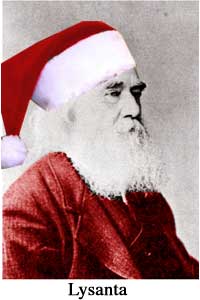
Seasons greetings from Lysanta!

Happy holidays, y’all. I hope that yours are full of light, and warmth, and fellowship.

(Photoshopping thanks to lowercase liberty 2005-12-25.)

Anticopyright. All pages written 1996–2026 by Rad Geek. Feel free to reprint if you like it. This machine kills intellectual monopolists.