Rad Geek People's Daily

official state media for a secessionist republic of one

Posts filed under The Long Memory

A Thought for Presidents’ Day

Today, about 100 people braved temperatures just above freezing to stand for peace at Toomer’s Corners in Auburn.

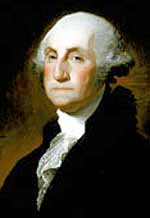
In honor of the event, here’s a thought for Presidents’ Day: What would the other George W. do?

Observe good faith and justice towards all Nations; cultivate peace and harmony with all. Religion and Morality enjoin this conduct; and can it be, that good policy does not equally enjoin it? It will be worthy of a free, enlightened, and, at no distant period, a great Nation, to give to mankind the magnanimous and too novel example of a people always guided by an exalted justice and benevolence. Who can doubt, that, in the course of time and things, the fruits of such a plan would richly repay any temporary advantages, which might be lost by a steady adherence to it? Can it be, that Providence has not connected the permanent felicity of a Nation with its Virtue? The experiment, at least, is recommended by every sentiment which ennobles human nature. Alas! is it rendered impossible by its vices?

In the execution of such a plan, nothing is more essential, than that permanent, inveterate antipathies against particular Nations, and passionate attachments for others, should be excluded; and that, in place of them, just and amicable feelings towards all should be cultivated. The Nation, which indulges towards another an habitual hatred, or an habitual fondness, is in some degree a slave. It is a slave to its animosity or to its affection, either of which is sufficient to lead it astray from its duty and its interest. Antipathy in one nation against another disposes each more readily to offer insult and injury, to lay hold of slight causes of umbrage, and to be haughty and intractable, when accidental or trifling occasions of dispute occur. Hence frequent collisions, obstinate, envenomed, and bloody contests. The Nation, prompted by ill-will and resentment, sometimes impels to war the Government, contrary to the best calculations of policy. The Government sometimes participates in the national propensity, and adopts through passion what reason would reject; at other times, it makes the animosity of the nation subservient to projects of hostility instigated by pride, ambition, and other sinister and pernicious motives. The peace often, sometimes perhaps the liberty, of Nations has been the victim.

–President George Washington, Farewell Address, 1796

War Hawks Fail to Make the Case

Editors, The Plainsman:

In a recent letter to the editor of The Plainsman, Jonathan Melville took a rather odd tack in his support for war against Iraq:

As for the argument that Iraq doesn’t pose a threat to us, this statement is completely irrelevant with respect to whether we wage war.

Mr. Melville may not believe that it is relevant whether the United States is unleashing its deadly military might in an act of self-defense or in an act of unprovoked conquest. This is, however, an odd position to take, and requires some explanation. Unfortunately, nowhere in his letter does Mr. Melville support his claim that the United States can be justified in waging wars based on aggression rather than self-defense. Nor does he provide any principle which he thinks is relevant to whether we wage war.

I would like to propose the following test for whether or not the United States is justified in going to war with Iraq. A war is justified if all of the following conditions are met:

  1. The Iraqi government possesses, or is likely soon to possess, significant weapons of mass destruction.
  2. There is a specific threat that the Iraqi government will use such weapons against citizens of the United States.
  3. There is good reason to believe that a war will substantially remove this threat.
  4. There is good reason to believe that the destruction caused by the war will not be worse than the threat left without a war.
  5. There are no options for removing the threat through less destructive means than war.

Now, neither Jonathan Melville nor myself is a U.N. weapons inspector. Neither of us has any particular access to whether (1) is true or false. As it happens, Hans Blix, who is in charge of chemical and biological weapons inspections, and Mohamed El-Baradei, who is in charge of nuclear weapons inspections explicitly deny that they have discovered anything which should prompt a war against Iraq. Since Mr. Melville claims to know that Iraq does in fact possess banned chemical and biological weapons, and also claims to know that they are about to have nuclear weapons, perhaps he has access to secret intelligence that the U.N. weapons inspectors do not. But he can hardly expect us to take his assertions on blind faith.

But even if (1) turns out to be true, neither the Bush administration, nor Jonathan Melville, has bothered to present any evidence whatsoever for (2)-(4). There is no evidence at all that Saddam Hussein has any more plans to attack the United States now than he did for the past twelve years. Has something changed in that time to transform a broken, beaten, third world country into an imminent threat to the world’s last unchallenged superpower? If something has changed, then the War Party should point it out. But, as far as I can tell, no-one has shown that anything has changed except the belligerence of the ruling party in Washington, DC.

How about (5)? Are there any options other than war? Certainly there are. For example, the United States can step back and let the inspections process continue to work–as Hans Blix and Mohamed El-Baradei have indicated they would be willing and able to do.

Mr. Melville and his fellow epistolator Charlie Vaughan do not present any evidence for believing that (2)-(5) are true. Instead, they both try to use an analogy with the struggle against fascism as a historical backdrop for the Bush administration’s plans for war–by accusing peace supporters of favoring appeasement of Saddam Hussein, as Neville Chamberlain favored appeasement of Hitler.

The attempted comparison is a grotesque abuse of history. Saddam Hussein is certainly a ruthless dictator with a lot of blood on his hands. However, comparing him to Hitler simply blanks out one minor detail: while Hitler stood atop a massive military machine that conquered nearly all of Europe in a few short years, Hussein is the tinhorn dictator of a devastated third world country, completely surrounded by hostile and militarily superior forces. There is no appeasement of Hussein to be done, because he poses a threat to no other country. What peace supporters ask is that we do not go out of our way to unleash the destruction of war on the Iraqi people when we can deal with Saddam Hussein through peaceful means.

Mr. Vaughan also angrily accuses Dr. El Moghazy of comments that are a slap in the face of those currently serving in our military. But El Moghazy never criticized women and men in the military–rather, his criticism was directed against the Administration that is dead-set on putting those brave men and women in harm’s way. It seems to me that it is no disrespect to our troops to try to keep them from being sent off to die in another dumb foreign war. If I were in the military, I’d rather have people support our troops by keeping me alive, rather than by giving me a medal after I’m dead.

Sincerely,
Charles W. Johnson
Auburn Peace Project

Brain Mutilation for Fun and Profit: The Story of Walter Freeman

A while ago I was looking for some good pages to reference about some of psychiatry’s more barbaric procedures. Along the way, I stumbled across the Washington Post’s peculiar profile of Dr. Walter Freeman, the pioneer of the ice-pick lobotomy and one of the most controversial figures in the past few decades of clinical psychiatry.

For those who aren’t familiar, Freeman performed thousands of lobotomies on people suffering from depression, anxiety, obsessive-compulsive disorder, schizophrenia, mental retardation, and other disorders. Sublimely apathetic to the fact that there was no actual evidence that his treatment worked, he carried on mutilating people’s brains–knocking them out by electroshock or anesthesia, and then hammering an icepick through the tear duct and swinging it around in the frontal lobe to destroy the connection with the thalamus.

Freeman made his fame, and a great deal of money, by refining Egas Moniz’s techniques for human lobotomy and touring the country evangelizing its use to psychiatric hospitals. Because lobotomy succeeded in making some trouble-making patients more docile, it was widely adopted by psychiatric hospitals after presentations by Freeman. It didn’t seem to bother them that most patients suffered severe losses of functioning after the procedure, that adult patients ended up pissing on themselves and having to be re-taught how to eat. It didn’t even matter to them that Freeman had forcibly anesthetized patients in order to carry out his assault on their brain whether they wanted it or not. What mattered to them was that patients were docile and manageable, not whether their humanity was being respected or their underlying mental conditions improved. In the period of Freeman’s greatest activity, between 1936 and the late 1950s, somewhere between 40,000 and 50,000 Americans were subjected to lobotomies.

Along the way, Freeman managed to kill several of his patients in surgery and to try bizarre experiments to refine his technique, such as a case where he followed the lobotomy of 14 patients with an injection of hot water into the brain, in which he was prepared to accept two fatalities. Prior to his career as a lobotomist, he had also personally introduced electroconvulsive therapy and insulin shock therapy to the hospital in which he worked.

A few of the incidents are recounted by the Post:

When the day arrived, Mrs. Hammatt tried to change her mind when she found out that her head had to be shaved. Freeman and Watts promised to spare as much of her hair as they could, before forcibly anesthetizing her. Later, Freeman recorded that her last words before surgery were, Who is that man? What does he want here? What’s he going to do to me? Tell him to go away. Oh, I don’t want to see him, followed by a scream.

The Post doesn’t bother to point it out, but what Freeman and Watts had just done was to cut into a person’s brain against her will, committing a bizarre and wantonly cruel surgical assault. Later in his brain-slicing career, he committed what could only be called murder from depraved indifference to human life:

At Cherokee State Hospital in Iowa, he accidentally killed a patient when he stepped back to take a photo during the surgery and allowed the leucotome to sink deep into the patient’s midbrain.

We’ll leave alone the question of why he was never put in prison for his crimes; so many atrocities against mental patients have gone unpunished. But why is it that the Washington Post has decided to portray Dr. Freeman, whose wanton disregard for human life and barbarous procedures should put his medical influence alongside that of Dr. Josef Mengele, as some kind of unheralded psychiatric innovator? They conclude their profile by writing:

Lobotomy also raised high hopes in its day. During the late 1950s, when the new tranquilizing drugs had grown popular in state hospitals, Freeman wrote letters to his psychosurgical colleagues around the world, praying for a time when brain operations would again gain wide favor in the battle against mental illness. It didn’t happen in his lifetime.

Now that it might happen in ours, Freeman’s presence is unwelcome. He flits around, a pesky spirit looking for the recognition he believes he is due, an unwanted ghost causing sighs and regret.

Poor Walter Freeman! As to the reason for these sighs and regret, the Post writes that The answer lies in the complex tangle of Freeman’s personality and motivations, and in the public’s fear of past abuses.

Perhaps the Post should reconsider the possibility that Freeman is discredited not only because of a grating personality and lingering public hysteria. Maybe it also has something to do with the fact that he was an irresponsible, sadistic asshole who killed several people and ruined the lives of tens of thousands more with a procedure that was completely useless, cruel, and barbaric.

Of course, methods which are not much more refined are carried on today–the ice-pick lobotomy was replaced with the chemical lobotomy of tranquilizers and other disabling psychiatric medications. The article would have been no more responsible if it had stridently condemned Freeman but uncritically endorsed these modern methods. But I really have to wonder what could have blinded the Post to something so thoroughly obvious as the evil that Freeman perpetrated on innocent people. It’s a fucking ice-pick driven through the skull. Even some of his psychiatric contemporaries, who regularly used electroconvulsive therapy and insulin shock, fainted at the sight of Freeman’s procedure. Can’t we expect at least that much sympathy out of those of us who have lived to have the benefit of hindsight on the horrors that Freeman wrought?
A Remembrance for Hiroshima

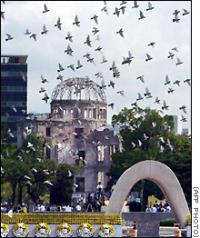
photo: Doves flew over Hiroshima during the memorial ceremony today

Amongst the Living

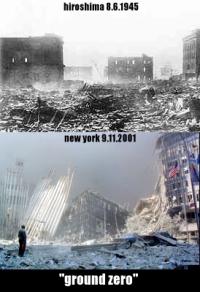
photo: The ruins of Hiroshima and the World Trade Center in New York

In Memory of the Dead

At 8:15am a solitary bell rang in Hiroshima. Doves were released and the names of some 4,977 people were placed underneath an arch-shaped memorial. Today’s memorial ceremony marked the 57th anniversary of the atomic holocaust in Hiroshima, in which over 220,000 people were killed by the firestorm, shockwave, radiation poisoning, cancers, and various other illnesses.

It’s become more or less a commonplace on the Left to recognize that Hiroshima was an atrocity, a crime against humanity inflicted upon innocent people by the US government. And while there remains a great deal of resistence among the media elites to understanding the horror of Hiroshima in the same terms as the horror of Auschwitz or the Killing Fields or September 11, it is far from an unspoken truth.

So let me merely say: Let us pause for a moment to remember those who died today. And let us celebrate those who live on and who work for a more peaceful, loving world.

Remembering Stonewall

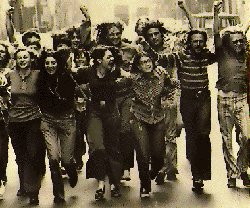
photo: Gay liberationists storm the streets

Andrew Sullivan‘s worst nightmare: the GLF on the march, New York City

Today is the 33rd anniversary of the Stonewall uprising (well, perhaps: some date Stonewall on June 28, since much of what occurred was after midnight) in New York City, the foundational event of the modern gay liberation movement. But it seems to have slipped many gay rights organizations’ minds.

Stonewall marked the first spectacular uprising of a radical, agitating gay movement which would no longer settle for the daily denigration and terrorism inflicted against LGBT people, and would not accept compromise, appeasement, or a ghettoized underground gay community as the solution.

Although the Stonewall Inn remains a powerful marker to gay liberation activists outside of the US, many in America have forgotten it, or wish we would. Today, there is a feel-good liberal gay rights movement which (sometimes) pays lip service to Stonewall, but rarely remembers the power of that moment. And there is a gay Right movement which loathes Stoneall and everything it stands for. They both work, with only slightly different priorities, for appeasement, tolerance, and assimilation into the mainstream of American culture. But at Stonewall they were not pleading for justice in return for assimilation. Butch dykes, fairies, drag queens, street kids, and every other spectre haunting homophobic American culture stormed through the streets, fighting back against the police who had victimized them for so long. Stonewall’s lasting legacy rests in groups such as the Gay Liberation Front, Radicalesbians, ACT-UP, and others, which confronted our culture with an uncompromising demand for justice, an end to oppression rather than an end to difference. This is what has marked the past three decades with unparalleled success, compared to the relative stagnation of the era of reformist groups such as the Mattachine Society and Daughters of Bilitis and ghettoized underground bars.

The feel-good liberals and the conservatives play into each other’s hands to write the radicals out of history. I looked for a good story on the anniversary, and found nothing at all on:

  1. The Advocate magazine and news updates
  2. Out
  3. Gay.com News
  4. Human Rights Campaign
  5. PFLAG

But in spite of the blackout, the radicals have been here all along. They were instrumental to the triumphs of the past thirty years, as gay liberation has made stellar progress on every front. They were here to suffer the horrors, with the Reagan backlash, the AIDS holocaust, and the rise in anti-gay murders. And all significant progress toward gay liberation depends on the ability of radical views and solutions to remain within the LGBT community and LGBT activism.

I hope that everyone will take some time today to remember and thank those who have gone before us in the struggle for justice. Happy anniversary, everyone.

Anticopyright. All pages written 1996–2025 by Rad Geek. Feel free to reprint if you like it. This machine kills intellectual monopolists.