Rad Geek People's Daily

official state media for a secessionist republic of one

Official national hero types

(Via Gene Expression 2008-04-04.)

Here’s the Danny Bonaduce of the Blogosphere, marking the occasion of the 40th anniversary of the death of Martin Luther King Jr., to reflect on the comforting lies about Dr. King, which the New Class political-intellectual complex has spent the last 40 years manufacturing and promoting:

Kai Wright has an excellent piece on the forgotten radicalism of Martin Luther King, Jr. — always a point worth making in a day and age when conservatives would like you to think they would have been standing right beside King when he marched on Washington.

That said, to some extent I think the creation of the King Myth and the displacement of the more authentic radical King is a good thing. A country doesn’t get official national hero types without mythologizing and sanitizing them to a large extent, and it’s a good thing, at the end of the day, that King has moved into national hero status.

— Matt Yglesias, The Atlantic (2008-04-04): MLK’s Radicalism

Really.

It seems to me that if the only way you can get official national hero types is by oversimplifying, lying, and thus eviscerating the substance of a world-changing life of work and body of thought, then official national hero types are worth less than nothing. What interest do they serve, and what are we supposed to need them for?

Certainly not the interest of honesty, or truth, and it seems to me that in these times those are coins far rarer — and therefore far more dear — than the pompous deliveries of the cosseted clique of power-tripping politicians and professional blowhards, who have convinced themselves that their collective in-jokes, shibboleths and taboos constitute the public life of a nation. I don’t give much of a damn, in the end, whether or not King gets ritualistically name-checked by men and women who were or would have been his mortal enemies to make stentorian speeches supposedly on his behalf. What I give a damn about is what the man, for all his many faults, actually cared about, fought for, and died for: the struggle of ordinary men and women for their own freedom, which meant their struggle to defy, resist, or simply bypass the consolidated violence of the belligerent power-mongers and the worse-than-useless moderate hand-wringers who made their living peddling excuses, apologetics, and the endless counsel of wait, wait.

This, not public-school pageants and official national hero types, is what the vast majority of us, who get no profit from the fortunes of the political-intellectual complex and its pantheon, need:

As I have walked among the desperate, rejected, and angry young men, I have told them that Molotov cocktails and rifles would not solve their problems. I have tried to offer them my deepest compassion while maintaining my conviction that social change comes most meaningfully through nonviolent action. But they ask — and rightly so — what about Vietnam? They ask if our own nation wasn’t using massive doses of violence to solve its problems, to bring about the changes it wanted. Their questions hit home, and I knew that I could never again raise my voice against the violence of the oppressed in the ghettos without having first spoken clearly to the greatest purveyor of violence in the world today — my own government.

… All the while the people read our leaflets and received the regular promises of peace and democracy and land reform. Now they languish under our bombs and consider us, not their fellow Vietnamese, the real enemy. They move sadly and apathetically as we herd them off the land of their fathers into concentration camps where minimal social needs are rarely met. They know they must move on or be destroyed by our bombs.

So they go, primarily women and children and the aged. They watch as we poison their water, as we kill a million acres of their crops. They must weep as the bulldozers roar through their areas preparing to destroy the precious trees. They wander into the hospitals with at least twenty casualties from American firepower for one Vietcong-inflicted injury. So far we may have killed a million of them, mostly children. They wander into the towns and see thousands of the children, homeless, without clothes, running in packs on the streets like animals. They see the children degraded by our soldiers as they beg for food. They see the children selling their sisters to our soldiers, soliciting for their mothers.

What do the peasants think as we ally ourselves with the landlords and as we refuse to put any action into our many words concerning land reform? What do they think as we test out our latest weapons on them, just as the Germans tested out new medicine and new tortures in the concentration camps of Europe? Where are the roots of the independent Vietnam we claim to be building? Is it among these voiceless ones?

We have destroyed their two most cherished institutions: the family and the village. We have destroyed their land and their crops. We have cooperated in the crushing of the nation’s only noncommunist revolutionary political force, the unified Buddhist Church. We have supported the enemies of the peasants of Saigon. We have corrupted their women and children and killed their men.

Now there is little left to build on, save bitterness. Soon the only solid physical foundations remaining will be found at our military bases and in the concrete of the concentration camps we call fortified hamlets. The peasants may well wonder if we plan to build our new Vietnam on such grounds as these. Could we blame them for such thoughts? We must speak for them and raise the questions they cannot raise. These, too, are our brothers.

… These are the times for real choices and not false ones. We are at the moment when our lives must be placed on the line if our nation is to survive its own folly. Every man of humane convictions must decide on the protest that best suits his convictions, but we must all protest.

… A true revolution of values will lay hand on the world order and say of war, This way of settling differences is not just. This business of burning human beings with napalm, of filling our nation’s homes with orphans and widows, of injecting poisonous drugs of hate into the veins of peoples normally humane, of sending men home from dark and bloody battlefields physically handicapped and psychologically deranged, cannot be reconciled with wisdom, justice, and love.

— Martin Luther King, Jr. (1967-04-04): Beyond Vietnam

And also this:

We know through painful experience that freedom is never voluntarily given by the oppressor; it must be demanded by the oppressed. Frankly, I have never yet engaged in a direct action movement that was well timed, according to the timetable of those who have not suffered unduly from the disease of segregation. For years now I have heard the words Wait! It rings in the ear of every Negro with a piercing familiarity. This Wait has almost always meant Never. We must come to see with the distinguished jurist of yesterday that justice too long delayed is justice denied.

We have waited for more than three hundred and forty years for our constitutional and God-given rights. The nations of Asia and Africa are moving with jet-like speed toward the goal of political independence, and we still creep at horse and buggy pace toward the gaining of a cup of coffee at a lunch counter. I guess it is easy for those who have never felt the stinging darts of segregation to say, Wait. But when you have seen vicious mobs lynch your mothers and fathers at will and drown your sisters and brothers at whim; when you have seen hate filled policemen curse, kick, brutalize and even kill your black brothers and sisters with impunity; when you see the vast majority of your twenty million Negro brothers smothering in an airtight cage of poverty in the midst of an affluent society; when you suddenly find your tongue twisted and your speech stammering as you seek to explain to your six-year-old daughter why she can’t go to the public amusement park that has just been advertised on television, and see tears welling up in her eyes when she is told that Funtown is closed to colored children, and see the depressing clouds of inferiority begin to form in her little mental sky, and see her begin to distort her little personality by unconsciously developing a bitterness toward white people; when you have to concoct an answer for a five-year-old son asking in agonizing pathos: Daddy, why do white people treat colored people so mean?; when you take a cross-country drive and find it necessary to sleep night after night in the uncomfortable corners of your automobile because no motel will accept you; when you are humiliated day in and day out by nagging signs reading white and colored; when your first name becomes nigger, your middle name becomes boy (however old you are) and your last name becomes John, and your wife and mother are never given the respected title Mrs.; when you are harried by day and haunted by night by the fact that you are a Negro, living constantly at tip-toe stance never quite knowing what to expect next, and plagued with inner fears and outer resentments; when you are forever fighting a degenerating sense of nobodiness; then you will understand why we find it difficult to wait. There comes a time when the cup of endurance runs over, and men are no longer willing to be plunged into an abyss of despair. I hope, sirs, you can understand our legitimate and unavoidable impatience.

You express a great deal of anxiety over our willingness to break laws. This is certainly a legitimate concern. Since we so diligently urge people to obey the Supreme Court’s decision of 1954 outlawing segregation in the public schools, it is rather strange and paradoxical to find us consciously breaking laws. One may well ask: How can you advocate breaking some laws and obeying others? The answer is found in the fact that there are two types of laws: There are just and there are unjust laws. I would be the first to advocate obeying just laws. One has not only a legal but a moral responsibility to obey just laws. Conversely, one has a moral responsibility to disobey unjust laws. I would agree with Saint Augustine that An unjust law is no law at all. … So I can urge men to disobey segregation ordinances because they are morally wrong.

I must make two honest confessions to you, my Christian and Jewish brothers. First, I must confess that over the last few years I have been gravely disappointed with the white moderate. I have almost reached the regrettable conclusion that the Negro’s great stumbling block in the stride toward freedom is not the White Citizen’s Counciler or the Ku Klux Klanner, but the white moderate who is more devoted to order than to justice; who prefers a negative peace which is the absence of tension to a positive peace which is the presence of justice; who constantly says I agree with you in the goal you seek, but I can’t agree with your methods of direct action; who paternalistically feels he can set the timetable for another man’s freedom; who lives by the myth of time and who constantly advises the Negro to wait until a more convenient season. Shallow understanding from people of goodwill is more frustrating than absolute misunderstanding from people of ill will. Lukewarm acceptance is much more bewildering than outright rejection.

I had hoped that the white moderate would understand that law and order exist for the purpose of establishing justice, and that when they fail to do this they become dangerously structured dams that block the flow of social progress. I had hoped that the white moderate would understand that the present tension in the South is merely a necessary phase of the transition from an obnoxious negative peace, where the Negro passively accepted his unjust plight, to a substance-filled positive peace, where all men will respect the dignity and worth of human personality. Actually, we who engage in nonviolent direct action are not the creators of tension. We merely bring to the surface the hidden tension that is already alive. We bring it out in the open where it can be seen and dealt with. Like a boil that can never be cured as long as it is covered up but must be opened with all its pus-flowing ugliness to the natural medicines of air and light, injustice must likewise be exposed, with all of the tension its exposing creates, to the light of human conscience and the air of national opinion before it can be cured. …

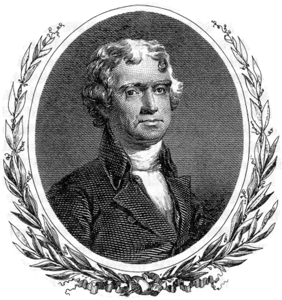
… You spoke of our activity in Birmingham as extreme. At first I was rather disappointed that fellow clergymen would see my nonviolent efforts as those of the extremist. … But as I continued to think about the matter I gradually gained a bit of satisfaction from being considered an extremist. Was not Jesus an extremist for love — Love your enemies, bless them that curse you, pray for them that despitefully use you. Was not Amos an extremist for justice — Let justice roll down like waters and righteousness like a mighty stream. Was not Paul an extremist for the gospel of Jesus Christ — I bear in my body the marks of the Lord Jesus. Was not Martin Luther an extremist — Here I stand; I can do none other so help me God. Was not John Bunyan an extremist — I will stay in jail to the end of my days before I make a butchery of my conscience. Was not Abraham Lincoln an extremist — This nation cannot survive half slave and half free. Was not Thomas Jefferson an extremist — We hold these truths to be self-evident, that all men are created equal. So the question is not whether we will be extremist but what kind of extremist will we be. Will we be extremists for hate or will we be extremists for love? Will we be extremists for the preservation of injustice–or will we be extremists for the cause of justice? In that dramatic scene on Calvary’s hill, three men were crucified. We must not forget that all three were crucified for the same crime–the crime of extremism. Two were extremists for immorality, and thusly fell below their environment. The other, Jesus Christ, was an extremist for love, truth and goodness, and thereby rose above his environment. So, after all, maybe the South, the nation and the world are in dire need of creative extremists.

— Martin Luther King Jr., Letter from Birmingham Jail

For anybody other than a self-appointed public intellectual, honest appraisal and serious engagement with the real life, virtues, foibles, questions, and struggles of a creative extremist like King are things more profound, more beautiful, more powerful, more passionate, and ultimately more useful than all the combined hagiographies and bed-time stories of the canonized saints of American theo-nationalism.

Further reading:

I can’t make out what you’re trying to say on account of the corpse in your mouth.

There’s an Australian state socialist magazine called Links, which, for reasons that remain completely opaque to me, seems to believe that the old Movement of the Libertarian Left listserv wants and needs to be buried under reams of its promotional materials. Here’s a choice passage from an interview they ran, which they recently promoted on the list:

Peter Boyle: You're criticising Labor for not seriously tackling global warming but what do socialists say should be done to address the crisis?

Dave Holmes: What is needed to cope with the crisis is a sharp change of direction. We need an emergency mobilisation of society, a five- or 10-year plan to achieve a drastic reorientation of our economy and use of energy. Anything else is simply not serious.

— Links (2008-04-03): A revolutionary response to the climate change crisis

Everything old is new again.

My own views about global warming, as a phenomenon, are perhaps shockingly ordinary. From what I’ve read I see no reason to doubt that it’s real, and caused largely by human activity, and an increasingly serious concern for many people all over the world. I think that each of us individually, and together with our neighbors, ought to be giving serious thought to the problem, and especially to how hypercentralized, state-supported and state-insulated corporate capitalism (especially the state-regimented, state-subsidized, and state-cartelized fossil fuel industry) structures the problem, and what we can each of us do about both the situation as it affects us, and also about the root causes that drive it.

But when you have a problem created, in large part, by a system of massive government regimentation, privilege, and technocratic planning, in an industry whose exploration and extraction are founded in colonialism and government land-grabs, whose distribution is heavily regulated, concentrated, and promoted by government, and whose protection flows from the barrel of Coalition tanks, I am not entirely convinced that this is a good reason to call for more government regimentation, privilege, and technocratic planning, or for concluding that We need less of [the so-called free market], not more.

I am convinced that people who talk about revolution without understanding the possibility of free action outside the realm of state coercion, who never see any way to approach a pressing social problem except emergency mobilization through lock-step central plans fraudulently passed off as a big society-wide discussion, but in fact handed down in the form of government marching orders–such people are talking with a corpse in their mouths.

Further reading:

Collateral damage

Here’s two passages from two different articles that I read today. See if you can fill in the blanks to identify the spokesman, the military force in question, and the enemy force being condemned.

  1. . . ., rejecting criticism of attacks by . . . that have killed thousands, maintained that it does not kill innocent people. … If there is any innocent who was killed in the . . .’s [bombings], then it was either an unintentional error or out of necessity, . . . said. He went on to accuse . . .’s opponents of being the ones who kill innocent people. He also charged that the enemy intentionally takes up positions in the midst of . . . for them to be human shields for him.

  2. Anecdotally, . . . also add some caveats to recent civilian casualty headlines. They acknowledge that mistaken intelligence has led to some truly accidental deaths, including the deaths of children. But in other cases, they say, . . . appear to be delivering inflated reports of civilian deaths. . . . also fights among civilians, dramatically increasing the likelihood of civilian deaths …. (. . . say that during a recent firefight, innocent civilians were forced into a trench alongside . . . so that any [bombings] would result in the significant loss of civilian lives).

See the answer to number 1 here. And the answer to number 2 here.

Herbert Spencer Anti-Defamation League (Part 423 of ???)

Here’s noted evolutionary biologist and village atheist Richard Dawkins, in the course of his review of what seems to be a laughable little documentary that he was tricked into giving an interview for:

My own view, frequently expressed (for example in the The Selfish Gene and especially in the title chapter of A Devil’s Chaplain) is that there are two reasons why we need to take Darwinian natural selection seriously. Firstly, it is the most important element in the explanation for our own existence and that of all life. Secondly, natural selection is a good object lesson in how NOT to organize a society. As I have often said before, as a scientist I am a passionate Darwinian. But as a citizen and a human being, I want to construct a society which is about as un-Darwinian as we can make it. I approve of looking after the poor (very un-Darwinian). I approve of universal medical care (very un-Darwinian). It is one of the classic philosophical fallacies to derive an ought from an is. Stein (or whoever wrote his script for him) is implying that Hitler committed that fallacy with respect to Darwinism. If we look at more recent history, the closest representatives you’ll find to Darwinian politics are uncompassionate conservatives like Margaret Thatcher, George W Bush, or Ben Stein’s own hero, Richard Nixon. Maybe all these people, along with the Social Darwinists from Herbert Spencer to John D Rockefeller, committed the is/ought fallacy and justified their unpleasant social views by invoking garbled Darwinism.

— Richard Dawkins (2008-03-28): Lying for Jesus?

There’s a fair amount to praise here, and a fair amount to pick at. For the moment, though, I’d like to point out that Dawkins’ characterization of Herbert Spencer — the 19th century radical libertarian sociologist and philosopher — is completely wrong on two different counts.

Herbert Spencer, dirty evolutionist hippie

First, Spencer was not a Social Darwinist. He was not, in fact, a Darwinist at all; he published his most famous work on evolution and society, Social Statics, in 1851, eight years before Charles Darwin first published On the Origin of Species. His ideas about evolution, especially as applied to society, were Lamarckian, rather than Darwinian; which is not ultimately that surprising, since he came up with them independently of Darwinian evolutionary theory, and before that even existed in published form.

Second, Dawkins is completely wrong about Spencer’s radical political views, which bear virtually no resemblence to the belligerent Rightism and economic royalism of Thatcher, Bush, Nixon, or Rockefeller. Spencer was in fact a feminist, a labor radical, and a vehement critic of European imperialism (which he described as bearing a very repulsive likeness to the doings of buccaneers). Contrary to the most popular, and most wildly inaccurate, caricature of his social views, Spencer did not believe in cutting off charitable relief to, or mutual aid among, the poor, sick, or other folks whom the powers that be might marginalize and dismiss as unfit, in the name of survival of the fittest. (That is his phrase, but it is being misapplied.) Spencer opposed government welfare programs — because he opposed all forms of government command-and-control — but he believed that voluntary charity and mutual aid were not only a positive moral obligation, but in fact were features of the highest forms of social evolution (Social Statics, pp. 291-2), as the old militant mode of hierarchy and command was supplanted by the new industrial mode of solidarity and voluntary co-operation. Spencer devoted ten chapters of his late work, Principles of Ethics, to the duty of Positive Beneficence. He advocated the organization of voluntary labor unions as a bulwark against exploitation by capitalist bosses, and favored an economy organized primarily in free worker co-operatives as a replacement for the slavery of capitalist wage-labor.. For those — like the cartoon Social Darwinist that Spencer is so often portrayed to be — who advocated indifference or harshness towards the poor and blamed poverty on the ignorance, folly, or vices of the poor people themselves, Spencer himself had nothing but contempt:

It is very easy for you, O respectable citizen, seated in your easy chair, with your feet on the fender, to hold forth on the misconduct of the people – very easy for you to censure their extravagant and vicious habits …. It is no honor to you that you do not spend your savings in sensual gratification; you have pleasures enough without. But what would you do if placed in the position of the laborer? How would these virtues of yours stand the wear and tear of poverty? Where would your prudence and self-denial be if you were deprived of all the hopes that now stimulate you …? Let us see you tied to an irksome employment from dawn till dusk; fed on meager food, and scarcely enough of that …. Suppose your savings had to be made, not, as now, out of surplus income, but out of wages already insufficient for necessaries; and then consider whether to be provident would be as easy as you at present find it. Conceive yourself one of a despised class contemptuously termed the great unwashed; stigmatized as brutish, stolid, vicious … and then say whether the desire to be respectable would be as practically operative on you as now. … How offensive it is to hear some pert, self-approving personage, who thanks God that he is not as other men are, passing harsh sentence on his poor, hard-worked, heavily burdened fellow countrymen …. (Social Statics, pp. 203–5)

Of course, there is plenty in Spencer’s views that Dawkins, as a Social Democrat, would object to. But Dawkins has not yet succeeded in identifying what those disagreements would be. Spencer’s humanitarian, pro-labor, pro-charity radical left libertarianism has just about nothing in common with the authoritarian Right-wing political economy that Dawkins rightly condemns.

Further reading:

Grammatical Investigations: she, he, ze, and they

Last week I wrote about Jamie Kirchick’s latest excursion into truthiness for The New Republic‘s blogs; the comments seem to have lit out on an interesting tangent about language, grammar, and gender-neutral third-person pronouns. It’s all Anon73’s fault:

Continuing the pronoun pondering, I don't really agree with the method of alternating he and she to make language gender-neutral; it provokes too much confusion when one actually does want to specify a person's gender. I think the best method is to switch to new pronouns like ze and use he/she when gender matters to a discussion. But then I favor talking about kibibytes and mebibytes, so what do I know....

— Anon73 @ 24 March 2008 at 11:37 am

I replied:

I don’t actually alternate pronouns very often; with a very few exceptions, I just always use she in preference to he as a gender-indefinite pronoun. But in any case I don’t see either practice as posing much of a stylistic problem when you do want to specify gender: you just do that in the antecedent, rather than in the pronoun. In a language that had no gendered pronouns, that’s what you’d have to do anyway.

Anyone who likes words like ze, hir, ey, xe, thon, etc. should feel free to use them as widely as they can; I’m certainly not going to begrudge them the minimal effort it takes on my part to pick up on new monosyllables. But I generally don’t like them, stylistically speaking, because they usually don’t sound much like English–they don’t fit very well into the phonetic structure of either formal English or dialect. (For example, how is hir even supposed to be pronounced by an English speaker?)

The one big exception to that is the singular they, which comes out of living speech and which flourishes in most dialects because in most of the constructions you might use it in, it sounds pretty natural. But it often gets frowned on and doesn’t have much uptake by self-conscious language reformers, because the kind of people who would actually use a word like ze in writing or speech also tend to be the kind of people who would feel awkward about using an incorrect singular they.

If yo gets some uptake, that would sound fairly natural, too, and would sidestep whatever uneasiness people may feel about the singular they.

— Rad Geek @ 24 March 2008 at 1:21 pm

Laura J., who knows more about language than I could ever hope to, and perhaps more than an entirely sane human being should, adds:

Yo? How curious. I don't think I could easily get used to it – it simultaneously sounds too much like English you and Romance first-person pronouns for my tastes. But then, I don't have a grammatical gap to fill there since I routinely use they as a singular pronoun when there isn't one specific gendered person being referred to.

— Laura J. @ 24 March 2008 2:53pm

Here’s Roderick:

Shakespeare occasionally uses they as a singular pronoun, as I recall.

— Roderick Long @ 27 March 2008 9:30am

Me again, stirring up some controversy:

As do Jane Austen and the King James Version of the Bible. (Cf. 1 for still more examples.) But of course discomfort with the singular they has more or less nothing to do with the norms underlying actually-existing good English, either written or spoken, and everything to do with a fetishized ideal of how a logical language should work, or, more concretely, with participating in a particular culture of correction and officious priggishness, which institutional schooling browbeats most educated professionals into accepting.

— Rad Geek @ 30 March 2008 10:09pm

Anon72 (not to be confused with Anon73, unless they’re actually the same person–I don’t know one way or the other) joins in to reply

Well I think clarity and consistency are always good things to strive for in a language; I just don't see the singular they as satisfying either.

— Anon72 @ 31 March 2008 11:32am

This is pretty much always the first line of defense when challenging an incorrect bit of dialectical grammar. But I don’t buy it; clarity and consistency are certainly things to be desired, but this seems like special pleading. I reply:

I agree with the principle, but not with the application of it.

Can you think of any actual cases in your life where somebody used the singular they and you couldn’t understand what they were saying because of it?

If so, what was the case? If not, then it seems like your worry about clarity is misplaced.

As for consistency, is it a violation of consistency for English to have a single word, you, for the second-person singular and the second-person plural? If not, how is that different from having a singular they? If so, does it rub you the wrong way when someone uses you in the plural (or singular) just as much as when they use they in the singular? If it does, do you fix the problem by introducing dialectical constructions like y’all or youse or yuns in formal contexts? If it doesn’t, what do you suppose accounts for the difference in your reaction?

— Rad Geek @ 31 March 2008 12:16pm

Anon72 answers one of my questions:

As for consistency, is it a violation of consistency for English to have a single word, you, for the second-person singular and the second-person plural?

Yes. I don't like y'all, but it would be nice if the language had separate words for the singular and plural forms. If you want to know my philosophy on language, I think Heinlein was right when he said words should mirror the way we think about reality. Addressing a single person is very different from addressing a crowd, so it's logical to have different words for each. I'd say similar considerations apply to neutral pronouns; sometimes people want to refer to someone of certain but unknown gender, and he/she/it doesn't cut it. However, I don't necessarily agree with Hofstadter that sexism is partly due to gendered pronouns.

Incidentally I was reading an old grammar guide (circa 1961) and when listing the different genders it said something to the effect of he, she, and it are for male living things, female living things, and non-living things (neuter) respectively. It's interesting how the original english speakers decided a fourth category of living-but-necessarily-gendered was unimportant.

— Anon72 @ 1 April 2008 7:34pm

But I’m not especially convinced.

I agree that a proper language needs separate words for addressing a single person and addressing a group of people. But I think that privileged English already has two different words for those two different purposes, even without dialectical constructs like the ones I mentioned. Those two words are you and you.

Those are, to be sure, two words that can’t be distinguished by sound or spelling, but rather are distinguished by the context of their significant use (as expressed in word order, sentence structure, etc.). There are lots of pairs of words like that, sometimes with very different or even opposite meanings — sanction meaning punishment and sanction meaning approval or endorsement, for example — but in real, everyday language, context is often quite enough to distinguish those words from one another. To take another case, suppose that everyone suddenly stopped spelling their, there, and they’re differently in writing, and just used a single spelling for all three words, their. (Lots of people already do this unless a teacher raps them on the knuckles for it.) Would that impair your ability to distinguish the words from each other? Really? Does the fact that they all sound exactly alike impair your ability to distinguish them in speech?

Now, if someone’s depending on context rather than phonetic or graphical features to differentiate different words, then, to be sure, they have to consider how clearly context distinguishes and how often it leaves things ambiguous. In the case of you and you, it turns out there are enough cases with a significant risk of confusion that dialects have repeatedly, spontaneously with alternative second-person plural pronouns to solve the problem. But in the case of they, the situation is quite the reverse: the spontaneous and repeated trend, even among masterful and careful writers of good English — Shakespeare, Chaucer, Austen, the King James Version translators, et al. — has been to spontaneously use the singular they in order to get an epicene pronoun, where the privileged version of the language doesn’t provide it. I think that the dialectical situation is different here because, as a matter of actual fact, the rules for using singular they (which, grammatically, isn’t actually a perfect substitute for he or she; it only works in a subset of cases where he or she works) are such that there’s hardly ever any chance of confusion, given the context of the sentence.

Which brings me back to a couple of my earlier question, which I really would be interested to hear Anon72’s answers to:

Can you think of any actual cases in your life where somebody used the singular “they” and you couldn't understand what they were saying because of it?

And also:

If so, does it rub you the wrong way when someone uses you in the plural (or singular) just as much as when they use they in the singular? … If it doesn’t, what do you suppose accounts for the difference in your reaction?

Incidentally, I should add that I think that y’all is lovely English and I would have no problem introducing it (or you all or whatever) into the context of formal writing, which would (among other things) have the benefit of avoiding certain kinds of ambiguity. There are lots of cases where I prefer an academic she to a singular they, too, but honestly I think any charges of either unclarity or inconsistency against they are surely trumped up, and probably a reflection of just that fetishized ideal of how logical languages are supposed to look (as if the logic were in the signs themselves rather than in their significant use) that I complained about earlier.

Anticopyright. All pages written 1996–2026 by Rad Geek. Feel free to reprint if you like it. This machine kills intellectual monopolists.