CSPAN is always a bit hard-up for programming at 12 in the morning, except when a marathon Congressional debate happens to be stretching into the long, cold hours. Tonight they’ve managed to do–maybe without realizing it–quite a public service, for those who had the chance to see it: they replayed, in its entirety, a remarkable episode of the Dick Cavett show from 1971, featuring a debate between a 27-year-old John F. Kerry, representing Vietnam Veterans for the War, and John O’Neill, representing a small administration front-group calling itself Vietnam Veterans for a Just Peace
. In a generation endlessly bombarded with pre-packaged popcult nostalgia, where whole channels are devoted to sit-com reruns and to musical has-beens, this is something unique, and valuable: a chance to sit your fat ass in front of the television and see some actual political history–some of the stuff that people were actually worried about in the 1970s. Of course, that remembering and witnessing basic points of the political debate at a time so recent in living memory counts as mining history
, by the standards of our day, is sad enough in itself–but that is another diatribe for another time.
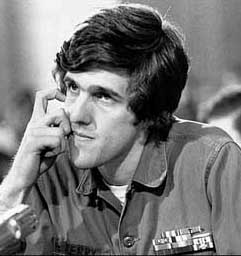
John Kerry testifies before Congress in 1971
As for the show itself: it’s interesting, but I’m not really that concerned with the current well-publicized flap between Mr. Kerry and Mr. O’Neill, or how the Cavett debate illuminates it. It’s obvious that Mr. O’Neill is a two-bit character assassin; and it’s also obvious that he’s a dishonest tool. You could tell that from his recent appearances, and you could tell it from his endless, vituperative red herrings from the encounter in 1971. Nothing new here. And while I do think that the tenor and the conduct of the debate–where, for all of Mr. O’Neill’s interruptions and hectoring, Mr. Kerry’s tightly-argued case was given the space and time and moderation to win the audience over by force of reason–is remarkable as a point of contrast to Howler Monkey cognitive style that is so favored in contemporary public debate, that’s also not what grabs my attention most tonight. What I’m more interested in is what Mr. Kerry said then, when he was younger and wiser:
I want to know why we can’t set a date when we know that the prisoners
will come home, when we know that people will stop being maimed for the
most senseless purpose in the world …
…
Whether or not the group on the other side knows it or not–in fact, they
should change their name from Vietnam Veterans for a Just Peace to Vietnam
Veterans for a Continued War because that in fact is really what
Vietnamization is. It is nothing more than a way of getting the United States
out of Vietnam by changing the colors of the bodies in that country. It’s a
military solution in a problem that requires a very, very sophisticated political
solution. And all that it will do in the end is possibly intricate us into a much,
much deeper war than we are in now or at least allow us to withdraw in time
for the elections of next year when the president can say, Yes, indeed, we
did withdraw,
at which time more Americans will have lost their lives and
more Vietnamese will have lost their lives needlessly.
…
The bigger issue at hand is the question literally of how the United States is
going to get out of Vietnam now, and I have said again and again this
evening that we can set a date, that we can bring the prisoners home, but
the point is I think this administration is still seeking some kind of victory
over there.
…
as long as you do not settle the political question of how the Vietnamese
communists are going to fit in to some kind of regime, as long as you continue
the hypocrisy of saying that we are fighting for a democracy when you
have a regime which only recently passed a law which may not let them have
other candidates in an election, which has some 40 thousand to 100 to 200
thousand political prisoners in jail, which 14 days ago closed down–excuse
me–10 days ago closed down 14 newspapers because they printed a key
speech about the corruption of the government, as long as we’re supporting
this kind of government that doesn’t allow representative forces to be part of
it, you are asking for trouble, and that’s what we’re doing.
…
But I’m glad you’ve raised the question of the Pentagon Papers because I
think that … they are a terribly, terribly important aspect of what has
happened because they do show–well, they show a great many things and
they are partially incomplete, but they certainly show the duplicity and the
deceit which has been involved in building up this war because clearly there
was a peace candidate who ran in 1964 who was not a peace candidate, and
clearly we had–we were committing aggressive acts against–covert warfare
against Laos and against North Vietnam prior–without telling the American
people. We’ve been bombing Laos now for seven years, and only this year the
American people were told, and I think that this typifies a great deal of the
most recent approach of the American government to the people, that they’ve
shown a kind of disdain for the ability of the American people to determine for
themselves the difference between right and wrong, and I think clearly that
when it comes to a question of sending men off to fight and to die, the people
of this country have the ability to make that decision for themselves.
–John F. Kerry, on the Dick Cavett show in 1971. You can read a decent full transcript online from an anti-John Kerry hatchet site.
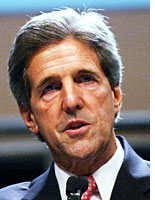
John Kerry hangs out in Congress, 2004
What is it about walking in the halls of power that has put John Kerry so far away from the man who said these words in 1971, with a sense of urgency and earnest moral conviction? When did the mental and moral rot of national honor
and winning the peace
sink in? Why doesn’t he seem to believe, anymore, that we have a real duty to honestly account for the human costs of a seemingly endless, futile counter-insurgency war?
Why doesn’t he see how living up to his younger seriousness and earnestness would help him (both morally and practically)? Is it controversial, at this point, that Vietnam was a dreadful mistake? How much longer will it be controversial that the Iraq war and the ongoing occupation are also dreadful mistakes, for almost exactly the same reasons as in Vietnam? Why doesn’t Kerry feel that he can connect with the people he’s trying to win over on these grounds? (Hell, when Kerry is facing a steady barrage of character-assassination over how he spent the late 1960s and early 1970s, why aren’t the Democrats paying to run the tapes of this show during prime-time?)
And why don’t we, as citizens, remember what it was like then, and what he was like then? Why can’t we do a better job of urging Mr. Kerry to live up to his best self, and hold him to the standards that he set for himself three decades ago?
Utah Phillips put it this way, and I think he was right: The long memory is the most radical idea in America.
In other news, Senator Kerry tried to head off charges of inconsistent dithering by announcing the other day that he still would have voted for the Iraq war even if he’d known it was all a bunch of goddamned lies. Mr. Bush responded by claiming that this vindicated his bunch of goddamned lies and attempted to slam Mr. Kerry by saying My opponent has found a new nuance
–apparently suggesting that nuanced political positions are a sign of weakness. May God continue to bless America, and may God have mercy on our souls.
Further reading