Rad Geek People's Daily

official state media for a secessionist republic of one

How to Save Money On Books

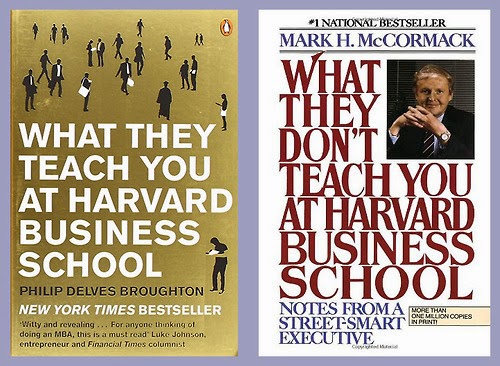
Just buy these two. The Law of Excluded Middle proves, apriori, you won’t need any others:

Here's a phot of two books.

1. Philip Delves Broughton, What They Teach You at Harvard Business School. 2. Mark H. McCormack, What They Don’t Teach You at Harvard Business School (subtitled: Notes from a Street-Smart Executive).

Tertium non datur.

(Via Anna O. Morgenstern.)

Alabama Sin Miedo / Alabama Unafraid

The immigrant justice movement is a freedom struggle. This is exactly what is needed. More confrontation. More direct action. Not one more deportation.

Shared Article from inthesetimes.com

The Immigration Movement's Left Turn

Advocates are moving away from the “pathway-to-citizenship” compromise—and are demanding a moratorium on deportations.

inthesetimes.com


#Not1More #BordersAreStupid #ShutDownICE

Shared by Alabama Coalition for Immigrant Justice.

Who will be the Obama administration's two-millionth deportee? The question haunts neighborhoods, schools and workplaces from Phoenix to Philadelphia.

And as the Obama administration continues its en masse removal of undocumented immigrants, that unlucky distinction could go to any of the roughly 11 million undocumented people who call the U.S. home—a carwash worker nabbed for a broken taillight; a field laborer who has overstayed her work visa; or a youth donning a cap and gown, deliberately crossing the path of the border patrol in a show of civil disobedience.

Deportations are expected to reach the 2 million mark in early April, and activists are campaigning fiercely at the gates of detention centers, border checkpoints and congressional offices to show the White House they will not let the Obama administration's reach that milestone without a fight.

Last month in Alabama, immigrant rights advocates organized one such action by forming a human chain outside the Etowah County Detention Center, chanting "not one more"—the rallying cry of a wave of anti-deportation actions that have swept the nation over the past year, gaining political currency as a social media campaign, a slogan at street demonstrations, and more recently, a political salvo in Washington, where more conciliatory policy demands from inside the Beltway have sputtered.

One protester at the Etowah rally, Gwendolyn Ferreti Manjarrez, declared, "I am tired of living with the fear that my family or any family can be torn apart at the seams for living our everyday life."

— Michelle Chen, The Immigration Movement’s Left Turn,
from In These Times (1 April 2014)

Overtaking Zeno

Shared Article from Slate Magazine

Zeno's Paradox Is a Trick—But a Very Interesting T…

The Greek philosopher Zeno wrote a book of paradoxes nearly 2,500 years ago. "Achilles and the Tortoise" is the easiest to understand, but…

David Plotz @ slate.com


O.K., so, briefly: If you think that the point of Zeno’s Paradoxes of motion is to prove that the arrow never will reach its target, or that Achilles never does pass the tortoise, &c. — then I think that you are mistaken about the point of raising the paradox in the first place. Of course, it’s hard to be confident about the motives of dead philosophers who have no surviving books. But what we do know is that Zeno was a student of Parmenides; and Plato tells us that his books were written to defend Parmenides’s doctrines, by negative means,[1] showing that the views of his opponents led to contradictions.

So the most charitable understanding of Zeno’s aims is not that he’s trying to show you that Achilles can never catch the tortoise. Of course he does; just watch them race and you’ll see it happen. His point is to ask, given that Achilles passes the tortoise, well, how is that possible? And, for good or for ill, to argue from the paradox that you can only make sense of Achilles passing the tortoise if you reject presentism, and accept eternalist and Parmenidean conclusions about the nature of time and being.

Maybe he’s right about that, and maybe he’s wrong. (I’m inclined to think he’s wrong.) But note that if your solution is to try and settle the issue by introducing a lot of mathematical notation and conceptual apparatus from modern calculus — for example infinitesimal limit processes, convergent and divergent series, etc. — as is done in the Slate article here, and as is probably the overwhelmingly most common first response to Zeno’s paradoxes by mathematically-trained writers — then probably you are doing a better job than any pre-classical Greek philosopher could do in elaborating the precise nature of the problem.[2] But you’re not obviously refuting Zeno’s claims in any way, at least not yet. At the most you’re kicking the can down the road, and really you’re sort of strengthening Zeno’s own position. After all, naive formulations of mathematical notation are more or less always going to involve you in all kinds of specifically eternalist language, for example about moments in past and future time actually existing, instantiating the value of functions, etc. You cannot normally take the limit of ?@ce;201d;S(t) over values of t that don’t exist (no longer exist, do not yet exist).[3]

Or perhaps you can. But if you can, then doing so, and explaining what you’re doing when you do it, will take some very non-naive reinterpretation of ordinary mathematical language — and some nice metaphysics, too, to justify your reinterpretation. In any case the solution is going to have to be deeply philosophical, not just a matter of applying a technical innovation in maths.

  1. [1]In the Parmenides: I see, Parmenides, said Socrates, that Zeno would like to be not only one with you in friendship but your second self in his writings too; he puts what you say in another way . . . You affirm unity, he denies plurality. . . . Yes, Socrates, said Zeno. . . . The truth is, that these writings of mine were meant to protect the arguments of Parmenides against those who make fun of him and seek to show the many ridiculous and contradictory results which they suppose to follow from the affirmation of the one. My answer is addressed to the partisans of the many, whose attack I return with interest by retorting upon them that their hypothesis of the being of many, if carried out, appears to be still more ridiculous than the hypothesis of the being of one.
  2. [2]Since the 19th century, we’ve done a lot to really nicely rigorize the mathematics of infinites and infinitesimals, in ways that sometimes anticipated by but never fully available to ancient mathematicians.
  3. [3]If anything, this is even more true of late-modern mathematics than it was of classical mathematics. Contemporary mathematics constantly helps itself to a lot of the language of existence, actuality, etc., for mathematical objects, in areas where Euclid and other classical mathematicians were typically much more circumspect about making existence claims for mathematical objects that hadn’t yet been constructed.

Happy Tyrannicide Day (observed)

Happy Tyrannicide Day (observed)! To-day, March 15th, commemorates the assassination of two notorious tyrants. On the Ides of March in 2014 CE, we mark the 2,057 anniversary — give or take the relevant calendar adjustments — of the death of Gaius Julius Caesar, ruthless usurper, war-monger, slaver and military dictator, who rose to power in the midst of Rome’s most violent civil wars, who boasted of butchering and enslaving two million Gauls, who set fire to Alexandria, who battered and broke through every remaining restraint that Roman politics and civil society had against unilateral military and executive power. Driving his enemies before him in triumphs, having himself proclaimed Father of His Country, dictator perpetuo, censor, supreme pontiff, imperator, the King of Rome in all but name, taking unilateral command of all political power in Rome and having his images placed among the statues of the kings of old and even the gods themselves, he met his fate at the hands of a group of republican conspirators. Led by Marcus Junius Brutus and Gaius Cassius Longinus, calling themselves the Liberators, on March 15, 44 BCE they surrounded Caesar and ended his reign of terror by stabbing him to death on the floor of the Senate.

Here's a painting of

Die Ermordung C?@c3;a4;sars, Karl von Piloty (1865)

By a coincidence of fate, March 13th, only two days before, also marks the anniversary (the 133rd this year) of the assassination of Alexander II Nikolaevitch Romanov, the self-styled Imperator, Caesar and Autocrat of All the Russias. A group of Narodnik conspirators, acting in self-defense against ongoing repression and violence that they faced at the hands of the autocratic state, put an end to the Czar’s reign by throwing grenades underneath his carriage on March 13th, 1881 CE, in an act of propaganda by the deed.

Here's a color drawing of

Das Attentat auf Zar Alexander II. am 13. M?@c3;a4;rz 1881 in St. Petersburg. Anonymous.

In honor of the coinciding events, the Ministry of Culture in this secessionist republic of one, together with fellow republics and federations of the free world, is happy to proclaim the 15th of March Tyrannicide Day (observed), a commemoration of the death of two tyrants at the hands of their enraged equals, people rising up to defend themselves even against the violence and oppression exercised by men wrapped in the bloody cloak of the State, with the sword of the Law and in the name of their fraudulent claims to higher authority. It’s a two-for-one historical holiday, kind of like President’s Day, except cooler: instead of another dull theo-nationalist hymn on the miraculous birth of two of the canonized saints of the United States federal government, we have instead one day on which we can honor the memory, and note the cultural celebrations, of men and women who defied tyrants’ arbitrary claims to an unchecked power that they had neither the wisdom, the virtue, nor the right to wield against their fellow creatures.

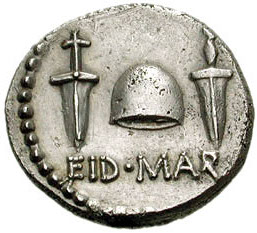
Here's a photo of a silver coin with the caption EID MAR. Above the caption are two daggers, flanking a Liberty Cap to the left and the right.

My favorite collectible coin. This silver denarius was actually minted and circulated in Macedonia by M. Junius Brutus after he and his fellow conspirators stabbed Caesar to death. The obverse features Brutus’s head in profile. The thing in the middle, above EID MAR (Ides of March) and flanked by the two daggers, is a Liberty Cap, traditionally given to emancipated slaves on the day of their freedom.

It is worth remembering in these days that the State has always tried to pass off attacks against its own commanding and military forces (Czars, Kings, soldiers in the field, etc.) as acts of terrorism. That is, in fact, what almost every so-called act of terrorism attributed to 19th century anarchists happened to be: direct attacks on the commanders of the State's repressive forces. The linguistic bait-and-switch is a way of trying to get moral sympathy on the cheap, in which the combat deaths of trained fighters and commanders are fraudulently passed off, by a professionalized armed faction sanctimoniously playing the victim, as if they were just so many innocent bystanders killed out of the blue. Tyrannicide Day is a day to expose this for the cynical lie that it is.

There are in fact lots of good reasons to set aside tyrannicide as a political tactic — after all, these two famous cases each ended a tyrant but not the tyrannical regime; Alexander II was replaced by the even more brutal Alexander III, and Julius Caesar was replaced by his former running-dogs, one of whom would emerge from the carnage that followed as Imperator Gaius Julius Son-of-God Caesar Octavianus Augustus, beginning the long Imperial nightmare in earnest. But it’s important to recognize that these are strategic failures, not moral ones; what should be celebrated on the Ides of March is not the tyrannicide as a strategy, but rather tyrannicide as a moral fact. Putting a diadem on your head and wrapping yourself in the blood-dyed robes of the State confers neither the virtue, the knowledge, nor the right to rule over anyone, anywhere, for even one second, any more than you had naked and alone. Tyranny is nothing more and nothing less than organized crime executed with a pompous sense of entitlement and a specious justification; the right to self-defense applies every bit as much against the person of some self-proclaimed sovereign as it does against any other two-bit punk who might attack you on the street.

Every victory for human liberation in history — whether against the crowned heads of Europe, the cannibal-empires of modern Fascism and Bolshevism, or the age-old self-perpetuating oligarchies of race and sex — has had these moral insights at its core: the moral right to deal with the princes and potentates of the world as nothing more and nothing less than fellow human beings, to address them as such, to challenge them as such, and — if necessary — to resist them as such.

How did you celebrate Tyrannicide Day? (Personally, I toasted the event at home, watched the Season 1 finale of Rome, posted some special-occasion cultural artifacts to Facebook, and re-read Plutarch’s Life of Brutus from a nice little Loeb edition that I picked up from Jackson Street Books in Athens, Georgia.) And you? Done anything online or off for this festive season? Give a shout-out in the comments.

Toasting the Ides at home. . .

Thus always to tyrants. And many happy returns!

Beware the State. Celebrate the Ides of March!

Translation of “One comrade from Mérida sounds off: Oh I’ve got the desire” (Viento sin Fronteras, in EL LIBERTARIO)

Here is another translation from Venezuela, once again of a one-compa-sounds-off article, this time from Viento sin Fronteras (Wind without Borders) in a rural area of Mérida, a state in western Venezuela. The article was reprinted by the Venezuelan anarchist newspaper EL LIBERT@RIO. Inline links and editorial notes in footnotes are added by me. As always, the same caveats apply: I'm a nervous translator trying to keep up with a lot of regional references that I don't always know, and moving through a lot of material coming out more quickly than I can translate it; this is a working draft; if you notice any mistakes or mangling please feel free to point them out in the comments, and I'll attach a note or a correction to the text here. Again, there are lots of different Anarchists in Venezuela, and this is one compa’s view; there are many with different views about the attitude that Anarchists should take towards the protest. (See, for example, this previous translation of a commentary by Victor Camacho. Viento sin Fronteras is, let’s say, significantly more hands-on.)

A comrade from Mérida sounds off: Oh, I’ve got the desire

Viento sin Fronteras

This is a little chronicle many are certainly familiar with. Yesterday I got up at 6 a.m. so I could get ready to go to work. I arrived at work around 7:30 am and I spent the whole day over there. At 7pm I went back to my house. When I got home I had to go down to the nearest bodega (I live in a rural area) to buy stuff for making dinner or lunch in the coming days. Well O.K., so a purchase that consists of some three potatoes, two cans of sardines, three tomatoes, an onion, laundry soap,[1] a box of cigarettes and a few cookies, comes out to 170 bolivars [!!!@@e2;2030;2c6; US $27]. Up to this point everything seems normal but it isn’t. My daily salary is 200 bolivars [!!!@@e2;2030;2c6; US $32].

Clearly, they are 200 bolivars and this leaves me only just 30 bolivars [!!!@@e2;2030;2c6; US $5] to save for paying the rest of my expenses, like the rent for example. Or the fare for public transport, if I weren’t walking to work I’d have to take 10 bolivars off these 30 that are supposed to be left over for me.

Besides this, I remembered that the last time that I went without natural gas nearly a month passed before that commodity came back to my house. And I my house, of course, a little house of 38 square meters [!!!@@e2;2030;2c6; 409 sq. ft.] where the water shuts off every day for an hour or two, with a rent that’s equivalent to nearly half the minimum wage I work for. It brings to mind that house from the housing project[2] that that the showboat[3] of the Communal Council[4] built (great affiliate of PSUV[5] certainly and an ideological reference for many here) and which was empty until two weeks ago, which he managed to sell, for no less than the discreet sum of 700,000 bolivars [!!!@@e2;2030;2c6; US $ 111,250].

Something comes into my mind, and my nerves get hotter. I spent 10 years of my life in college. I have an undergraduate degree, a master’s, and I left my doctoral thesis half done when I lost interest. And O.K., it’s not that I believe that I deserve a Ministry salary, but for some reason, and this reason for some other reason always ends up being my fault; it has been impossible for me to find a job that, without being exactly the thing for which I supposedly studied at least would permit me (and that’s what college is supposedly about) to give back to society or to whoever, a little bit of that intellectual or technical material that I supposedly acquired in those years. At times, they then give me some moments of clarity and I say: clearly, it’s that to get hooked up you have to know whose balls to yank.[6] Or I think and I swear[7] about how to set up that writing project with the ever sacrosanct words: Eternal Commander, Fellow Comrade, the Little Bird, Our Process, the Economic War, the Eternal Giant, the Legacy.[8] All this without a doubt adds to the degree of a feeling of frustration that’s growing.

And with that, what comes into my head are the contracts for the Guasare coal, the Deltana Plate, the three billion dollars that Chevron loaned us, the concessions to Chinese timber companies in the high Caroní, the death of the Sabinos, the criminalization of the Wayuu, the Red Fascist wall shooting dissident unionists, the armed forces of the government holding old women with their pans at gunpoint, ordering them to be quiet, the dead of Uribana, the 400 dying every year in prison, the intellectual authors of the massacre of El Amparo placed in the government designing the anti-terrorism laws. And so on. And so I think that late or early, me, and many people who aren’t identified one bit with the spokespeople of the opposition parties, including folks who come from the Chavista movement, are getting out into the streets to protest. And I’ll be over there, if country life lets me, handing out pamphlets to anyone who has eyes to read them. Without falling into naivete, I know that there will be plenty of imbecile fanatics for Pérez Jiménez[9] or Leopoldo Lopez[10] there with their slogans and believe me that I’ll fight them right there. Right there I’ll show that they’re the same as the others.

Oh, I’ve got the desire[11] to go out hurling stones when the police car crosses my path. Because they are some thugs and some cheerleaders.[12] Oh, I’ve got the desire to take all the trash that they aren’t capable of managing and set it all on fire in the doorway of the Mérida state government. Oh, I’ve got the desire to smash the windows of the supermarket and leave all those products tossed on the floor that I have to wait in line for on my weekend days. Oh, I’ve got the desire to catch an ATM[13] alone and try once and for all to see how the fuck you can withdraw all the money with a sledgehammer.

I’ve got the desire to give thanks in person to the folks who set SEBIN’s trucks on fire[14] because they’re a murdering intelligence agency that tortures and persecutes political dissidents. I’ve got the desire to go up to that student leader, who’s really an ally of PJ,[15] and tell her to shut her mouth, that she’s a wanker,[16] that it’s her fault (and that of those mamelotracios[17] that she obeys) that the protest — which could have been a good way to lock up the pigs[18] and a place where we’d all recognize that all these demands are the vindication urgent for EVERYONE — was converted instead into a slogan, pretty much belonging to their own partisan interests.

The year is just beginning and it doesn’t promise to be a year for calm ones. Well, let the storm come.

— Ganas no me faltan (21 Feb. 2014). Very imperfectly translated by Charles W. Johnson

  1. [1]Lit. jab?@c3;b3;n azul, a specialized kind of soap used especially for laundry (although it can also be used for household cleaning or for personal hygiene).
  2. [2]misi?@c3;b3;n vivienda, a huge public housing construction project launched as part of the Bolivarian Missions sponsored by the government, and administered through government-approved community councils.
  3. [3]Cantama?@c3;b1;anas, more accurately, someone who promises to do something and never does it.
  4. [4]Orig. Spanish: CC, i.e., Consejo Comunal, a local council which, among other things, administers government funds granted under the Bolivarian Mission programs.
  5. [5]United Socialist Party of Venezuela, the current ruling political party.
  6. [6]Venezuelan slang, jalar bolas, lit. to pull balls, fig. to flatter or sweet talk with an ulterior motive.
  7. [7]Ambiguous: reniego, meaning either potentially reneging, cursing, detesting, renouncing a religion, or, significantly given the context, uttering blasphemy.
  8. [8]comandante eterno, compa?@c3;b1;ero camarada, el ara?@c3;b1;ero, nuestro proceso, la guerra econ?@c3;b3;mica, el gigante eterno, el legado, all nicknames or honorary phrases associated with the Bolivarian Socialist government and especially with the cult of personality around Hugo Chávez.
  9. [9]Presumably Marcos Pérez Jiménez (1914-2001), right-wing military dictator of Venezuela 1952-1958. A few of the more right-wing opposition groups explicitly identify their goals with perezjimenismo.
  10. [10]Leopoldo L?@c3;b3;pez Mendoza, leader in the right-wing political opposition party Voluntad Popular, arrested earlier this month and imprisoned on terrorism charges after the outbreak of street protests in Venezuela.
  11. [11]Ganas no me faltan, common phrase, meaning I don’t lack the desire or I don’t lack the urge.
  12. [12]Matraqueros, lit. those who use matracas, a kind of spinning noise-maker popular with diehard Latin American sports fans.
  13. [13]Cajero del banco, which can refer either to an ATM or to a human teller. From the reference to smashing with sledgehammers, I assume (hope?) from context that this is referring to smashing up a machine to get at the cash inside of it.
  14. [14]Servicio Bolivariano de Inteligencia Nacional, the main national intelligence agency and political police force in Venezuela.
  15. [15]Primero Justicia, a center-right party in the political opposition, run by Henrique Capriles, a right-wing opposition leader who has condemned the street protests.
  16. [16]Pajua, from paja, lit. masturbation or fig. wankery, in the sense of talking bullshit.
  17. [17]Original Spanish, untranslated. I don’t have a good idea of what this means, even after consulting with native speakers from South America. (It’s not in any slang dictionaries I have access to, either.) Our best guess is that it’s probably a portmanteau profanity of some kind and that it’s probably intended to suggest something like cocksuckers.
  18. [18]I am not at all sure that this is a correct translation. Orig. Spanish: que podría haber sido una buena tranca de cochina. Tranca is a lock or a door-bolt, cochina literally means sow, but cochino/a are also used as the masculine and feminine forms of an insult meaning nasty or dirty. This phrase, taken as a whole, doesn’t seem to be an idiomatic expression, or at least, does not seem to occur anywhere else on the Internet.
Anticopyright. All pages written 1996–2026 by Rad Geek. Feel free to reprint if you like it. This machine kills intellectual monopolists.