Direct Action Comix (#3)
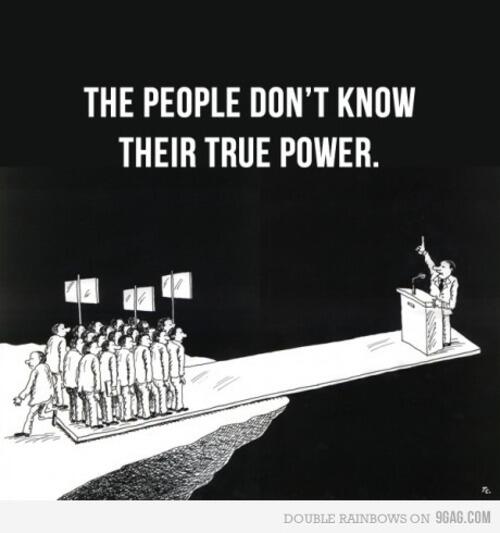
(Via Roderick Long (2013-06-25), Shorter La Boétie.)
Also.
- GT 2006-07-06: Direct Action Comix #2 (Cat and Girl versus Current Events)
- GT 2006-04-16: Direct Action Comix (from Calvin & Hobbes)
official state media for a secessionist republic of one
(Via Roderick Long (2013-06-25), Shorter La Boétie.)
Here’s a great article by Clarissa Wei, which appeared a while back over at the CNN Travel website. I read it a couple months ago, thanks to a share and some great commentary by Anthony Gregory.
Clarissa Wei: American-Chinese food is real Chinese food
Yes, I'm actually going to defend orange chicken (陈皮鸡).
Fundamentally fried chicken with sauce — the perfect late-night snack and, quite frankly, great drinking food — orange chicken is beloved by millions of people of all ethnic groups (including many Chinese) in the United States.
As with most American-Chinese food, however, there's a stigma attached to orange chicken.
Chinese food snobs call the dish, as well as the restaurants that serve it, "fake" or "not authentic."
Superior foodies love nothing more than bashing the chefs and restaurant owners for their alleged perversion of the sacred culinary genre — as if only they know what real Chinese food is, as if someone died and made them arbiter of all Chinese cuisine.
How sad.
Orange chicken, egg foo young (芙蓉蛋) and General Tso’s chicken (?@e5;b7;¦?@e5;ae;—?@e5;a0;‚鸡) have fallen victim to a lot of hatemongers since their introduction to the U.S. culinary scene back in the 19th century.
Those who unapologetically enjoy orange chicken (and many other American-Chinese dishes) and who actually know a little bit about the history of Chinese people outside of China are left to ponder a simple question: What is authenticity?
There's nothing inauthentic about American-Chinese dishes. The bulk of them were created by Chinese people for Chinese people.
These Chinese people just happened to be living outside of the mother country.
. . . [D]uring the 1840s Gold Rush in California, early Chinese immigrants (most were railroad builders) had no or extremely limited access to traditional Chinese ingredients. So they used what they could find in their new homes to create then-contemporary Chinese dishes, such as the now much-derided chop suey (æ‚碎), one of the first Chinese dishes invented in the United States. . . . They were made to satisfy the cravings of “real” Chinese people. When railroad work was no longer available, many Chinese laborers resorted to opening restaurants.
. . . "American-Chinese food is Chinese food," says Julie Lau, owner of Suzie's on Bleecker Street in New York City. . . . American-Chinese dishes have evolutionarily similarities with Chinese staples. . . . “It's just the American take on ethnic food."
So why all the fuss? Why not consider American-Chinese food just another style of Chinese cooking?
–Clarissa Wei, American-Chinese food is real Chinese food
CNN Travel, 7 May 2012.
Well, of course it is real Chinese food. And of course it’s real American food, too.[1] The only reason that it seems like it couldn’t be both is the deeply-engrained, but ultimately completely silly notion that human cultures can be fit into to the same confining borders, the same carved-up exclusivity, and the same nationalized monopolies on allegiance and social support that are currently imposed on people’s political identities in a world of bordered nation-states.
And when you add that completely silly notion to the need for superior foodies to invent new forms of carefully curated expert knowledge,
and add in the snobbish and exoticizing notion that the foods eaten by immigrants, by people on the periphery, or by people in the diaspora, somehow count as less really, authentically, or properly part of the national
cuisine as the food eaten by people in the capital or the interior, you get exactly this sad and confining sort of stigma. This is as true of immigrant Chinese food as it is of northern Mexican food and of every other kind of so-called inauthentic
borderland cuisine that is routinely ranked down by those who imagine that the food cultures of the world somehow map out like the pavillions in Epcot Center, not like the line-crossing, tradition-reworking, living, expanding, adapting, borrowing, overflowing, constantly mutating and constantly interacting and experimenting, profoundly human messes that they really are.

Poster by Jolly Armada and Erin Wilson.
I was happy to see this in my mailbox this morning. From the New Orleans bookfair collective (emphasis added):
Comrades,
We are writing to let you know that the First Annual New Orleans Anarchist Book Fair will take place on October 19-20, 2013. We are now accepting vendor applications for tabling. Please visit our website for more information on the book fair in general and registration in particular.
We are also on Facebook and Twitter.
Solidarity,
The New Orleans Anarchist Book Fair Organizing Committee
N.O.A.B.
1631 Elysian Fields #282
New Orleans, LA 70117
http://www.nolaanarchistbookfair.org/
From the website:
We'd like to invite you to an exciting experiment in books, tables and Gulf Coast Anarchism, The First Annual New Orleans Anarchist Book Fair! Our collective has been hard at work securing a wonderful list of tablers and events for our book-based autonomist free-for-all on October 19th and 2013, 2013. The Book Fair will take place at the cavernous Zeitgeist Multi-disciplenary Arts Center and include events, shows and readings all around the city. For more information feel free to browse around the site or contact us directly. We are also helping to coordinate rideshares and housing for those coming into the city from out of town.
Their Facebook page is at facebook.com/NewOrleansAnarchistBookfair. Their website is at nolaanarchistbookfair.org. Mark your calendars! A.L.L. Distro just sent in an application for a table; more on this, hopefully, soon.
This is from Bernardo Soares’s (or Fernando Pessoa’s, as you like)[1] Book of Disquiet, text 24. In the context of the book, the passage is contextually even more striking because it contains only the second time (after dozens of pages) that anything appears in the text that was said by another human voice besides the narrator’s. And the first that what someone else said is actually breaks through, or alters Soares’s train of thought.
Today, feeling almost physically ill because of that age-old anxiety which sometimes wells up, I ate and drank rather less than usual in the first-floor dining room of the restaurant responsible for perpetuating my existence. And as I was leaving, the waiter, having note that the bottle of wine was still half full, turned to me and said:
So long, Senhor Soares, and I hope you feel better.The trumpet blast of this simple phrase relieved my soul like a sudden wind clearing the sky of clouds. And I realized something I had never really thought about: with these café and restaurant waiters, with barbers and with the delivery boys on street corners I enjoy a natural, spontaneous rapport that I can’t say I have with those I supposedly know more intimately.
Camaraderie has its subtleties.
Some govern the world, others are the world. Between an American millionaire, a Caesar or Napoleon, or Lenin, and the Socialist leader of a small town, there’s a difference in quantity but not of quality. Below them there’s us, the unnoticed: the reckless playwright William Shakespeare, John Milton the schoolteacher, Dante Alighieri the tramp, the delivery boy who ran an errand for me yesterday, the barber who tells me jokes, and the waiter who just now demonstrated his camaraderie by wishing me well, after noticing I’d drunk only half the wine.
–Bernardo Soares, The Book of Disquiet text 24 (pp. 27-28)
New York: Penguin. trans. Richard Zenith.
heteronyms,that is, signatures that represented not only an alternate name, but actually a complex set of interacting characters that Pessoa invented and set into the Portuguese literary scene of his day.↩

ALLies,
Are you yourself, or do you know anybody who is, an individualist anarchist, agorist, mutualist, market anarchist, or otherwise on the libertarian left, who happens to live in or nearby the Indianapolis, Indiana metropolitan area?
Are you yourself, or is the ALLy that you know, interested in meeting like-minded people and getting (more) involved in local activism and organizing? If so, please drop me a line with your or their contact information. I have some requests — from three local ALLies — who are looking for other libertarian-left folks to discuss, meet up with, and possibly start organizing a local group of the Alliance of the Libertarian Left. I would love to be able to put interested ALLies in contact with each other.