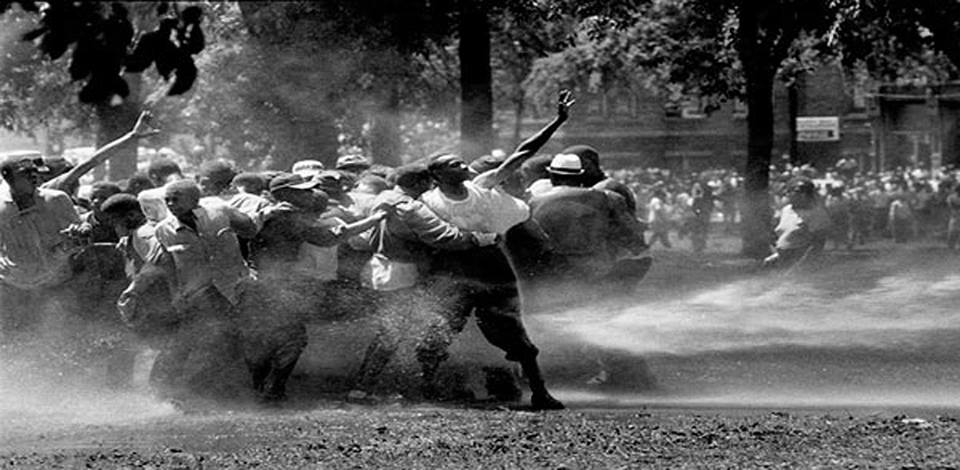
Fifty-three years ago today, — one day after the start of the Children’s Crusade marches, — black youth were in the streets in Birmingham to march on City Hall and protest Jim Crow in one of the best-known protest marches in American history. They stood up against Mayor Art Haynes and Public Safety Commissioner Eugene Connor and his police and his fire department and the whole violent system of Jim Crow. They filled the jails and they kept marching. Desperate, Bull Connor ordered police and firemen to turn police dogs and water cannons on the kids in the street.
In the end, the kids in the street won, and the white power establishment, the segregationist politicians and the Public Safety Commissioners and the police lost.
This photograph is from Kelly Ingram Park, Birmingham, Alabama, May 3, 1963. It was taken by Bob Adelman.
Today, the IESG approved publication of "An HTTP Status Code to Report Legal Obstacles". It'll be an RFC after some work by the RFC Editor and a few m…
mnot.net
It is so profoundly saddening that this development of HTTP is, practically speaking, necessary.
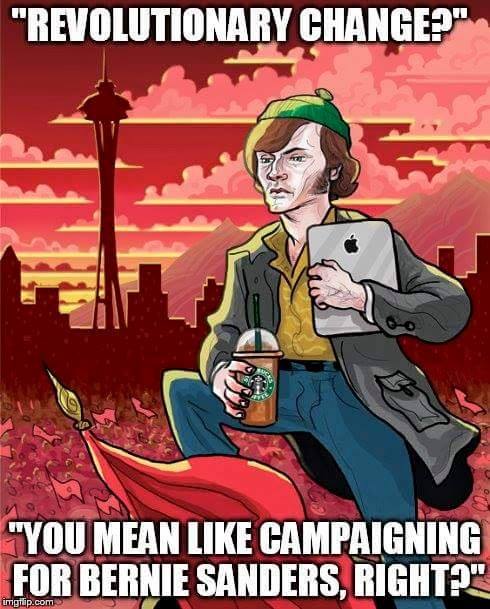
Every four years there’s a new presidential election in the U.S., and campaign season lasts a good year or so before the election. So for about one out of every four years, you can expect to see an army of people (both professionals and citizen-militias) ready to corral any call for social change into a machine for political campaigning, and to grab hold of the rhetoric and imagery of radicals and revolutions to put it into the service of well-funded, weakly reformist campaigns to elect a Republican or Democrat to office. Just support the right candidate, and we are going to overthrow the powerful, we are going to stand up for the marginalized and oppressed, we are going to change the world together. By electing a better President than the other candidates who are running for the office. A couple days ago, InfoShop.org was circulating a joke image on Facebook to make fun of this tunnel-vision defining-down of radical goals to the limited circle of respectable electoral politics:
Which, as you might predict, caught a lot of flak from commenters deeply invested in the milieu of Progressive reform politics. One commenter, David STwo, offered a well-worn reply:
Revolutionary change… you mean like posting on Facebook, right?
Well, it’s easy enough to make fun of self-indulgent Facebook political signaling. But I’m willing to accept the challenge. David jokes, but posting on Facebook, for all its limits, absolutely has far more potential to practically contribute to long-term transformative social change than voting for long-shot reformist presidential candidates. The reason being that talking to people online is often self-indulgent and often runs in circles, but like any form of communication, it is potentially a medium of cultural pressure and cultural change. And cultural change, while tricky and partial and always highly imperfect, does a lot more to actually change things from day to day than energy-intensive, practically futile utopian schemes like voting for reformist candidates.
With most Leftists — including most anarchists embedded within the broader Leftist milieu — the standard line is that we are supposed to be looking for radical change in the long term, but in the short term supporting practical reforms. And the way we’re supposed to do that in the short term is by offering critical support or lesser evil votes to reformist candidates. If you take a hard stance against voting or electoral politicking, then you can expect to be met with the routine accusations that you’re prioritizing your radical idealism or purism over real people’s chances to achieve practical, short-term improvements. Those improvements, you will be told, are nowhere near enough, but they matter for people’s everyday lives, and we shouldn’t abandon any hope of making practical improvements until some distant day After The Revolution.
And of course it’s true that partial, gradual improvements on the margin matter for people’s everyday lives, and of course it’s true that they shouldn’t be abandoned for the sake of symbolic gestures. But the problem here is that the standard pro-voting line is a call for symbolic gestures, and offers very little of practical use to making those marginal reforms. The problem isn’t that electoral politics is impure; it’s that it’s impractical. The standard pro-voting line is alluring because of the cultural mystique that surrounds democratic politics in the U.S. But in reality its promise of practical gains through reformist electioneering is nearly the exact opposite of the truth. If significant marginal change is what you want, you are almost certainly doing more good towards that by posting radical political jokes on Facebook than by vocally supporting Bernie Sanders.
Voting for reformist candidates has two basic problems: there is an output problem, and there is an input problem.
The output problem is something I’ve written about a lot before.[1] To justify voting for Bernie Sanders as a strategy for positive social change, you have to have some fairly reliable grounds for thinking that President Sanders will actually govern the way you think he will govern based on his campaign promises and his rhetoric, and that he won’t do anything negative along the way that significantly undermines the positive effects of his platform. I think there are good reasons to consider that hope to be optimistic, or indeed wildly unrealistic. It’s certainly not what the last seven years of Progressive Democratic Party administration would suggest.
But I want to set aside the output problem for a moment. For the sake of argument, let’s grant the most optimistic assumptions, the very happiest hypotheses about how a Bernie Sanders presidency would improve on the status quo in exactly the ways that Bernie Sanders supporters expect.
It doesn’t matter, because even if you assume away the output problem, you still haven’t dealt with the input problem. Whether or not you can count on the output of a political mechanism, even if we assume that a Social Democrat presidency would improve some things over the status quo, you still need to give me some realistic grounds for thinking that my actively supporting Bernie Sanders’ candidacy will somehow, practically, contribute to Bernie Sanders being elected in the first place. I don’t think that anyone doubts that that outcome is still a pretty long shot at best. And whether it is a long shot or a close race or a sure thing, you are going to need to think through the actual practicalities involved in campaigning for votes here, not just bake in a bunch of civics text-book mythology to the effect that Every Vote Is Sacred, Every Vote Is Good.[2] Realistically speaking, a lot of people in the United States can’t vote at all. An electoral campaign offers no practical opportunities to undocumented immigrants, who cannot vote. It offers no practical opportunities to most documented immigrants. It offers no practical opportunities to disenfranchised felons. It also offers no practical opportunity to me. Any given person’s vote is almost certain to have a statistically neglible effect on the outcome of a big national race. But in my own case, it’s more than just statistical neglibility. In my own case, the practical, real-world situation is that I live in a small, fairly conservative town in east Alabama, and no matter who I vote for, or don’t vote for, I can predict with 99.999% confidence right now that the state of Alabama will still break about 60-40 in favor of whoever the Republican Party happens to nominate, and all of the electoral votes for the state of Alabama will go to that Republican. It’s not just that my vote makes a small contribution to the outcome. It’s that it makes literally no contribution to the outcome. If Bernie Sanders has a shot at winning the election, then I cannot possibly improve his shot by swinging my vote. Even if I convinced every single one of my neighbors for a fifteen mile radius in every direction to vote for Bernie Sanders, I still couldn’t improve his shot at winning the presidency. If he has no shot at winning the election, no matter how hard I might vote in Bernie’s favor, I certainly can’t do anything to chip away at that impossibility from where I am.
It might be nice to indulge in what-ifs about what Bernie might do if elected, but, functionally, telling me to support his campaign is telling me to devote a great deal of my limited time, attention and activist energy to a long-shot political campaign that offers no policy change whatever if it should fail (as it probably will), and whose chances of success or failure my vote cannot possibly influence in the slightest, even if it should succeed. It is not a practical recommendation for me, and it’s not a practical recommendation for any of my neighbors. It is like asking me to campaign against a hurricane hitting Mobile, or voting in favor of Auburn winning all their football games this season. Sometimes rooting and cheerleading are enjoyable ways to spend your time. But if so their value comes from the enjoyment they offer, not the practical advantages they convey, and my support for the Sanders campaign would be, practically speaking, an impractical, purely symbolic gesture in favor of an improbable utopian fantasy.
Now I am an anarchist. I have no problem per se with indulging in symbolic gestures in favor of improbable utopian fantasies. I am accustomed to long shots and unrealistic, utopian dreams. It may be that nothing I could do really accomplishes much, because radical change is hard. But then if I am going to take the time to make a symbolic gesture in favor of an improbable utopian fantasy, then why should I waste my symbolic gestures on hypothetical support for the lesser-disaster virtues of a more liberal state and another Progressive Democrat presidency? I would at least like to make a symbolic gesture in favor of an improbable utopian fantasy that I actually believe in.
Whether or not I should wish for Bernie Sanders to be elected, my supporting or not supporting Bernie Sanders will have exactly a 0% chance of helping Bernie Sanders get elected. Until you have some concrete way of improving on those odds, my view is going to remain that social protest, direct action, honest debate and day to day little pushes on the margin towards radical cultural change are not just more idealistic or pure, but really seriously immensely more immediate, immensely more practical outlets for whatever activist energy I have than cheerleading for yet another long-shot presidential campaign.
Practicality doesn’t come for free with a ballot. Ignoring that doesn’t make you a hardnosed realist, it just makes you another dreamy devotee of American civic religion.
Liberals always think that the process of getting their favorite policy enacted is just like this, simple:
$ patch < reform.diff
But that is never how it works. Your reform is not written up in the right format. This will just get you an error message. Actually, what you’re doing is always, necessarily, going to be this:
But what you get at the end of all those filters is always something quite different from what you were hoping for. Or if it was just what you were hoping for, your hopes and dreams are kind of terrible. In either case, it’s questionable whether this actually counts as the more practical approach to social and political change. In either case, you should broaden your horizons. In Anarchy, there is another way.
WASHINGTON (AP) — Abandoning his pledge to act by the end of summer, President Barack Obama has decided to delay any executive action on immigr…
huffingtonpost.com
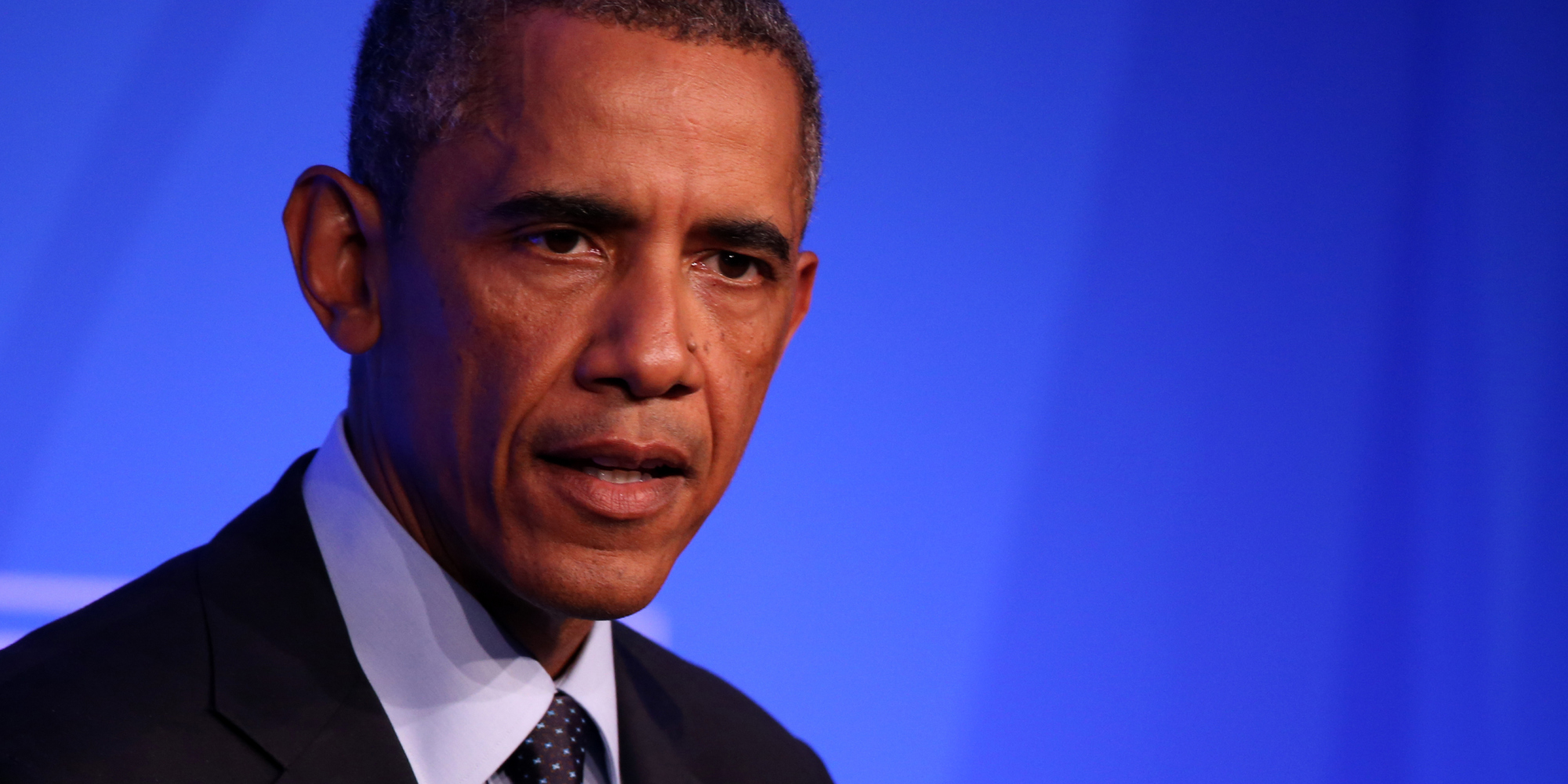
Of course, this is a shameful move from Barack Obama. Immigrants’ lives and families are being sacrificed, yet again, over and over and again, to opportunism and to crass political calculation. The careers of Democratic politicians are not more important than people’s lives and livelihoods. What makes it worse is that this move is as completely predictable as it is morally grotesque.
Progressive electoral politics is like building a vast, extraordinarily expensive, Rouge River-scale machine plant to build cars. Then, after the ribbon is cut, the plant opens to great fanfare, billions of dollars are spent, and a couple of go-karts are rolled off the line as a test, the manager up and tells you that there won’t be any more cars for the time being — because all the wear and tear on the machines would destroy their ability to make more cars, some day in the future. So until then you’ll have to wait. All the while the machine whirs along, drawing more power and costing more money all the time, but no more cars ever come off the line, because every time there might have been some output, it was sacrificed to make sure that the machine itself would keep idling smoothly. But it is so perfectly polished.