Rad Geek People's Daily

official state media for a secessionist republic of one

Posts filed under Politics

Benjamin Tucker on Anarcho-Capitalism

Benjamin R. Tucker

Well, kind of.

Obviously Benjamin Tucker had no direct opinions about anarcho-capitalism, because the term was not even coined until many years after his death, and several decades after his retirement from radical politics. But Tucker did have quite a bit to say about the relationships among anarchism, socialism, and capitalism, and it may be worth having a look at it.

The question’s interesting partly as a matter of historical curiosity, but partly also because it may help shed some light on an old argument which has mostly produced heat. There are certain groups of anti-capitalist anarchists — most of them communist or collectivist anarchists — who tend to start spitting fire when pro-capitalist anti-statists like Murray Rothbard or David Friedman describe themselves as anarcho-capitalists, or identify their position as a form of anarchism simpliciter, or identify anarcho-capitalism as a close relation of the free-market individualist anarchism of Benjamin Tucker, Lysander Spooner, Victor Yarros, et al. The locus classicus of the fire-spitting on the web is of course Section F and Section G of the social anarchist Anarchist FAQ; if that’s not where you’re encountering the debate, you’re almost certain to hear it get cited repeatedly anyway. At this point a heated debate soon follows over whether anarcho-capitalism is a genuine form of anarchism, or an unrelated form of right-wing anti-statism being fraudulently passed off as anarchism. The debate often focuses in on the notion of an anarchist tradition, and the argument turns to the question of (1) whether a pro-capitalist position is or is not incompatible with essential and continuous elements of that tradition; and (2) whether anarcho-capitalism is a legitimate part of that tradition or an independent and basically alien ideology that has just nicked some terminology and a couple slogans from traditional anarchism. And this is where the individualist anarchists get dragged into the fight.

Social anarchists and anarcho-capitalists spend quite a bit of time fighting with each other over who gets to claim the individualist anarchists of the late 19th and early 20th century. The anarcho-capitalists point out the Liberty circle’s relentless emphasis on free markets, free competition, individually-held property, and opposition to communism. The social anarchists point out Tucker et al.’s self-identification as socialists, their relentless explicit attacks on the capitalist and landlord classes, their identification with nonviolent forms of labor militancy, and their analysis of interest on loans, rent on land, profits from the hiring out of capital, etc. as the creatures of state-fabricated privileges to the propertied classes. I don’t want to get too deep into these exegetical arguments right now; I’ve already discussed some of the semantic difficulties involved elsewhere (1, 2, 3, etc.), and Roderick has a couple of excellent posts on the topic at Austro-Athenian Empire (2007-04-01): Against Anarchist Apartheid and more recently Austro-Athenian Empire (2007-11-11): Voltairine de Cleyre, Anarcho-capitalist? For now, suffice it to say that both sides of the argument are substantially right, and substantially wrong; many anarcho-capitalists have been maddeningly selective, and substantially distorted the individualists in order to obscure or neglect the socialistic bite of the individualist understanding of class, privilege, and exploitation. But the social anarchists have also cut a lot of corners in explaining the individualists’ positions, which mostly serve to make Tucker, Spooner, Yarros, de Cleyre, etc. seem much more monolithic than they actually were, and to make them seem significantly less propertarian, and more friendly towards collectivistic and communistic socialism, than they actually were. Meanwhile the social anarchists’ reconstruction of anarcho-capitalist theory is so ferociously uncharitable, and so far out of touch with the versions of anarcho-capitalism espoused by central figures such as Karl Hess and Murray Rothbard in the period of Left and Right and Libertarian Forum, that frankly they ought to be embarrassed to show it in public.

In any case, since I am myself an individualist anarchist, and not an anarcho-capitalist or a social anarchist, I don’t have much of a dog in the fight, except insofar as it gets a bit tiresome watching the two bicker over the individualist tendency within the movement as if they were arguing over the contents of their dead grandmother’s will. We are still about and hardly need a bunch of anarcho-capitalists and social anarchists to do the talking for us. But setting aside most of the exegetical argument, there are a couple of claims that social anarchists routinely make about the anarchist tradition that need some closer scrutiny.

First, social anarchists claim that a no-government position is necessary but not sufficient for genuine anarchism; second, they claim that traditionally anarchists have understood anarchism to demand not only the abolition of the State as such, but also opposition to capitalism, in some fairly robust sense, and that the anti-capitalist position is as essential to all genuine traditional anarchism as the anti-statist position. Hence the amount of ink spilled in order to demonstrate that Benjamin Tucker did, indeed, call himself an anarchistic socialist, that the individualists did indeed believe that wage workers were systemically exploited by employers, that they did support squatters over absentee landlords, and that the economic predominance of capitalists, landlords, and money barons in the marketplace was a creature of government privilege, which would collapse on a genuinely free market. (It’s actually not at all clear to me how this position is supposed to be radically different from Karl Hess’s position, or Rothbard’s position in Confiscation and the Homestead Principle. But whatever.) It is certainly true that Tucker and his comrades considered themselves socialists as well as individualists, and that they considered their socialism very important to their position. But did these traditional anarchists actually agree with contemporary social anarchists’ interpretive claims about the meaning of the term anarchism, or the essential features of the anarchist tradition?

Roderick recently put up a good post about the attitude of Voltairine de Cleyre, during her earlier individualist anarchist phase. (De Cleyre later changed her position in a way that she understood as a rejection of individualist anarchism, and which social anarchists often claim was a conversion to anarcho-communism. But in fact her later position was more of an economic panarchy in which individualist and communist communities could coexist.) Now, here’s Tucker, in an column that he first penned for Liberty in 1890, and then reprinted in Instead of a Book. Tucker was responding to an explicit attempt to give definitions of socialism and anarchism in Hugh Pentecost’s radical paper, the Twentieth Century. The boldface is mine.

Take now another Twentieth Century definition,—that of Anarchism. I have not the number of the paper in which it was given, and cannot quote it exactly. But it certainly made belief in co-operation an essential of Anarchism. This is as erroneous as the definition of Socialism. Co-operation is no more an essential of Anarchism than force is of Socialism. The fact that the majority of Anarchists believe in co-operation is not what makes them Anarchists, just as the fact that the majority of Socialists believe in force is not what makes them Socialists. Socialism is neither for nor against liberty; Anarchism is for liberty, and neither for nor against anything else. Anarchy is the mother of co-operation,—yes, just as liberty is the mother of order; but, as a matter of definition, liberty is not order nor is Anarchism co-operation.

I define Anarchism as the belief in the greatest amount of liberty compatible with equality of liberty; or, in other words, as the belief in every liberty except the liberty to invade.

It will be observed that, according to the Twentieth Century definitions, Socialism excludes Anarchists, while, according to Liberty's definitions, a Socialist may or may not be an Anarchist, and an Anarchist may or may not be a Socialist. Relaxing scientific exactness, it may be said, briefly and broadly, that Socialism is a battle with usury and that Anarchism is a battle with authority. The two armies—Socialism and Anarchism—are neither coextensive nor exclusive; but they overlap. The right wing of one is the left wing of the other. The virtue and superiority of the Anarchistic Socialist—or Socialistic Anarchist, as he may prefer to call himself—lies in the fact that he fights in the wing that is common to both. Of course there is a sense in which every Anarchist may be said to be a Socialist virtually, inasmuch as usury rests on authority, and to destroy the latter is to destroy the former. But it scarcely seems proper to give the name Socialist to one who is such unconsciously, neither desiring, intending, nor knowing it.

— Benjamin Tucker, Armies that Overlap, Instead of a Book. ¶Â¶ 10–12.

Tucker was famously strict in applying the term anarchist — he argued that professedly anti-statist communists such as Johann Most or the Haymarket martyrs were not in fact anarchists, but only governmentalists of a different stripe who had illegitimately appropriated the term from the proponents of individual property and free markets. So it’s interesting to note that here, while Tucker places himself in the socialist camp, he is explicitly willing to grant the name anarchist to those who oppose the state even if they reject socialism and accept or support capitalistic usury; it would seem that Tucker would have accepted anarcho-capitalism, but not many forms of social anarchism, as legitimately anarchistic. If it were the 19th century individualists who were separating the sheep from the goats, instead of having a bunch of latter-day social anarchists swoop in putatively to do it on their behalf and save them from the evil schemes of the an-caps, then you’d get a very different line-up for the anarchist tradition; of the two Murrays, Rothbard would probably be in, and Bookchin would probably be out.

Now, that’s an interesting result. Not because of the fact that Tucker must be right about this; just because Tucker used the word one way doesn’t mean that everyone did then, or that everyone has to now. After all, I certainly don’t have any problem with referring to Most or Albert Parsons or Kropotkin as an anarchist, even though I think that there are key points on which Tucker is right and they are wrong. But I do think that it’s important, if you’re going to go appeal to the anarchist tradition, to make sure that the claims you’re making about continuity and essential features are supported by how those traditional anarchists saw themselves, and not just a projection of your own priorities and your own ideas about what’s essential onto your predecessors. Given what Tucker, for one, actually said about what he understood anarchism to mean, and who he would or would not recognize as a fellow anarchist, I don’t think that the the social anarchist polemics have done a very good job of that, as far as the Liberty individualists are concerned.


What a shock.

Let’s review.

The nearly 10-minute video clip, which has drawn nothing but negative comments toward the trooper on YouTube, shows Gardner approaching Massey’s SUV and asking for his driver’s license and registration. Massey asks how fast he was going, which prompts Gardner to repeat his request.

I need your driver’s license and registration — right now, the trooper says.

Massey continues to question Gardner about the posted speed limit and how fast he was going but hands over his papers. The trooper walks back to his car.

Gardner returns to the SUV and tells Massey he’s being cited for speeding. On the video, Massey can be heard refusing to sign the ticket and demanding that the trooper take him back and show him the 40 mph speed limit sign.

What you’re going to do — if you’re giving me a ticket — in the first place, you’re going to tell me why … Massey says.

For speeding, the trooper interjects.

… and second of all we’re going to go look for that 40 mph sign, Massey says.

Well you’re going to sign this first, Gardner says.

No I am not. I’m not signing anything. Massey says.

Gardner tells Massey to hop out of the car, then walks back to the hood of his patrol car, setting down his ticket book. Massey is close behind the trooper pointing toward the 40 mph speed limit sign he’d passed just before being pulled over.

Turn around. Put your hands behind your back, Gardner says. He repeats the command a second time as he draws his Taser and takes a step back.

The trooper points the Taser at Massey who stares incredulously at him.

What the hell is wrong with you? Massey asks.

Gardner repeats the command to turn around two more times as Massey, with part of his right hand in his pants pocket, starts to walk back toward his SUV.

What the heck’s wrong with you? Massey can be heard asking as Gardner fires his Taser into Massey’s back. Immobilized by the weapon’s 50,000 volts, Massey falls backward, striking his head on the highway. The impact caused a cut on Massey’s scalp.

Massey’s wife Lauren, who was seven months pregnant at the time, gets out of the SUV screaming and is ordered to get back in the vehicle or risk being arrested. Gardner handcuffs Massey and leaves him on the side of the highway while he goes to talk to Massey’s wife.

He’s fine. I Tasered him because he did not follow my instructions, Gardner explains to the audibly upset woman.

You had no right to do that! she responds. You had no right to do that!

While Gardner is still talking to Lauren Massey, her husband gets to his feet and approaches the trooper from behind. Gardner takes the handcuffed man back toward his patrol car and again orders Lauren Massey to stay in her vehicle or risk being arrested.

Officer you’re a little bit excited. You need to calm yourself down, Jared Massey tells Gardner before being put into the trooper’s patrol car where he continues to demand an explanation for his arrest.

— Geoff Liesik, Deseret Morning News (2007-11-21): Trooper’s Taser use pops up on YouTube

Cops in America are heavily armed and trained to be bullies. They routinely force their way into situations they have no business being in, use violence first and ask questions later, and pass off even the most egregious forms of violence against harmless or helpless people as self-defense or as the necessary means to accomplish a completely unnecessary goal. In order to stay in control of the situation, they have no trouble electrifying small children, alleged salad-bar thieves, pregnant women possibly guilty of a minor traffic violation, or an already prone and helpless student who may have been guilty of using the computer lab without proper papers on hand. They are willing to pepper spray lawyers for asking inconvenient questions and to beat up teenaged girls for not cleaning up enough birthday cake or being out too late at night. It hardly matters if you are an 82 year old woman supposedly benefiting from a care check, or if you are sound asleep in your own home, or if you are unable to move due to a medical condition, or if the cops attack you within 25 seconds of entering the room, while you are standing quietly against the wall with your arms at your sides. It hardly even matters if you die. What a cop can always count on is that, no matter how senselessly he escalates the use of violence and no matter how obviously innocent or helpless his victims are, he can count on his buddies to clap him on the back and he can count on his bosses to repeat any lie and make any excuse in order to find that Official Procedures were followed. As long as Official Procedures were followed, of course, any form of brutality or violence is therefore passed off as OK ….

Note that Gardner never, at any point in the video, claimed that anything that Massey did in the encounter was threatening or that he felt he had to defend himself. He explicitly stated, over and over again, to Jared Massey, to his wife, and to a fellow cop, not that the reason for his actions was self-defense, but that it was to coerce compliance. Gardner also never told Massey that he was under arrest until after knocking Massey to the ground with his taser. However, cop enablers are not about to let the mere evidence of their senses get in the way of fabricating excuses for police violence …

— GT 2007-11-27: Law and Orders #3: John Gardner of the Utah Highway Patrol tasers Jared Massey in front of his family for questioning why he was pulled over

Some days, I really hate being right.

Utah taser probe: Trooper acted reasonably

SALT LAKE CITY (AP) — A Utah trooper who used a Taser to subdue a stubborn motorist who was walking away from him during a traffic stop felt threatened and acted reasonably, state officials said Friday.

Trooper Jon Gardner remains on leave, primarily for his safety, after numerous anonymous threats were made against him, said Supt. Lance Davenport of the Utah Highway Patrol.

Gardner twice zapped [sic] Jared Massey with a Taser when the driver walked away and refused to sign a speeding ticket on Sept. 14. The incident was recorded on Gardner’s dashboard camera. Massey filed a public-records request and posted the video on YouTube, which said it has been viewed more than 1 million times.

We found that Trooper Gardner’s actions were lawful and reasonable under the circumstances, Davenport said at a news conference, joined by Scott Duncan, commissioner of the UHP’s parent agency, the Utah Department of Public Safety.

The investigation was conducted by officials in the Department of Public Safety, which oversees the highway patrol. The officials have asked the Utah attorney general’s office to also review the case to determine if laws were broken.

Massey was not at the news conference and could not immediately be reached for comment.

The video showed Massey arguing about whether he was exceeding the speed limit on U.S. 40 in eastern Utah. Massey got out and walked to the rear of his vehicle. The trooper pulled out his Taser when the driver tried to return to his seat.

Massey shrieked, fell and said: Officer, I really don’t know what you’re doing.

Face down! Face down! Put your hands behind your back, Gardner said.

— USA Today (2007-11-30): Utah taser probe: Trooper acted reasonably

This seems to be more or less how most cops seem to think that all their conversations with the public that they serve and protect should go.

When Massey’s wife emerged from the passenger side, the trooper ordered her to get back in — or you’re going to jail, too. Moments later, when another officer arrived, one of them said, Oh, he took a ride with the Taser.

Davenport said that comment was inappropriate.

— USA Today (2007-11-30): Utah taser probe: Trooper acted reasonably

Well, that’s mighty white of him.

Officials said Gardner could have issued the ticket without Massey’s signature.

The investigation found use of the Taser was justified because Massey had turned his back and put a hand near his pocket, Davenport said.

For a law-enforcement officer, that is a very, very scary situation, he said.

Nonetheless, the trooper now realizes that other options were available, Davenport said.

— USA Today (2007-11-30): Utah taser probe: Trooper acted reasonably

Remember that at no point in the encounter did Gardner ever claim that he used the taser because he felt threatened or because he believed that Massey was reaching for a piece. In fact, he explained several times why he used the taser, to Massey, to Massey’s wife, and to another cop, and every time he said the reason was that Massey didn’t follow instructions. I’m sure he just forgot to mention that he feared for his life, too. It’s wonderful how a gang of cops investigating possible after-the-fact excuses for another cop’s use of violence can jog the memory.

However, once we strip out the self-serving lies, note that we are left with the following:

Officials said Gardner could have issued the ticket without Massey’s signature.

… Nonetheless, the trooper now realizes that other options were available, Davenport said.

Let’s review.

Officials said Gardner could have issued the ticket without Massey’s signature.

… Nonetheless, the trooper now realizes that other options were available, Davenport said.

And there you have it. In the view of the Utah Highway Patrol, it is lawful and reasonable to torture you with 50,000-volts of electricity in order to force you to comply with their orders, even when those orders are completely unnecessary and even when other options are available.

What a shock.

(Story via Strike the Root and no authority 2007-12-01.)

Further reading:

Oops. Our bad.

In Lawrenceburg, Indiana last week, Kayla Irwin, a young single mother, got served and protected by a paramilitary police attack squad:

A SWAT team raids the wrong home in Lawrenceburg, Indiana, now the homeowner wants some answers.

Police said they were led to the Village Apartments on the trail of fugitive Sean Deaton.

Convinced he was inside apartment 407G, the Lawrenceburg SWAT unit surrounded the building.

It looked like they were ready to go to war, one neighbor said. Some of the ones out here had AR15’s and shotguns.

Neighbors said police spent hours, ordering Deaton to surrender.

But when that didn’t work, they responded with tear gas and forced entry.

— NBC News: SWAT Team Mistake Leaves Woman’s Home Wrecked

Only one problem. It turns out that the reason he didn’t come out to surrender is because he was never fucking there in the first place. They had the wrong apartment.

It looked like my apartment was on fire. The smoke was just blowing out of my windows, Kayla Irwin, the tenant of 407G said.

Irwin, a single mother of two, said she is unable to live in her apartment and didn’t even know the man police were searching for.

Now, she said, she has been left with the mess and no apology.

It’s all covered with poison. I don’t know where to start over with two kids, said Irwin. How do you start with replacing the items that your kids have had since the day they were born?

— NBC News: SWAT Team Mistake Leaves Woman’s Home Wrecked

You can see what the assault squad left when they were done in the video news story. The windows are all boarded up. The inside looks like a disaster area. The reporter who did the story still couldn’t stay in the apartment for long before the lingering tear gas residues made it intolerable to stand inside. Ms. Irwin’s neighbor, Emanuel Brightwell, a soldier who had just come back from clearing landmines in Iraq, said that he’d never seen anything like it, and that while the cops were ransacking her place, it looked like they were enjoying what they were doing. They did not need to do all this.

Irwin said she appealed to the police, but hasn’t gotten anywhere.

They basically just said, sorry for the inconvenience. Go ahead and clean it up. Clean up our mess, Irwin said.

She said she’s had to borrow everything from family in the week since the incident.

She also said she can’t stay in the apartment because of the acrid gas residue.

An assistant chief and another officer were at the Village Apartments talking to Irwin telling her that they would try to get some money so she could clean her clothes and furnishing on her own.

This is the first time this has happened. I’m surprised the incident has not been remedied. We will take care of it the best we can, the assistant chief said.

— NBC News: SWAT Team Mistake Leaves Woman’s Home Wrecked

Note that the boss cops had refused to do this, and barely even offered an apology for the damage that their own employees had caused, until the local TV news got involved. Once a reporter called the police department for a statement, it took about 30 minutes for an assistant police chief to make his way down to her apartment complex and make some vague offers to try and rustle up some petty cash to help her get her clothes and furniture cleaned.

In the real world, outside of statist power trip la-la land, when you fuck up somebody’s life like that and trash their house, all due to a mistake, you pay for what you did. That’s how civilized people step up and try to make it right. At a minimum, that would mean paying her expenses and her rent for the time she was unable to live in her own home, paying for a professional cleaning of the apartment, paying to replace anything that their goon squad destroyed, and paying restitution for the family pet that they killed in the process. Also, in the real world, when you have make this kind of thing right, you pay for it; you don’t just get to send a bill to a bunch of unwilling third parties who never agreed to get involved. Here, the people who pay for it should be the cops who trashed her house and the police commanders who ordered them to do it. And I mean pay for it out of their own personal accounts. Of course, public servants that they are, they will instead pass along whatever costs their fuck-up may incur straight to a bunch of innocent taxpayers who had nothing to do with the raid.

If you want to know why cops keep forming heavily-armed elite goon squads, and keep on indulging in this sort of macho paramilitary dick-swinging exercise, no matter how many times they end up ruining, hurting, or killing innocent people in the process, well, that’s the reason right there.

(Story via Karen De Coster @ LewRockwell Blog 2007-11-21.)

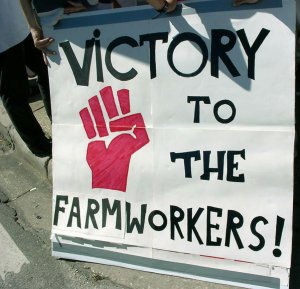
Coalition of Immokalee Workers marches in Miami

Fellow workers:

Right now, the Coalition of Immokalee Workers are marching in the streets of Miami, as part of their campaign to win wage increases for tomato pickers whose tomatoes are bought by Burger King. Here’s why.

Today, farmworkers from Immokalee, Florida and their religious, labor, and student allies are marching 9 miles through the streets of Miami to the world headquarters of Burger King.

Today we march because there is a human rights crisis in the fields of Florida. Tomato pickers who harvest tomatoes for the fast-food industry face sweatshop conditions every day, including sub-poverty, stagnant wages (pickers earn about $10,000/year on average and a per-bucket piece rate that has not changed significantly since 1978) and the denial of basic labor rights.

Today we march because to earn minimum wage for a 10-hour day, a tomato picker in Florida must harvest over TWO AND A HALF TONS of tomatoes.

Today we are marching because, in the most extreme cases, farmworkers face conditions of modern-day slavery. We have seen five slavery operations in the fields brought to the federal courts since 1997, helping to liberate over 1,000 workers and sending 10 employers to prison.

Today we march because Burger King contributes directly to farmworkers' poverty through its high-volume purchasing practices, for decades demanding the cheapest tomatoes possible but never demanding fair treatment or just wages for the people who harvest those tomatoes.

Today we are marching because we have hope. In the past years farmworkers and consumers have united to bring Yum Brands (the world’s largest restaurant corporation) and McDonald’s to the table to help improve tomato pickers’ wages and working conditions.

Today we march because, in the wake of these changes, we stand on the threshold of a more modern, more humane agricultural industry in Florida. Yet, facing this historic opportunity, Burger King has responded with lies and excuses to not take responsibility.

Today we are marching to say ENOUGH.

Today we are marching for the dignity of workers, consumers, and our communities alike.

JOIN US as we demand justice. Rally at Burger King headquarters this afternoon, 3:30 to 6:00, at Blue Lagoon Drive and NW 57 Ave.

Coalition of Immokalee Workers (2007-11-30): Why We March

Migrant farmworkers in southern Florida spend every workday picking tomatoes by hand for 10 to 12 hours at a stretch, at a piece rate of $0.40–$0.45 for every 32 pound bucket that they fill (or about 1¼ to 1½ pennies per pound of tomatoes picked). Since that piece rate hasn’t changed since 1978, farmworker’s real wages have actually fallen by more than two thirds over the past three decades, thanks to the combination of the farm bosses’ efforts to stonewall wage increases and the Federal Reserve’s efforts to keep the market safe for finance capital by eating up the value of other people’s wages.

The Coalition of Immokalee Workers, a farmworkers’ union founded in 1993 and organized along community workers’ council lines, has been working to change all that. They are mostly immigrants from Mexico, Central America, and the Caribbean; many of them have no legal immigration papers; they are pretty near all mestizo, Indian, or Black; they have to speak at least four different languages amongst themselves; they are often heavily in debt to coyotes or labor sharks for the cost of their travel to the U.S.; they get no benefits and no overtime; they have no fixed place of employment and get work from day to day only at the pleasure of the growers; they work at many different sites spread out anywhere from 10–100 miles from their homes; they often have to move to follow work over the course of the year; and they are extremely poor (most tomato pickers live on about $7,500–$10,000 per year, and spend months with little or no work when the harvesting season ends). But in the face of all that, and across lines of race, culture, nationality, and language, the C.I.W. have organized themselves anyway, through efforts that are nothing short of heroic, and they have done it as a wildcat union with no recognition from the federal labor bureaucracy and little outside help from the organized labor establishment. By using creative nonviolent tactics that would be completely illegal if they were subject to the bureaucratic discipline of the Taft-Hartley Act, the C.I.W. has won major victories on wages and conditions over the past two years. They have bypassed the approved channels of collective bargaining between select union reps and the boss, and gone up the supply chain to pressure the tomato buyers, because they realized that they can exercise a lot more leverage against highly visible corporations with brands to protect than they can in dealing with a cartel of government-subsidized vegetable growers that most people outside of southern Florida wouldn’t know from Adam.

The C.I.W.’s creative use of moral suasion and secondary boycott tactics have already won them agreements with Taco Bell (in 2005) and then McDonald’s (this past spring), which almost doubled the effective piece rate for tomatoes picked for these restaurants. They established a system for pass-through payments, under which participating restaurants agreed to pay a bonus of an additional penny per pound of tomatoes bought, which an independent accountant distributed to the pickers at the farm that the restaurant bought from. Each individual agreement makes a significant but relatively small increase in the worker’s effective wages — about $100 more per worker per year in the case of the Taco Bell agreement — but each victory won means a concrete increase in wages, and an easier road to getting the pass-through system adopted industry-wide, which would in the end nearly double tomato-pickers’ annual income.

Since the victory in the McDonald’s campaign, the C.I.W. have turned their attention from the Clown to the Crown, and Burger King Inc. has mostly followed the same path as Yum! Brands and McDonald’s did. First they ignored them. Then they stonewalled them. Then they tried to make up some excuses, and had a P.R. flack make an ill-considered little funny about how distressed farmworkers should apply for a job at their stores. (If I recall correctly, that same exact joke was recycled from Taco Bell.) Unfortunately, before moving on to the inevitable last step — in which they cave, the C.I.W. wins, the farm workers get a bonus, and the fast food chain gets to issue a press release patting themselves on the back for their humanitarian buying standards — Burger King has decided to make a detour through some dirty anti-labor joint maneuvers with the Florida tomato growers’ cartel.

The Florida Tomato Growers’ Exchange is a cartel and legislative lobby which represents more than 90% of Florida’s tomato growers. It has recently set out to destroy the pass-through system. Since the bonuses are paid by the buyers, the system costs the farm bosses nothing to implement, and I’m not entirely clear what their interest is here (although, if I had to guess, they are probably worried that widespread success for the system would raise workers’ expectations about pay and conditions). Burger King and the cartel recently teamed up on a joint P.R. campaign intended to convince the eating public that farm workers are actually richer than most minimum-wage workers, and besides which the farm bosses pay for charity houses and scholarships for their poor kids. (The basis for their argument is a comparison of estimated hourly wages. Of course, the reliability of those hours, or the total annual income, is never mentioned.)

Meanwhile, the F.T.G.E. and Burger King have endorsed the cartel’s yellow-dog auditing agency, S.A.F.E. Reps from Burger King and the tomato cartel have also teamed up with a Republican state congressman to discredit the C.I.W., by claiming that the set-up looks fishy, denouncing nonviolent protest and consumer boycotts as extortion, and then insinuating that the pass-through system is little more than a channel for graft, and that C.I.W. is pocketing a skim. Since they have no empirical evidence for this claim, they have relied on innuendo and unsubstantiated soundbites, and they have refused to give any backing for their claims, while steadfastly ignoring the offers of participating restaurants, who dismiss the claim, to explain how the system works.

Meanwhile, Reggie Brown, the tomato cartel’s professional spokesdick, has invoked the spectre of federal prosecution, claiming that the C.I.W.’s voluntary pass-through system somehow violates federal antitrust and racketeering laws. Brown has also denounced the freely bargained agreements as un-American, apparently because they organized bosses’ divine right to control the terms of wage negotiations with no input from workers organizations or, for that matter, their customers. The cartel has publicly warned its members not to participate, and, behind the scenes, they have apparently threatened any member who participates in the penny-per-pound pass-through system with a $100,000 fine. As a result, while Taco Bell and McDonald’s are still willing to participate in the bonus system, all of the growers have, as of now, announced that they will not participate next year.

Well, fine. If they want to play hardball, let them play hardball. Workers are more than capable of hitting that hardball right back. The main danger, at this point, is that, with spokesdick Brown’s muttered fulminations about federal prosecution and the bosses’ enlistment of state government creeps on their side, this fight may get kicked from creative, nonviolent industrial action, over into the stifling atmosphere of legal and regulatory action. As long as the C.I.W., and the workers and consumers acting in solidarity with them, keep away from political action, we have all the resources we need to beat them. The Taco Bell boycott was won, after years of stonewalling, through fight-to-win tactics like working with sympathetic students to get Taco Bell franchises booted out of campus dining halls. This fight can be won through more of the same, and better. Never forget that the workers are more powerful with their hands in their pockets than all the weapons and property that the plutocrats have to attack us. As Robin Blumner writes in the St. Petersburg Times:

The coalition initially tried to convince the growers to pay the added penny but they wouldn’t budge, so the group sought to enlist fast-food giants instead. Go to the major buyers who have reputations to uphold and have them pay the penny. It was a brilliant stroke.

Consumers tend to respond well to a company they think is socially responsible, and the converse is true.

… According to [C.I.W. rep Julia] Perkins, there are growers willing to help their workers secure this additional wage but the exchange is standing in the way.

Both Yum Brands and McDonald’s say they are committed to their agreement with the coalition. It appears that for now, however, things are on hold until the coalition and these companies can figure out a way around the intransigence of the exchange.

This is how it often is in labor fights: Employers dig in so hard that even an extra penny – one that they’re not even paying – is too much to ask. No wonder they can’t find Americans to do this work.

In the meantime, the coalition is trying to convince Burger King Corp. to come aboard, and is planning a demonstration at its headquarters in Miami on Friday. Keva Silversmith, a Burger King representative, says that the Florida growers have a right to run their business how they see fit.

I guess expending the $250,000 it would cost Burger King is simply too much for a company that is paying its CEO $2.35-million a year.

Okay consumers, sic ’em.

— Robin Blumner, St. Petersburg Times (2007-11-25): At a penny per pound, a little adds up to a lot

Further reading:

Res ipsa loquitur

For those who may be curious, here’s my attitude towards the Ron Paul primary campaign. I would not vote for Ron Paul, even though I don’t have any in-principle objection to voting defensively in government elections. The short explanation is that I don’t vote for anti-abortion candidates, and I don’t vote for candidates who are significantly worse than the status quo on immigration. Unfortunately, whatever it’s other merits, Ron Paul’s campaign features both of these poison pills. On the other hand, currently he is running in a primary, and so to some extent I wish, without much hope, that he might somehow manage to defeat his current opponents, i.e., the other Republicans, i.e., that bunch of howling bare-fanged war-fascists.

But that’s about all the enthusiasm I’ve got. Many anti-war types and many libertarians are getting positively gleeful about the campaign, claiming that even if Ron Paul has little real hope for electoral victories, the campaign will at least provide a platform for outreach and education about libertarian and non-interventionist ideas, both through media notoriety and also through attracting an obviously enthusiastic and organizationally clever following of base supporters. For my part, I certainly hope that the Paulians learn something in the process, but the first problem is that Ron Paul’s positions, however preferable a select set of them may be to the positions espoused by the rest of the pack, are not libertarian; they’re Constitutionalist, which is something different. He can’t even always be counted on to mount principled, non-legalistic arguments against the war, and that issue’s the centerpiece of his campaign.

The second problem, even setting aside the ideological differences, is that the usual dynamics of electoral horse-racing, and the sometimes ridiculous tone of uncritical personal adulation toward Ron Paul’s personal virtues and the shining radiance of Ron Paul Thought, give me a lot of reason to fear that whatever lessons are drawn may very well be the wrong lessons, and that in any case the enthusiasm and activity around his campaign is likely to collapse into frustrated torpor more or less immediately after their sole vehicle for activism, the Ron Paul political machine, closes down for the season, and stays shuttered for the rest of a multiyear election cycle. Unless something changes, but soon, I see no reason to believe that the flurry of activity, as exciting as it may seem, is going to survive the end of this one maverick candidate’s personal electoral prospects.

Micha Ghertner recently posted a good article at The Distributed Republic, which touches on some similar themes and makes a number of other good points besides, focusing on the way in which the choice of electoral politics as a vehicle seriously hobbles the prospects for accomplishing much in the way of successful education about freedom or anti-imperialism through the Ron Paul machine. Thus:

But it is unreasonable to expect most of the target audience, having been successfully persuaded that Ron Paul is the candidate to support, to then go through the trouble of seperating the wheat from the chaff and come to the self-realization that implicit in Paul’s message of liberty is the notion that our focus should not be on selecting a candidate with admirable qualities such as honesty, integrity, and devotion to constitutional limits on government, but instead our focus should be on the inherent threat to liberty of the system itself, regardless of who happens to be temporarily at its helm. Bundling these two things together involves a self-contradiction between the medium and its message. Expecting people to ignore that contradiction, expecting people to hear the message we actually intend to send while rejecting the message of the medium itself, is expecting too much.

— Micha Ghertner, The Distributed Republic (2007-11-28): The Medium Is The Message: Why I Cannot In Good Conscience Support Ron Paul

Meanwhile, in the comments section, in order to prove that Ron Paul’s supporters really are approaching this from the standpoint of fair-minded principle, really are making the necessary careful distinctions, and really are putting principled concern for liberty over electoral politicking and partisan cheerleading, an anonymous paleo comes along in the comments to reply that You beltway libertarians are morons and that Micha’s remarks sound like the uninformed commentary of Hillary Clinton pollster.

Well, I guess it’s a fair cop. What could be more inside-the-Beltway than considered opposition to making an incumbent Congressman’s candidacy for the Presidency of the United States the main vehicle for your social and political vision, or encouraging means of activism, education, and resistance that bypass the machinery of the federal government?

Anticopyright. All pages written 1996–2026 by Rad Geek. Feel free to reprint if you like it. This machine kills intellectual monopolists.