Rad Geek People's Daily

official state media for a secessionist republic of one

Posts filed under Politics

Tu quoque

Here’s the latest from the Great Patriotic War on Terror:

WASHINGTON — Adding fire to the political debate over national security, a bleak government intelligence report says the war in Iraq has become a cause celebre for Islamic extremists, breeding deep resentment of the United States that’s likely to get worse before it gets better.

A four-page summary from an April National Intelligence Estimate — released Tuesday on President George W. Bush’s orders — offers little reason for optimism over the next five years. Despite serious damage to Al Qaeda leadership, it concludes, the threat from Islamic extremists has spread both in numbers and in geographic reach.

If this trend continues, threats to U.S. interests at home and abroad will become more diverse, leading to increasing attacks worldwide, it says.

Bush ordered the release after portions were leaked to the New York Times and the Washington Post; both papers published stories about it Sunday.

Some people have guessed what’s in the report and concluded that going into Iraq was a mistake, Bush said Tuesday.

I strongly disagree, he said, calling those views naive. With portions of the report public, everybody can draw their own conclusions, he said.

— Detroit Free Press (2006-09-27): Terror report fans flames as election draws near

It would be a logical fallacy to dismiss George Bush’s argument based on George Bush’s own failings. Arguments can and should be evaluated on their own merits, independently of your assessment of the person who makes them. But I will say that the spectacle of George Walker Bush — after the grave and gathering danger, after Mission Accomplished, after stuff happens, after we were all wrong, after the past three years of major turning points and final throes — turning around and chiding critics of his Iraq policy for naiveté about the situation on the ground simply beggars belief.

I’d also like to note that declassifying a cherry-picked selection of portions of the report for public release may not be the best way for the Decider to dispel politicized spin on selective leaks, or to encourage everybody [to] draw their own conclusions.

Further reading:

Moral standards

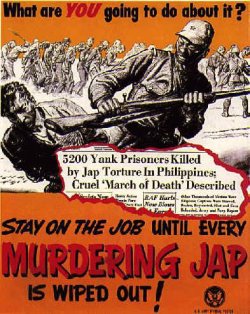
Here’s part of a recent reply to my post on the use of the phrase moral relativism. The original post discussed a controversy over whether or not Harry Truman should be called a terrorist for knowingly and willingly slaughtering civilians — orders of magnitude more civilians than Osama bin Laden (et al.) slaughtered in the attack on the World Trade Center — for the sake of military and political strategy. Here’s how Jamie DeVries tried to make the case that we cannot draw any moral parallels between the two figures:

Here is the question we ought to ask ourselves: )Did Truman have the ability and power to incinerate each and every Japanese citizen, even after a surrender was declared? The answer is: yes. Did he or the U.S have the WILL to do so? The answer: of course not.

Well, that was mighty white of him.

In all seriousness, how much lower could the bar possibly be set for rulers of the Allied governments in World War II? Is there absolutely any atrocity in the name of unconditional surrender that the Court Intellectuals and their countless acolytes would not rush to defend, or at least to excuse? I wish this were merely a bit of pointed rhetoric. But actually I’m asking it as a serious, open question.

Further reading:

International Ignore the Constitution Day festivities

Today is the 219th annual International Ignore the Constitution Day.

Here’s William Lloyd Garrison, in The Liberator, on December 29, 1832:

There is much declamation about the sacredness of the compact which was formed between the free and slave states, on the adoption of the Constitution. A sacred compact, forsooth! We pronounce it the most bloody and heaven-daring arrangement ever made by men for the continuance and protection of a system of the most atrocious villany ever exhibited on earth. Yes—we recognize the compact, but with feelings of shame and indignation, and it will be held in everlasting infamy by the friends of justice and humanity throughout the world. It was a compact formed at the sacrifice of the bodies and souls of millions of our race, for the sake of achieving a political object—an unblushing and monstrous coalition to do evil that good might come. Such a compact was, in the nature of things and according to the law of God, null and void from the beginning. No body of men ever had the right to guarantee the holding of human beings in bondage. Who or what were the framers of our government, that they should dare confirm and authorise such high-handed villany—such flagrant robbery of the inalienable rights of man—such a glaring violation of all the precepts and injunctions of the gospel—such a savage war upon a sixth part of our whole population?—They were men, like ourselves—as fallible, as sinful, as weak, as ourselves. By the infamous bargain which they made between themselves, they virtually dethroned the Most High God, and trampled beneath their feet their own solemn and heaven-attested Declaration, that all men are created equal, and endowed by their Creator with certain inalienable rights—among which are life, liberty, and the pursuit of happiness. They had no lawful power to bind themselves, or their posterity, for one hour—for one moment—by such an unholy alliance. It was not valid then—it is not valid now. Still they persisted in maintaining it—and still do their successors, the people of Massachussetts, of New-England, and of the twelve free States, persist in maintaining it. A sacred compact! A sacred compact! What, then, is wicked and ignominious?

… It is said that if you agitate this question, you will divide the Union. Believe it not; but should disunion follow, the fault will not be yours. You must perform your duty, faithfully, fearlessly and promptly, and leave the consequences to God: that duty clearly is, to cease from giving countenance and protection to southern kidnappers. Let them separate, if they can muster courage enough—and the liberation of their slaves is certain. Be assured that slavery will very speedily destroy this Union, if it be left alone; but even if the Union can be preserved by treading upon the necks, spilling the blood, and destroying the souls of millions of your race, we say it is not worth a price like this, and that it is in the highest degree criminal for you to continue the present compact. Let the pillars thereof fall—let the superstructure crumble into dust—if it must be upheld by robbery and oppression.

— William Lloyd Garrison, The Liberator (1832-12-29): On the Constitution and the Union

Here’s Lysander Spooner, in No Treason (1867-1870):

The practical difficulty with our government has been, that most of those who have administered it, have taken it for granted that the Constitution, as it is written, was a thing of no importance; that it neither said what it meant, nor meant what it said; that it was gotten up by swindlers, (as many of its authors doubtless were,) who said a great many good things, which they did not mean, and meant a great many bad things, which they dared not say; that these men, under the false pretence of a government resting on the consent of the whole people, designed to entrap them into a government of a part; who should be powerful and fraudulent enough to cheat the weaker portion out of all the good things that were said, but not meant, and subject them to all the bad things that were meant, but not said. And most of those who have administered the government, have assumed that all these swindling intentions were to be carried into effect, in the place of the written Constitution. Of all these swindles, the treason swindle is the most flagitious. It is the most flagitious, because it is equally flagitious, in principle, with any; and it includes all the others. It is the instrumentality by which all the others are mode effective. A government that can at pleasure accuse, shoot, and hang men, as traitors, for the one general offence of refusing to surrender themselves and their property unreservedly to its arbitrary will, can practice any and all special and particular oppressions it pleases.

The result — and a natural one — has been that we have had governments, State and national, devoted to nearly every grade and species of crime that governments have ever practised upon their victims; and these crimes have culminated in a war that has cost a million of lives; a war carried on, upon one side, for chattel slavery, and on the other for political slavery; upon neither for liberty, justice, or truth. And these crimes have been committed, and this war waged, by men, and the descendants of men, who, less than a hundred years ago, said that all men were equal, and could owe neither service to individuals, nor allegiance to governments, except with their own consent.

… Inasmuch as the Constitution was never signed, nor agreed to, by anybody, as a contract, and therefore never bound anybody, and is now binding upon nobody; and is, moreover, such an one as no people can ever hereafter be expected to consent to, except as they may be forced to do so at the point of the bayonet, it is perhaps of no importance what its true legal meaning, as a contract, is. Nevertheless, the writer thinks it proper to say that, in his opinion, the Constitution is no such instrument as it has generally been assumed to be; but that by false interpretations, and naked usurpations, the government has been made in practice a very widely, and almost wholly, different thing from what the Constitution itself purports to authorize. He has heretofore written much, and could write much more, to prove that such is the truth. But whether the Constitution really be one thing, or another, this much is certain — that it has either authorized such a government as we have had, or has been powerless to prevent it. In either case, it is unfit to exist.

–Lysander Spooner, No Treason No. 2 and No. 6

Here’s me, from last year’s celebration in the Rad Geek People’s Daily:

You, too, can celebrate Ignore the Constitution Day! Today, completely ignore all claims to authority granted in the Constitution. Live your life as if the Constitution had no more claim on you than the decrees of Emperor Norton. Enjoy your rights under natural law; you have them whether or not the Constitution says one mumbling word for them. While you’re at it, treat the Constitution as completely irrelevant in political arguments too; instead of complaining that unbridled war powers for the President are unconstitutional, for example, complain that they are evil; instead of reciting that damn Davy Crocket bed-time story again and complaining that government-controlled disaster relief is unconstitutional, complain that government-controlled disaster relief is foolish and deadly. (If the Constitution clearly authorized unilateral war powers for the President, or abusive and incompetant government-controlled disaster relief, would that make it okay?) And, hell, while you’re at it, quit complaining that forced Constitution Day celebrations may be unconstitutional; complain instead that they force children to participate in cultish praise for the written record of a naked usurpation.

Just go ahead. Ignore the Constitution for a day. See what happens. Who’s it gonna hurt? And if your political reasoning becomes sharper, your discourse no longer bogs down in a bunch of pseudo-legal mummeries, and you have a pleasant day without having to ask anybody’s permission for it, then I suggest you continue the celebration, tomorrow, and every day thereafter.

— GT 2005-09-17: International Ignore the Constitution Day

I think that legalism is an insidious error that liberals and libertarians alike are all too prone to fall into. In fact the rule of law is something to be hoped for only insofar as the laws are just: rigorously enforcing a wicked law–even if that law is duly published and generally formulated–is just relentlessness, not virtue. And in our bloodstained age it is as obvious as anything that many laws are very far from being just. But one way of trying to accomodate this point, while entirely missing it, is to throw your weight behind some Super-Duper Law that is supposed to condemn the little-bitty laws that you consider unjustifiable. Besides taking the focus away from creative extremism and direct action, and leaving power in the hands of government-appointed conspiracies of old white dudes in black robes, this strategy also amounts to little more than a stinking red herring. It diverts the inquiry from the obvious injustices of a State that systematically robs, swindles, extorts, censors, proscribes, beats, cuffs, jails, exiles, murders, bombs, burns, starves countless innocent people in the name of its compelling State interests, and puts the focus the powers that are or are not delegated to the government by another damn written law. As if the contents of that law had any more right to preempt considerations of justice than the subordinate laws supposedly enacted under its authority. Those who have spent their days trying to find a lost Constitution under the sofa cushions are engaged in a massive, sophisticated, intricately argued irrelevancy. I’d compare it to debating how many angels can dance on the head of a pin, but that would be grossly unfair–to Scholastic metaphysicians.

Further reading:

… but the streets belong to the people!

Here is the latest communiqué from United for Peace and Justice. This will be interesting ….

From: UFPJ Action Alerts
To: Charles Johnson
Date: September 14, 2006 5:39 PM

Please forward as widely as possible!

On Tuesday, Sept. 19, President Bush will be speaking at the United Nations as part of an election-year public-relations push on his disastrous Iraq War.

The New York City Police Department has refused to grant a permit to United for Peace and Justice to march anywhere near the United Nations. ]Based on feedback from our member groups and supporters][1], we have come to a decision: We are marching anyway. Permit or no permit, we will stand up against this immoral war and for our right to dissent.

While the Bush Administration has pursued its belligerent policy of preemptive war abroad, attacking a country that posed no danger to us, our Constitutional rights have been steadily eroded here at home, with peaceful protesters treated as security threats. In New York City, the NYPD and other agencies have systematically declared one location after another off-limits to protest — no rallies in most of Central Park, no marches on Fifth Avenue, no pickets in Times Square, and so on endlessly.

We know there are serious security issues to consider when the president and other heads of state are in town. But those needs must be balanced against protecting the right to assemble, the right to protest, and the right to dissent. The NYPD said no to every alternative we put on the table and simply refused to give us a permit for a reasonable location for our march next Tuesday.

Enough is enough. We are marching — marching to demand that the troops come home now, and to assert our right to peaceful protest. Marching without a permit amounts to nonviolent civil disobedience, and those of us who participate in the march on Tuesday will place ourselves at risk of arrest.

We also know and respect the fact that many people cannot participate in an activity that does not have a permit. And so we are seeking a permit for a rally starting at 8:30 a.m. in Herald Square, one of the busiest locations in Manhattan. This will enable anyone who wishes to protest the war and the restriction of our civil liberties to join us without risking arrest.

There are important details to work out, but this we know for certain: we will not be silenced, we will call for an immediate end to the war in Iraq, and we will be on the streets of New York City on Tuesday, September 19th!

WE NEED YOUR HELP:

  1. Please share this email message as widely as possible. Help make sure that everyone knows about the rally and march on Sept. 19th and the denial of our request for a march permit.

  2. Especially if you are in the NYC area, make plans now to join us next Tuesday morning. If you would like to participate in the march, please take a moment to call our office at 212-868-5545 so we can give you information about nonviolence trainings. We would rather take this risk than allow our rights to be undermined.

  3. Check the UFPJ website for updates on the details for Sept. 19th, including the exact time and location of the rally and the plans for the march. If you are looking for or would like to offer a ride to NYC, please visit our ride board.

  4. And, of course, all of this work takes money. Whether or not you are able to participate in person on Tuesday, you can show your support by making a financial donation today! Make an online contribution, call our office at 212-868-5545 to make a credit card donation over the phone, or send a check or money order to UFPJ, P.O. Box 607, Times Square Station, NY NY 10108.

Over My Shoulder #29: James Baldwin on race in Europe and America, whiteness, and African-American identity, from Stranger in the Village

Here’s the rules:

  1. Pick a quote of one or more paragraphs from something you’ve read, in print, over the course of the past week. (It should be something you’ve actually read, and not something that you’ve read a page of just in order to be able to post your favorite quote.)

  2. Avoid commentary above and beyond a couple sentences, more as context-setting or a sort of caption for the text than as a discussion.

  3. Quoting a passage doesn’t entail endorsement of what’s said in it. You may agree or you may not. Whether you do isn’t really the point of the exercise anyway.

Here’s the quote. This is from Stranger in the Village, the closing essay in James Baldwin’s Notes of a Native Son (1955). Baldwin has been discussing the time that he spent writing in a tiny Swiss town, which he was the first Black person ever to visit, and thence the difference in the race question in Europe and America.

When one considers the history of the Negro in America it is of the greatest importance to recognize that the moral beliefs of a person, or a people, are never really as tenuous as life–which is not moral–very often causes them to appear; these create for them a frame of reference and a necessary hope, the hope being that when life has done its worst they will be enabled to rise above themselves and triumph over life. Life would scarcely be bearable if this hope did not exist. Again, even when the worst has been said, to betray a belief is not by any means to have put oneself beyond its power; the betrayal of a belief is not the same thing as ceasing to believe. If this were not so there would be no moral standards in the world at all. Yet one must also recognize that morality is based on ideas and that all ideas are dangerous–dangerous because ideas can only lead to action and where the action leads no man can say. And dangerous in this respect: that confronted with the impossibility of remaining faithful to one’s beliefs, and the equal impossibility of becoming free of them, one can be driven to the most inhuman excesses. The ideas on which American beliefs are based are not, though Americans often seem to think so, ideas which originated in America. They came out of Europe. And the establishment of democracy on the American continent was scarcely as radical a break with the past as was the necessity, which Americans faced, of broadening this concept to include black men.

This was, literally, a hard necessity. It was impossible, for one thing, for Americans to abandon their beliefs, not only because these beliefs alone seemed able to justify the sacrifices they had endured and the blood they had spilled, but also because these beliefs afforded them their only bulwark against a moral chaos as absolute as the physical chaos of the continent in which Americans found themselves, these beliefs threatened an idea which, whether or not one likes to think so, is the very warp and woof of the heritage of the West, the idea of white supremacy.

Americans have made themselves notorious by the shrillness and the brutality with which they have insisted on this idea, but they did not invent it; and it has escaped the world’s notice that those very excesses of which Americans have been guilty imply a certain, unprecedented uneasiness over the idea’s life and power, if not, indeed, the idea’s validity. The idea of white supremacy rests simply on the fact that white men are the creators of civilization (the present civilization, which is the only one that matters; all previous civilizations are simply contributions to our own) and are therefore civilization’s guardians and defenders. Thus it was impossible for Americans to accept the black man as one o themselves, for to do so was to jeopardize their status as white men. But not so to accept him was to deny his human reality, his human weight and complexity, and the strain of denying the overwhelmingly undeniable forced Americans into rationalizations so fantastic that they approached the pathological.

At the root of the American Negro problem is the necessity of the American white man to find a way of living with the Negro in order to be able to live with himself. And the history of this problem can be reduced to the means used by Americans–lynch law and law, segregation and legal acceptance, terrorization and concession–either to come to terms with this necessity, or to find a way around it, or (most usually) to find a way of doing both these things at once. The resulting spectacle, at once foolish and dreadful, led someone to make the quite accurate observation that the Negro-in-America is a form of insanity which overtakes white men.

In this long battle, a battle by no means finished, the unforseeable effects of which will be felt by many future generations, the white man’s motive was the protection of his identity; the black man was motivated by the need to establish an identity. And despite the terrorization which the Negro in America endured and endures sporadically until today, despite the cruel and totally inescapable ambivalence of his status in his country, the battle for his identity has long ago been won. He is not a visitor to the West, but a citizen there, an American; as American as the Americans who despise him, the Americans who fear him, the Americans who love him–the Americans who became less than themselves, or rose to be greater than themselves by virtue of the fact that the challenge he represented was inescapable. He is perhaps the only black man in the world whose relationship to white men is more terrible, more subtle, and more meaningful than the relationship of bitter possessed to uncertain possessor. His survival depended, and his development depends, on his ability to turn his peculiar status in the Western world to his own advantage and, it may be, to the very great advantage of that world. It remains for him to fashion out of his experience that which will give him sustenance, and a voice.

The cathedral at Chartres, I have said, says something to the people of this village which it cannot say to me; but it is important to understand that, this cathedral says something to me which it cannot say to them. Perhaps they are struck by the power of the spires, the glory of the windows; but they have known God, after all, longer than I have known him, and in a different way, and I am terrified by the slippery bottomless well to be found in the crypt, down which heretics were hurled to death, and by the obscene, inescapable gargoyles jutting out of the stone and seeming to say that God and the devil can never be divorced. I doubt that the villagers think of the devil when they face a cathedral because they have never been identified with the devil. But I must accept the status which myth, if nothing else, gives me in the West before I can hope to change the myth.

Yet, if the American Negro has arrived at his identity by virtue of the absoluteness of his estrangement from his past, American white men still nourish the illusion that there is some means of recovering the European innocence, of returning to a state in which black men do not exist. This is one of the greatest errors Americans can make. The identity they fought so hard to protect has, by virtue of that battle, undergone a change: Americans are as unlike any other white people in the world as it is possible to be. I do not think, for example, that it is too much to suggest that the American vision of the world-which allows so little reality, generally speaking, for any of the darker forces in human life, which tends until today to paint moral issues in glaring black and white-owes a great deal to the battle waged by Americans to maintain between themselves and black men a human separation which could not be bridged. It is only now beginning to be borne in on us-very faintly, it must be admitted, very slowly, and very much against our will–that this vision of the world is dangerously inaccurate, and perfectly useless. For it protects our moral high-mindedness at the terrible expense of weakening our grasp of reality. People who shut their eyes to reality simply invite their own destruction, and anyone who insists on remaining in a state of innocence long after that innocence is dead turns himself into a monster.

The time has come to realize that the interracial drama acted out on the American continent has not only created a new black man, it has created a new white man, too. No road whatever will lead Americans back to the simplicity of this European village where white men still have the luxury of looking on me as a stranger. I am not, really, a stranger any longer for any American alive. One of the things that distinguishes Americans from other people is that no other people has ever been so deeply involved in the lives of black men, and vice versa. This fact faced, with all its implications, it can be seen that the history of the American Negro problem is not merely shameful, it is also something of an achievement. For even when the worst has been said, it must also be added that the perpetual challenge posed by this problem was always, somehow, perpetually met. It is precisely this black-white experience which may prove of indispensable value to us in the world we face today. This world is white no longer, and it will never be white again.

–James Baldwin, Stranger in the Village (1953), in Notes of a Native Son (1955), pp. 171-175
Anticopyright. All pages written 1996–2026 by Rad Geek. Feel free to reprint if you like it. This machine kills intellectual monopolists.