
Rad Geek People's Daily

official state media for a secessionist republic of one

Posts filed under Smash the State

Roe v. Wade Day #36

Blog for Choice Day * January 22, 2009

The most important thing feminists have done and have to keep doing is to insist that the basic reason for repealing the laws and making abortions available is justice: women's right to abortion.

... There are many reasons why a woman might seek a late abortion, and she should be able to find one legally if she wants it. She may suddenly discover that she had German measles in early pregnancy and that her fetus is deformed; she may have had a sudden mental breakdown; or some calamity may have changed the circumstances of her life: whatever her reasons, she belongs to herself and not to the state.

— Lucinda Cisler (1969): Abortion law repeal (sort of): a warning to women

To-day is the 36th anniversary of the United States Supreme Court’s ruling in Roe v. Wade on 22 January 1973 — the day when abortion laws were repealed in every state of the United States, and the United States judiciary finally took formal notice, even if in a limited and limiting sort of way, of every woman’s fundamental human right to decide what to do with the walls of her own damn uterus. To-day marks the end of the hundred years’ war that American state governments waged for forced pregnancy, and the recognition that every woman’s reproductive organs are her own, and that she has every right, if she sees fit, to give what she will of herself, or to refuse the use of her body to Man, Fetus, and State alike.

There's a lot not to like about the specifics of the reasoning in Roe, and it’s often frustrating that Roe is the ruling that we’ve got to celebrate, or at least defend. But if nothing else, it is worth taking a day to celebrate the pro-choice feminist movement that made Roe inevitable, and the remarkable struggle, over the course of just 4 years (from February 1969 to January 1973), pushed forward by an abolitionist movement which exploded seemingly out of nowhere, drew in and radicalized millions of women to fight for their own freedom, challenged a century and more of anti-abortion laws, defied and ridiculed all the grey eminences of Church and State, and then, amazingly, won victory after victory, with Roe as the final capstone.

The movement was new; it was led, and fought for by women; in particular, it was organized, led, and fought for by radical feminists. There had been a small, barely effectual abortion law reform movement for years before 1969, mostly led by men (mostly doctors), which argued for small reforms to existing laws (exceptions of the rape / incest / health-of-the-mother variety), and based its arguments mostly on pity for the suffering of victimized women, or else on unrelated policy outcomes, like social uplift or population control. They had made no progress to speak of after decades of activism; draconian abortion laws still stood in every state in the U.S., as they had for about a century.

But then, in February and March of 1969, while the reformists hemmed and hawed and accomplished nothing, and while liberal feminist groups like NOW mostly avoided such a divisive issue, a loose-knit group of radical Women’s Liberationists — women like Kathie Sarachild, Carol Hanisch, Susan Brownmiller, and Flo Kennedy — organized and led a series of unprecedented speak-outs and organizing efforts, concentrated in New York City and Chicago, which marked the definite beginning of a new movement, calling for the immediate and complete repeal of all abortion laws. And, just as importantly, they recognized and insisted that abortion is not just a medical issue (although it is that), or sexual privacy (although it is that, too) or an issue of the socio-economic uplift of the female sex. It is, they insisted, an issue of choice, and of freedom from the State’s invasive violence. The point is not to wring our hands and try to do right by the poor dears; the point is that each and every woman has an unconditional right to individually decide how her own body will or will not be used.

The sparks lit a fire. The fire spread. Thousands of women from across the country, many of whom had never been involved in political activism, threw themselves in with a loose-knit coalition of WL activists and radicalized women. The new pro-choice movement quickly shoved aside the male experts, both reactionary and reformist, who had dominated the discourse for decades beforehand. They insisted on their right to be heard; they insisted on their right to control their own bodies; and they argued that, because abortion is a human right, the government’s prohibition of abortion, and the back-alley butchery that went on underground because of it, was nothing more and nothing less than State violence against women. They made the urgency and the justice of the movement palpable by abandoning apologetic reformist, and by using consciousness-raising, speeches, demonstrations, and — especially — speak-outs, direct action, and public confrontations with the men who claimed power over them.

February 1969 was an important month in the abortion struggle. Larry Lader, a biographer of Margaret Sanger, summoned a handful of professionals in law and medicine to the Drake Hotel in Chicago for the organizing conference of NARAL, the National Association for Repeal of Abortion Laws. (NARAL became the National Abortion Rights Action League in 1974.) The conferees targeted specific states where they believed the repressive codes could be knocked down. New York, with its liberal constituency, was a top priority. Bills ranging from modest reforms (in cases of rape and incest) to outright repeal of all criminal penalties were already in the legislative hopper.

Betty Friedan, one of the main speakers at the Chicago NARAL meeting, reflected the changing political climate. At NOW’s founding convention in 1966, she had bowed to a clique that insisted that abortion rights were too divisive, too sexual, and too controversial for the fledgling organization, but since then a groundswell of younger members had stiffened her spine. NOW was being inundated by kids, one member observed. The kids from New York, Michigan, Ohio, Texas, and elsewhere pushed through an abortion plank at NOW’s 1967 convention.

And the kids were forging ahead with their own tactics. On the same wintry day in mid-February when NARAL’s founders were traveling to Chicago for their first conference six state legislators held a public hearing in Manhattan on some proposed liberalizing amendments to the New York law. Typical of the times, the six legislators were men, and the spekaers invited to present expert testimony were fourteen men and a Catholic nun.

On the morning of the February 13 hearing, a dozen infiltrators camouflaged in dresses and stockings entered the hearing room and spaced themselves around the chamber. Some called themselves Redstockings, and some, like Joyce Ravitz, were free-floating radicals who were practiced hands at political disruptions. Ravitz, in fact, had been on her way to another demonstration when she’d run into the Redstockings women, who convinced her to join them.

As a retired judge opined that abortion might be countenanced as a remedy after a woman had fulfilled her biological service to the community by bearing four children, Kathie Amatniek leaped to her feet and shouted, Let’s hear from the real experts–women! Taking her cue, Joyce Ravitz began to declaim an impassioned oration. Ellen Willis jumped in. More women rose to their feet.

Men don’t get pregnant, men don’t bear children. Men just make laws, a demonstrator bellowed.

Why are you refusing to admit we exist? cried another.

Girls, girls, you’ve made your point. Sit down. I’m on your side, a legislator urged, raising the temperature a notch higher.

Don’t call us girls, came the unified response. We are women!

The hearing dissolved in confusion. When the chairman attempted to reconvene it behind closed doors, the women sat down in the corridor, refusing to budge.

Stories appeared the next day in the Times (Women Break Up Abortion Hearing), the New York Post (Abortion Law Protesters Disrupt Panel), and the Daily News. Ellen Willis slipped out of her activist guise to do a report for Talk of the Town in The New Yorker. Nanette Rainone filed for WBAI radio and the Pacfica network. Barely a month old, Redstockings, with an assist from the radical floaters, had successfully dramatized the need for woman as expert in the abortion debate.

Five weeks later, on March 21, 1969, Redstockings staged a public speak-out, Abortion: Tell It Like It Is, at the Washington Square Methodist Church, a hub of antiwar activism in Greenwich Village. For some Women’s Liberation founders, the speak-out was the movement’s finest hour. Astounding, is the way Irene Peslikis puts it. It showed the power of consciousness-raising, how theory comes from deep inside a person’s life, and how it leads directly to action.

Peslikis had organized the panel and coached the women who were willing to speak. The idea, she says, was to get examples of different kinds of experiences–women who’d had the babies that were taken away, women who went to the hospital for a therapeutic abortion, women who’d gone the illegal route, the different kinds of illegal routes.

Three hundred women and a few men filled the church that evening as Helen Kritzler, Barbara Kaminsky, Rosalyn Baxandall, Anne Forer, and a few other brave souls passed a small microphone back and forth. Baxandall broke the ice with a touch of humor. I thought I was sophisticated, she joked into the mike. My boyfriend told me if he came a second time, the sperm would wash away, and I believed him.

Another woman recounted, So there I was in West New York, New Jersey, and the doctor had these crucifixes and holy pictures on the wall, and all he wanted was nine hundred dollars. I took out a vacation loan and I’m still paying it off.

Judy Gabree hurtled forward. I went to eleven hospitals searching for a therapeutic abortion. At the tenth, they offered me a deal. They’d do it if I agreed to get sterilized. I was twenty years old. I had to pretend I was crazy and suicidal, but having the abortion was the sanest thing I’d done.

More women added their personal testimony. I was one of those who kept quiet. Irene Peslikis had asked me to be one of the speakers, but I chose an easier path and played Village Voice reporter. My front-page story, Everywoman’s Abortions: The Oppressor Is Man, was the only substantive coverage the landmark speak-out received. Some retyped it in Chicago for the newsletter, which carried the news to activists around the country.

Another journalist, in aviator glasses and a miniskirt, was taking notes in the church that evening. She hovered near Jane Everhart, a NOW member, and whispered What’s going on?

Everhart whispered back, Sit down and listen!

Gloria Steinem was a friend of Women’s Liberation in 1969, but she had not yet thrown in her lot with the movement. Her plate was already overflowing with causes. Gloria spoke out against the war in Vietnam on late-night talk shows, raised money for liberal Democrats and Cesar Chavez’s farmworkers, and wrote earnest pieces on all of her issues for the popular magazines. Genetically endowed with the rangy limbs and sculpted features of a fashion model, Steinem glided through the rarefied world of radical chic expertly building her political connections. Beneath the exterior of the celebrity journalist was a woman who yearned to save the world.

Steinem received a shock of recognition when a Redstocking quipped, I bet every woman here has had an abortion. Hers had been done by a Harley Street practitioner in London during the late fifties after she’d graduated from Smith. Later she would say that the speak-out was her feminist revelation, the moment that redirected her public path. That night, however, she was working on a tight deadline. She threw together a hasty paragraph for the political diary she wrote for New York magazine. Nobody wants to reform the abortion laws, she explained in print. They want to repeal them. Completely.

The Redstockings abortion speak-out was an emblematic event for Women’s Liberation. Speak-outs based on the New York women’s model were organized in other cities within the year, and subsequent campaigns to change public opinion in the following decade would utilize first-person testimony in a full range of issues from rape and battery to child abuse and sexual harassment. The importance of personal testimony in a public setting, which overthrew the received wisdom of the experts, cannot be overestimated. It was an original technique and a powerful ideological tool. Ultimately, of course, first-person discourse on a dizzying variety of intimate subjects would become a gimmicky staple of the afternoon television talk shows, where the confessional style was utilized for its voyeuristic shock value. Back then, personal testimony was a political act of great courage.

–Susan Brownmiller, In Our Time: Memoir of a Revolution, pp. 106–109

By 1969, thousands of women in Chicago could find safe, affordable abortions through Jane, an underground, woman-run abortion service organized by members of the Chicago Women’s Liberation Union. In 1971, the movement won its first major aboveground political victory, with the repeal of state abortion laws in New York. And then, only two years later, they won the nation-wide repeal in January 1973. That’s something to remember, and to celebrate.

To-day, as part of Blog for Choice Day, NARAL would like bloggers to write about your top pro-choice hope for President Obama and/or the new Congress. But, as much as I might like for the now-ruling Democrats to roll back the past 8 years of new restrictions on abortion rights, I think the most important lesson to remember on this day is not to put your hope in the politicians and their power-plays. As noxious as Bush Jr.’s regime may have been, we can’t afford to forget that it was not George W. Bush, but pro-choice Bill Clinton who spent eight years presiding over the most intense and coordinated legal assaults on abortion rights in the post-Roe era — the emergence and proliferation of TRAP laws and procedure bans from 1992 to 2000. Politicians make political decisions, and even the most principled are subject to political forces beyond their personal control, and when we put our hope for social change in their hands, whatever convictions they confess and whatever parties they swear to, they will throw it away as soon as it suits them, again, and again, and again.

If not politicians, then who should we put our hopes in? But the answer should be obvious: we must put our hope in ourselves, in our own power, and our foremothers’ power, and our sisters’ and brothers’ power, to come together and change the world.

Like all anniversaries, this is a good day for remembering, and for honoring. One of the things I think it is most important to remember on this day, in spite of, or perhaps because of, the way in which the occasion is attached to a legal ruling handed down by nine men in black robes, is a matter of strategy. It is all too easy to make the latest political cockfight out as the be-all and end-all of pro-choice activism; to realize, correctly, that the legal position of abortion rights is really precarious and to leap, incorrectly, to the conclusion that if Roe falls, that will be the end of it. No it won’t. The pro-life State had its guns trained on us before, and we beat it. If it turns its guns on us again, that will be terrible, but we will beat it again nevertheless. Perhaps by once again forcing the hand of state legislators or the courts. Or perhaps not. There are other ways to get it done. Here is how a group of women in Chicago took matters into their own hands, years before Roe, without the blessing of the male experts and in defiance of the man-made Law, in order to make justice for their sisters a reality.

Radical women in Chicago poured their energy into Jane, an abortion referral service initiated by Heather Booth, who had been a one-woman grapevine for her college classmates. In 1971, after Booth’s departure, some of the women took matters into their own hands and secretly began to perform the abortions themselves. Safe, compassionate terminations for a modest fee became their high calling–a model, as they saw it, for women’s empowerment after the revolution.

Leaflets appeared in the Hyde Park neighborhood of the University of Chicago bearing a simple message: Pregnant? Don’t want to be? Call Jane at 643-3844. The number rang at the home of one of the activists who volunteered to be Jane. As word spread and the volume of calls increased, the service acquired its own phone line and an answering machine, a cumbersome reel-to-reel device that was one of the first on the market. Volunteers, known inside the service as call-back Janes, visited the abortion seekers to elicit crucial medical details (most important was lmp, the number of weeks since the last menstrual period), then another level of volunteers scheduled an appointment with one of the abortionists on the group’s list.

At first the service relied on Mike in Cicero, who was fast, efficient, and willing to lower his price to five hundred dollars as the volume increased. Mike gradually let down his guard with Jody Parsons, his principal Jane contact, an artisan who sold her beaded jewelry and ceramics at street fairs and was a survivor of Hodgkin’s disease. The clandestine abortionist and the hippy artisan struck up a bond. When Mike confessed that he was not in fact a real doctor but merely a trained technician, she cajoled him into teaching her his skills. Jody’s rapid success in learning to maneuver the dilating clamps, curettes, and forceps demystified the forbidden procedures for another half dozen women in Jane. If he can do it, then we can do it became their motto.

Madeline Schwenk, a banker’s daughter who had married at twenty, six months pregnant with no clue whatsoever about how to get an abortion, moved from counseling to vacuum aspiration after Harvey Karman, the controversial director of a California clinic, came to Chicago to demonstrate his technique. Madeline was one of the few women in Jane who was active in NOW, and who stayed affiliated with the Chicago chapter during the year she wielded her cannula and curette for the service. I’d get up in the morning, make breakfast for my three kids, go off to do the abortions, then go home to make dinner, she reminisces. Pretty ourageous behavior when you think about it. But exciting.

Jane’s abortion practitioners and their assistants were able to handle a total of thirty cases a day at affordable fees–under one hundred dollars. A doctor and a pharmacist among the women’s contacts kept them supplied with antibiotics.

Fear of police surveillance in radical circles had its match among clandestine abortionists who relied on a complicated rigamarole of blindfolds and middlemen. Jane straddled both worlds. Abortion seekers gathered every Wednesday, Thursday, and Friday at a front apartment, usually the home of a Jane member or friend, and were escorted by Jane drivers to the Place, a rented apartment where the abortions were performed. The fronts and the Place changed on a regular basis. New volunteers, brought into the group by counselors and drivers, went through a probation period before they were told that women in Jane were doing the abortions. The news did not sit well with everyone. Turnover was high, from fear and from burnout, although the service usually maintained its regular complement of thirty members.

Jane lost most of its middle-class clientele after the New York law [repealing the state’s abortion ban] went into effect. Increasingly it began to service South Side women, poor and black, who did not have the money to travel out of state, and whose health problems, from high blood pressure to obesity, were daunting. Pressure on the providers intensified. Audaciously they added second-trimester abortionsby induced miscarriage to their skills.

On May 3, 1972, near the conclusion of a busy work day in an eleventh-floor apartment on South Shore Drive overlooking Lake Michigan, Jane got busted. Seven women, including Madeline Schwenk, were arrested and bailed out the following day. The Chicago Daily News blared Women Seized in Cut-Rate Clinic in a front-page banner. The Tribune buried Lib Groups Linked to Abortions on an inside page. Six weeks later the service was back in buinsess. Wisely, the women facing criminal charges selected a defense attorney who was clued in to and optimistic about the national picture. She advised them to hang tight–some interesting developments were taking place in Washington that could help their case. (After the January 1973 Roe decision, all outstanding charges against the seven were dropped.)

The activists of Jane believe they performed more than ten thousand abortions. It’s a ballpark figure based on the number of procedures they remember doing in a given week. For security reasons they did not keep records.

–Susan Brownmiller, In Our Time: Memoir of a Revolution, pp. 123–125

The repeal of the abortion laws in the United States wasn’t a gift handed down out of benevolence by a gang of old men in robes. It was struggled for, and won, by women in our own times. It didn’t take ballot boxes; it didn’t take political parties; it didn’t take clever legal briefs. It took radical women who stood up for themselves, who challenged the authority of self-appointed male experts and law-makers, who spoke truth to power, who took things into their own hands and helped their sisters, in defiance of the law, because they knew that they had a right to do it, and to hell with any law and any government that said otherwise. Radical feminists who built a movement for their own freedom over a matter of months and decisively changed the world in less than five years. It’s not just that we owe the Redstockings, Cindy Cisler, Heather Booth, Jody Parsons, Madeline Schwenk, and so many others our praise. They do deserve our cheers, but they also deserve our study and our emulation. They did amazing things, and we — feminists, leftists, anti-statists — owe it not only to them, but to ourselves, to honor them by trying to learn from their example.

Further reading:

Libertarians for Protectionism, Appendix B: contrarium sequitur edition

I haven’t yet had the chance to read Michele Boldrin and David Levine’s Against Intellectual Monopoly. Ideas may not be subject to economic scarcity, but my time to enjoy them — alas — is. But it looks really promising, and exciting, judging from some of the excerpts and commentary I’ve seen about it online. I look forward to digging in soon.

In the meantime, besides tantalizing discussions, the online commentary has also offered a perfect opportunity for students of economics to witness the ridiculous sight of self-proclaimed free marketeers dragging out all the crassest sorts of corporate protectionism to apologize for actually-existing forms of economic privilege. And for students of logic to enjoy a few choice specimens of the contra-sequitur in its natural habitat.

Thus, for example, consider the reader comments on Jesse Walker’s notice of the book at Hit and Run:

Fluffy | January 16, 2009, 5:11pm | #

Fine — but without the ability to file a patent and make money off it, would James Watt have even bothered to invent the condenser that everyone else’s steam engine used?

Wah wah wah we could introduce innovations faster without patents! Maybe, but who would bother? Owner/operators only.

We already experienced a time without intellectual property. It was called the Middle Ages. And while the Middle Ages were not a completely backward time as imagined by the public and were marked by the gradual introduction of many important technological innovations in agriculture, mining, metallurgy, transport and power generation, just about all innovation came from owner/operators or their equivalent, and the pace of innovation and adoption of new technologies was brutally slow, despite the really high marginal utility that even the smallest advance brought under those conditions.

Of course, whatever you may think of the Middle Ages, some other eras without anything remotely like modern copyright or patent law have been called classical Athens, Renaissance Italy, Shakespearean England, and the Scientific Revolution. But never you mind that. The important thing is this: if it weren’t for copyrights and patents, technological innovation might not be profitable for large corporations to pursue. Heaven forbid; some business might have to be carried on by somebody other than large for-profit corporations. Similarly:

Hazel Meade | January 16, 2009, 8:46pm | #

Episarch. I think the idea is more that with IP rights someone else couldn’t simply take your cold fusion device apart, figure out how it works, and start manufacturing knock-offs. Unless they altered the design in a way that improved it.

The problem is that development of new technologies often takes years of research. If others can copy your designs, it makes it unprofitable to bother.

Automobile factories take years of capital-intensive construction and immense amounts of labor. If other corporations can just push cars into the market willy-nilly, it makes it unprofitable to bother. Without a protective tariff, who in their right mind would invest in American automobiles? In a free market, who would be in charge of making all the shoes?

If there is one thing that government can and ought to do, it is to make sure that no large business ever has to fundamentally rethink their business model, ever. I mean, sure, consumers and investors may have a different idea of how much art or R&D is enough art or R&D for them; they may decide they want to pay for other things on the margin — for example, they may want to put more efforts into derivative, marginal improvements rather than fundamental redesigns; or they may just want to spend some of that money on little fripperies, like food, clothing, or shelter. But if government isn’t there to force the prices of everything upward, then that may mean that corporate investment in some highly visible, culturally prestigious set of goods and services (like literary works, or mechanical devices, or Kenny G. albums) might possibly falter or fail when people want to pay for other, different things. Good lord, if nobody can make a profit from selling the easily-reproducible products of their creativity and thought, then thinking and creating might even be left to academics. Or to a bunch of rank amateurs.

Before I continue to the next argument, I want to mention, in all earnestness, that there is a common problem with all of these arguments. The problem is that they attempt to support intellectual enclosure on explicitly protectionistic grounds: they begin from the premise that there is some level of innovation or artistic production which, somehow or another, they presume to know perfectly well to be the right amount. Then they offer a pseudo-economic argument intended to show that absolutely free exchanges in products that depend on intellectual discovery or creativity would fail to funnel enough money into the purses of discoverers or creators to produce the level of production that they’ve deemed the right level. Thus, they conclude, you ought to institute government restrictions on free exchanges just in order to make sure that enough money is pried from out of buyers’ hands to encourage the level of production that the protectionists have deemed the right one. The problem with all this is, first, that the Intellectual Protectionists are ignoring the invisible cost of this visible subsidy; whatever extra money buyers are forced at bayonet-point to spend on nifty inventions or works of art is extra money that would have gone to other productive purposes — like living our lives, or working on projects of our own, or gaining the leisure to put some of our own thought and creativity to work. Like all forms of protectionism, Intellectual Protectionism engages the force of the State in subsidizing some politically-favored goods (or, rather, politically-favored producers) at the expense of other goods or producers, which happen to be economically popular but looked down on by politicians. And this form of inequity and privilege — enforced through government coercion — is in fact utterly arbitrary — arbitrary because Intellectual Protectionists never offer any non-arbitrary basis whatever for their judgment of what the right levels of their favored goods would be. Non-protectionists have a perfectly good standard: we figure that the right level is the level that free people would freely choose to get for themselves, if left alone to make their own decisions. But Intellectual Protectionists cannot appeal to anything of the sort, since the whole idea is to override the normal processes of free exchange. They just know, by some kind of revelation, which they more or less never spell out in any detail, that the right level is something more than that, and thus the need for a command economy, controlled by the legally-privileged copyright- or patent-holders — usually, as a matter of fact, giant, bureaucratic corporations (Apple, GE, AOL Time Warner, Pfizer, and the like) that can sustain big-time R&D departments and, just as importantly, can pay for the small army of lawyers needed to effectively manage their politically-fabricated portfolio.

I took the time out to say all that, with my face as straight as I could make it, because most of this post has involved an argument wrapped up in a lot of ridicule and facile sarcasm. But sometimes people say things that make ridicule and sarcasm simply beyond the point. Like this:

TallDave | January 16, 2009, 11:31pm | #

IP should expire (we don’t need Michael Jackson owning the Beatles’ albums 30 years late), but we need some kind of IP rights or there will be nothing but monopolies exploiting their entry barriers and stealing ideas. Yes, it’s less efficient in some ways, but that’s true of most any private property (public transportation vs. owning your own car, etc.).

Want to know what a world without IP looks like? It’s Microsoft. Wordperfect, Lotus 1-2-3, Netscape… all reverse-engineered and shoved down the OS marketing channel.

Some things you can reply to. Some things you can ridicule. Other things you can only repeat.

See also:

View images tagged “Building a new society within the shell of the old”

Here’s the profile picture from Kal’s blog, Two, Three, Many…; Kal gets an award from the Ministry of Culture of this secessionist republic of one, for the most awesome cultural mash-up of the past month, at least:

It's a logo of the IWW's sabo-tabby, arching its back, with the caption "im in ur factories, seizin ur means of production

See also:

Freedom Movement Celebrity Birthday Feast (this year with big round numbers)

Today is a feast day, and a jubilee celebration, declared by edict of the Ministry of Culture in this secessionist republic of one, in honor of those who have worked, and with hope for those who are working today, for the liberation of so many held captive by oppressive governments in foreign nations.

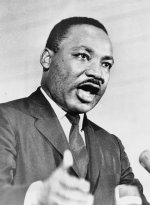
Happy 80th birthday, Martin Luther King Jr.!

We know through painful experience that freedom is never voluntarily given by the oppressor; it must be demanded by the oppressed. Frankly, I have never yet engaged in a direct action movement that was well timed, according to the timetable of those who have not suffered unduly from the disease of segregation. For years now I have heard the words Wait! It rings in the ear of every Negro with a piercing familiarity. This Wait has almost always meant Never. We must come to see with the distinguished jurist of yesterday that justice too long delayed is justice denied.

We have waited for more than three hundred and forty years for our constitutional and God-given rights. The nations of Asia and Africa are moving with jet-like speed toward the goal of political independence, and we still creep at horse and buggy pace toward the gaining of a cup of coffee at a lunch counter. I guess it is easy for those who have never felt the stinging darts of segregation to say, Wait. But when you have seen vicious mobs lynch your mothers and fathers at will and drown your sisters and brothers at whim; when you have seen hate filled policemen curse, kick, brutalize and even kill your black brothers and sisters with impunity; when you see the vast majority of your twenty million Negro brothers smothering in an airtight cage of poverty in the midst of an affluent society; when you suddenly find your tongue twisted and your speech stammering as you seek to explain to your six-year-old daughter why she can’t go to the public amusement park that has just been advertised on television, and see tears welling up in her eyes when she is told that Funtown is closed to colored children, and see the depressing clouds of inferiority begin to form in her little mental sky, and see her begin to distort her little personality by unconsciously developing a bitterness toward white people; when you have to concoct an answer for a five-year-old son asking in agonizing pathos: Daddy, why do white people treat colored people so mean?; when you take a cross-country drive and find it necessary to sleep night after night in the uncomfortable corners of your automobile because no motel will accept you; when you are humiliated day in and day out by nagging signs reading white and colored; when your first name becomes nigger, your middle name becomes boy (however old you are) and your last name becomes John, and your wife and mother are never given the respected title Mrs.; when you are harried by day and haunted by night by the fact that you are a Negro, living constantly at tip-toe stance never quite knowing what to expect next, and plagued with inner fears and outer resentments; when you are forever fighting a degenerating sense of nobodiness; then you will understand why we find it difficult to wait. There comes a time when the cup of endurance runs over, and men are no longer willing to be plunged into an abyss of despair. I hope, sirs, you can understand our legitimate and unavoidable impatience.

You express a great deal of anxiety over our willingness to break laws. This is certainly a legitimate concern. Since we so diligently urge people to obey the Supreme Court’s decision of 1954 outlawing segregation in the public schools, it is rather strange and paradoxical to find us consciously breaking laws. One may well ask: How can you advocate breaking some laws and obeying others? The answer is found in the fact that there are two types of laws: There are just and there are unjust laws. I would be the first to advocate obeying just laws. One has not only a legal but a moral responsibility to obey just laws. Conversely, one has a moral responsibility to disobey unjust laws. I would agree with Saint Augustine that An unjust law is no law at all. … So I can urge men to disobey segregation ordinances because they are morally wrong.

Martin Luther King Jr., born 80 years ago today on January 15, 1929. This passage is excerpted from his Letter from Birmingham Jail (1963) .

Happy 200th birthday, Pierre-Joseph Proudhon!

The sovereignty of Reason having been substituted for that of Revolution,

The notion of Contract succeeding that of Government,

Historic evolution leading Humanity inevitably to a new system,

Economic criticism having shown that political institutions must be lost in industrial organization,

We may conclude without fear that the revolutionary formula cannot be Direct Legislation, nor Direct Government, nor Simplified Government, that it is NO GOVERNMENT.

Neither monarchy, nor aristocracy, nor even democracy itself, in so far as it may imply any government at all, even though acting in the name of the people, and calling itself the people. No authority, no government, not even popular, that is the Revolution.

Direct legislation, direct government, simplified government, are ancient lies, which they try in vain to rejuvenate. Direct or indirect, simple or complex, governing the people will always be swindling the people. It is always man giving orders to man, the fiction which makes an end to liberty; brute force which cuts questions short, in the place of justice, which alone can answer them; obstinate ambition, which makes a stepping stone of devotion and credulity.

… I do not see why I myself should submit to this law. Who guarantees to me its justice, its sincerity? Whence comes it? Who made it? Rousseau teaches in unmistakeable terms, that in a government really democratic and free the citizen, in obeying the law, obeys only his own will. But the law has been made without my participation, despite my absolute disapproval, despite the injury which it inflicts upon me. The State does not bargain with me: it gives me nothing in exchange: it simply practises extortion upon me. Where then is the bond of conscience, reason, passion or interest which binds me?

But what do I say? Laws for one who thinks for himself, and who ought to answer only for his own actions; laws for one who wants to be free, and feels himself worthy of liberty? I am ready to bargain, but I want no laws. I recognize none of them: I protest against every order which it may please some power, from pretended necessity, to impose upon my free will. Laws! We know what they are, and what they are worth! Spider webs for the rich and powerful, steel chains for the weak and poor, fishing nets in the hands of the Government.

You say that you will make but few laws; that you will make them simple and good. That is indeed an admission. The Government is indeed culpable, if it avows thus its faults. No doubt the Government will have engraved on the front of the legislative hall, for the instruction of the legislator and the edification of the people, this Latin verse, which a priest of Boulogne had written over the door to his cellar, as a warning to his Bacchic zeal:

Pastor, ne noceant, bibe pauca sed optima vina. [Pastor, for your health, drink but little wine, but of the best.]

Few laws! Excellent laws! It is impossible. Must not the Government regulate all interests, and judge all disputes; and are not interests, by the nature of society, innumerable; are not relations infinitely variable and changeable? How then is it possible to make few laws? How can they be simple? How can the best law be anything but detestable?

You talk of simplification. But if you can simplify in one point, you can simplify in all. Instead of a million laws, a single law will suffice. What shall this law be? Do not to others what you would not they should do to you: do to others as you would they should do to you. That is the law and the prophets.

But it is evident that this is not a law; it is the elementary formula of justice, the rule of all transactions. Legislative simplification then leads us to the idea of contract, and consequently to the denial of authority. In fact, if there is but a single law, if it solves all the contradictions of society, if it is admitted and accepted by everybody, it is sufficient for the social contract. In promulgating it you announce the end of government. What prevents you then from making this simplification at once?

Pierre-Joseph Proudhon, born 200 years ago today, on January 15, 1809. This passage is excerpted from The Principle of Authority, the Fourth Study of The General Idea of the Revolution in the Nineteenth Century (1851).

Here’s to many happy returns!

(Reminders of the occasion thanks to this morning’s e-mail from The Daily Bleed.)

Repudiation now

We have not acquired any debt. The so-called public debt really belongs to the oligarchy. We the peoples have not acquired anything or been benefited, and thus we owe nothing.

–Confederation of Ecuadorian Kichwas (ECUARUNARI), quoted in Daniel Denvir, AlterNet (2008-12-15): Ecuador Calls foreign Debt Illegal, Defaults on Payments

Last month, the government of Ecuador defaulted on a US$ 30,600,000 interest payment on US$ 510,000,000 in bond debt. They will be defaulting on payments on two other series of bonds, amounting to US$ 9,937,000,000, or 19% of the entire country’s GDP.

Kevin Carson, in his first (hooray; congratulations) regular weekly commentary at the Center for a Stateless Society, says It’s about time, and Good on them. He points out that this massive government debt has nothing to do with freed trade or voluntary production. It has everything to do with building political alliances between governments and providing government funding for massive forced-modernization boondoggles and corporate privateering — with the costs, as always, taken out of the hides of Ecuadorian workers and farmers. As Carson writes:

That's entirely correct. In the specific case of Ecuador, according to John Perkins (Confessions of an Economic Hit Man), the loans were designed to foment conditions that make [Ecuador] subservient to the corporatocracy running our biggest corporations, our government, and our banks. Infratructure loans were granted on the condition that engineering and construction companies from our own country must build all these projects. In essence, most of the money never leaves the United States; it is simply transferred from banking offices in Washington to engineering offices in New York, Houston, or San Francisco.

. . .

[The main function of the government agencies set up to receive and manage foreign debt] is to work in collusion with the World Bank to run up debt building the infrastructure foreign capital needs for profitable investment. A majority of World Bank loans since that agency's inception have gone to building the roads and utilities necessary to support foreign-owned industry. The effect is to crowd out decentralized, small-scale, locally-owned industry serving local markets, and to integrate the domestic economy into a neoliberal framework of providing raw materials and labor for foreign industry.

The resulting debt (which the people of the country never approved) can then be used to further cement neoliberal policies, by blackmailing the local government into adopting a structural adjustment program. And the policies adopted under such programs generally include the privatization of the same infrastructure the loans were taken out to build, and selling it to the very people it was built to serve. Not only that, but the privatization is generally arranged on terms virtually dictated by the purchasers, with native governments sometimes spending more taxpayer money to make the assets salable than the sale actually fetches.

— Kevin Carson, Center for a Stateless Society (2009-01-05): Ecuador Repudiates Foreign Debt: It's About Time

Kevin has an excellent discussion of the structural and economic effects of massive government debts in formerly colonized countries like Ecuador. I think he’s entirely right. Of course, I couldn’t care less about the fact that the government of Ecuador has trouble raising funds for its own domestic parasitism and government-funded, government-regimented programs. Like all government programs, these range from useless to foolish and destructive. Would that the government of Ecuador couldn’t raise any money for any purpose. But what is a problem is the fact that the money for the payments on those debts — like all government payments — is always taken out of the pockets of the Ecuadorian people, through taxation, which is to say, by force.

And it’s that that I want to say something about today — not only the structural effects of government debt and government-lubricated neoliberalism (which is to say, government-financed state capitalism), but also the moral case for unilateral and unconditional repudiation. That case is a simple case, and it’s exactly what ECUARUNARI said: people should never be forced to pay debts that they never agreed to take on.

So-called public debt is, of course, never contracted by the public (if that means all the people of a particular country) it is contracted by a tiny, parasitic minority that lives at the expense of the rest of the public, and which has arbitrarily declared itself the rightful rulers and the designated collective-bargaining agents of everybody else in the country — whether or not anybody else ever agreed to that arrangement. When banks or foreign governments loan money to a government, they loan it to that tiny, parasitic minority, and they do so with the expectation that their investment will be repaid by means of taxation, which is to say, by means of the money that the government extracts from the public by force. None of the rest of us are ever asked to take on these debts; none of us are ever given any meaningful choice over whether to take on these debts, or how to disburse the money that has been loaned to us; we are just made to pay them against our will. (And it will not help to say that we somehow consented to let the government act as our financial agent, and so consented to cover the costs of the decisions they make on our behalf; nobody ever consents to the State.)

Now, those individual people — members of the tiny, parasitic minority — who did contract the debt may try to pay it — out of their own pockets — if they like. That’s their business. If they think it’s worthwhile to do so, they can even pass the plate and ask people to voluntarily help pay it back. That’s between them and their donors. But neither they, nor any governments which may show up later to assume the old regime’s usurping claims, have the least duty, or the least right, to inflict their debts on any other living person, or to send the bill to the government tax apparatus (which just means forcing taxpayers to pay for it). But then there are no legitimate government debts at all; at the very most, there are private debts that the tiny, parasitic minority have taken on themselves and then ransomed from the rest of us by force.

Whatever the would-be governmors of Ecuador may owe, the people of Ecuador owe not one damned dime to the World Bank, the IMF, CitiBank, or any other lender. And so the real issue is justice, not charity — except insofar as the most charitable thing that rich governments can do for poor people is to get their boots off, and their fangs out, of those people’s necks. All of which means that the political focus needs to be on inciting indignation and resistance from the people being forced to pay these criminal debts — not on appealing to the better natures of the people collecting them. And that the only just policy with regard to government debt is to burn the bills and stop taking the collectors’ calls — to repudiate all government debts unilaterally, immediately, completely, everywhere, and forever. Whether or not you have taken the time to get permission from the IMF, the United States government, or the humanitarian rock stars of the world.

It may be claimed that, even if repaying the loans by means of taxation is an injustice against Ecuadorian taxpayers, policy-makers (the dignified term that some people use for ranting, violent power-trippers in government offices) must balance that against the injustice of defaulting on the loans — which would be an injustice against investors who made those loans in good faith, expecting to be repaid. But no, it wouldn’t. They made the loans expecting that their return would be stolen from out of the pockets of the Ecuadorian people. (This is why government bonds are traditionally rated as safe investments; the safety consists in the fact that the interest payments are extracted by force rather than depending on market success.) There is no such thing as a good-faith loan to a piratical enterprise; if those who made the loans get nothing for their trouble, then they’ve earned, and deserve, exactly what they get.

It may also be objected that, whatever the justice of the case, insisting on the right to repudiate government-contracted debts will be harmful for the Ecuadorian people — more harmful than the alternative of paying off those illegitimate debts — and so that it would be a good idea to pay them off anyway, as a sort of a ransom. But these objections always depend on one of two lines of argument, both of which are fallacious. First, there are those who argue that repudiating government debts will make Ecuador a pariah, and cut them off from trade, credit, and other resources for economic growth. Thus, for example, Enrique Alvarez, head of research for Latin America Financial Markets for IDEAglobal in New York: They were already sort of headed into isolation. Essentially now they’ve drawn shut the gate. But this line of argument only makes sense if you talk about Ecuador and completely forget the difference between the Ecuadorian government and the Ecuadorian people. Repudiation of government debts will surely make it more difficult for the government to find credit or make financial deals in the future. But so what? If we’re interested in the well-being of the people in Ecuador, and if development means prosperity for ordinary people, rather than a government-driven fetish for great big centrally planned projects, then the important issue has nothing to do with whether or not the government can find credit. It has to do with whether or not people can find trading partners, investors, and money for their own projects. There’s no reason why repudiating government debts would make people in other countries less interested in trading with or extending credit to individual people or private outfits in Ecuador, and so no reason why anyone other than the Ecuadorian government would end up in isolation. And if the Ecuadorian government ends up in isolation, well, who cares, as long as the Ecuadorian people remain free to do their own work and make their own deals?

Others, having recognized that repudiation only immediately harms the financial prospects of the government, not ordinary Ecuadorians, will go on to object that it will still harm the Ecuadorian people, anyway, because that will make it harder for the Ecuadorian government to raise money for its own projects in the future. But while that’s true enough, it’s a plain non sequitur to infer from it that the Ecuadorian people will be harmed by that fact — unless you help yourself to the auxiliary premise that the Ecuadorian people somehow benefit when the Ecuadorian government has easy access to money for its projects. That in turn makes sense only if you suppose that the Ecuadorian government’s projects tend to benefit the Ecuadorian people. But while lots of people make that claim, either tacitly or explicitly, hardly anyone makes any real effort to defend it. And in fact, given both what we know about governments in general, and in particular about the kind of governments that tend to rule countries like Ecuador, it’s a claim that happens to be ridiculously implausible. As a matter of fact, permanently crippling governments’ ability to raise funds for costly government projects is one of the best developments I could hope for on the world scene.

When Progressive outfits like Make Poverty History have noticed the problems that government debts create, their response has been, mainly, to beg rich governments to cancel the existing debts of poor governments, as a sort of charitable hand-out to the poor dears, preferably through a process mediated by some international bureaucracy, probably under the control of the U.N. The whole proposal is absurd; the main consolation is that, like most other grand Progressive proposals, it is more or less completely ineffectual. (Who do you think has more influence over the U.S. government’s trade and international finance bureaucracies? Bono or the IMF and CitiGroup?)

In fact, discussions of government debt should not focus on mediated settlements or relief from creditor governments, but rather on unilateral repudiation of so-called public debt by debtor governments. Not because enforcing the collection of these debts is scroogish or because it ought to be tempered by considerations of charity, but rather because the debts themselves are completely illegitimate and enforcing the collection of these debts is absolutely unjust. Whether that’s the debts of the governments in Ecuador, or in Tanzania, or, for that matter, in the United States of America — where we are all being extorted to pay off US$ 10,000,000,000,000 of debts that we never once agreed to. Debts that were taken out without our permission, then inflicted on us against our will, so that this government could pay for its murderous wars, its tyrannical surveillance and intelligence apparatus, its brain-dead federal programs, its byzantine busybodying regulation, and its multitrillion dollar preservation programs for endangered capitalists and their habitats in the economic status quo.

So here’s to repudiation; and here’s hoping for two, three, many Ecuadors….

Anticopyright. All pages written 1996–2026 by Rad Geek. Feel free to reprint if you like it. This machine kills intellectual monopolists.