Rad Geek People's Daily

official state media for a secessionist republic of one

Posts filed under Smash the State

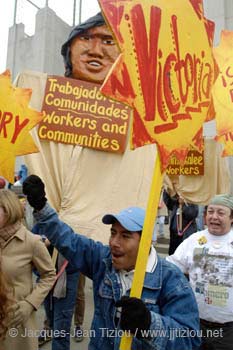
Victory to the farmworkers! Coalition of Immokalee Workers announces that Subway has signed on to the penny-per-pound pass-through agreement
Fellow workers,

The Blockheads of the world may insist that unions survive only through violence, and win only through either the intervention of the State or vigilantism against non-unionized fellow workers. Yet somehow, today, I find this message from the Coalition of Immokalee Workers — and a similar e-mail from their allies in the Student/Farmworker Alliance — a southern Florida farmworker’s union that uses nonviolent protest, secondary boycotts, and other creative pressure campaigns on behalf of Florida tomato pickers, and which (because it is a farmworkers’ union) has no access at all to the government labor relations bureaucracy. Somehow, they have survived. Somehow, they have won — again.

From: Coalition of Immokalee Workers
Date: 11:29 AM
To: announce@lists.ciw-online.org
Subject: [CIW News] SUBWAY SIGNS!

Subway, the third largest fast-food chain in the world and the biggest fast-food buyer of Florida tomatoes, reached an agreement this morning with the CIW to help improve wages and working conditions for the workers who pick their tomatoes!

Be sure to visit http://www.ciw-online.org for a photo of the signing and check back soon for more details about this exciting development in the Campaign for Fair Food.

If you are planning a protest as part of the Northeast tour, we ask you to stand down. The tour will still be hitting the road to visit Northeast with news of this newest victory and information on where the Campaign for Fair Food will head next. An updated schedule of events will be posted on the website soon.

Thanks,

The Coalition of Immokalee Workers

For those keeping track at home, here’s the timeline of C.I.W. victories in the penny-per-pound campaign:

  • April 2001: C.I.W. launches the Boycott the Bell campaign against Taco Bell, the first campaign to pressure a fast food restaurant into joining the penny-per-pound pass-through program to improve the piece rate for Florida tomato pickers.

  • March 2005 — 4 years later: The C.I.W. announces victory in the Taco Bell campaign after four years of negotiations, boycotts, protests, and, finally, a hardball campaign to enlist sympathetic student groups to Boot the Bell by pressuring their colleges and high schools to cancel or call off food-service contracts with Taco Bell. Taco Bell now becomes the first fast food provider to voluntarily pass through money to increase farmworkers’ wages. The C.I.W. announces that it will now turn its attention to getting similar agreements from other large fast-food chains like McDonald’s and Burger King.

  • April 2007 — 2 years after that: The C.I.W. announces victory with a penny-per-pound agreement from McDonald’s. It takes two years of negotiations and a low-intensity pressure campaign; just after the C.I.W. announces it is about to escalate with another Taco Bell-style boycott and Truth Tour, McDonald’s signs on for the agreement. The C.I.W. announces that it will organize its next campaign, focusing on Burger King.

  • May 2008 — 1 year after that: The C.I.W. announces victory with a penny-per-pound agreement from Burger King after a year of negotiations, some very dirty dealing by Burger King (most of which came back to haunt them when it was exposed), public protests by the C.I.W. and its allies, and national press attention from journalists who supported the C.I.W. and opposed Burger King’s union busting tactics. 13 months after the C.I.W. began its Burger King campaign, Burger King announces that it will sign on for the penny-per-pound agreement. The C.I.W. announces that it will organize campaigns to get new agreements from fast-food restaurants and grocery stores like Whole Foods, Subway, and Chipotle, which sell themselves as healthy, sustainable businesses.

  • September 2008 — 4 months after that: The C.I.W. announces victory with a penny-per-pound agreement from Whole Foods. The C.I.W. announces that it will turn its attention to escalating their campaigns to win similar agreements from Subway and Chipotle.

  • December 2008 — 3 months after that: After seven months of negotiations, and three months of a low-intensity pressure campaign (focusing on getting supporters to send postcards to Subway’s CEO), the C.I.W. announces plans to launch a multi-city protest Truth Tour in the northeast. Just before the tour begins, Subway agrees to sign on to the penny-per-pound agreement.

If the accelerating trend continues, we can expect the next C.I.W. victory to be announced some time around late January or February. (Except for Whole Foods being two months early, the time it takes for each new victory has consistently followed a geometric decay curve. That can’t last forever, but here’s hoping it holds for a while yet.) In any case, this is a big win, and it's hardly the end. The C.I.W. is still fighting to get an agreement from Chipotle, and is preparing to organize pressure campaigns for other supermarkets and food service outfits. There's a lot more yet to come.

Fellow workers, the C.I.W.’s ongoing series of inspiring victories for Florida farmworkers are both an inspiration and a reminder. We should never forget the power of creative extremism and wildcat unionism — a power that needs no government, no ballot boxes, no political bosses, no Officially Recognized labor bureaucrats, no lawyers, and no Changeling political parties. It’s the power that fellow worker Joe Ettor reminded us all of, as he and his fellow workers struggled to a hard-won victory in the great Bread and Roses textile strike of 1912, when he said:

If the workers of the world want to win, all they have to do is recognize their own solidarity. They have nothing to do but fold their arms and the world will stop. The workers are more powerful with their hands in their pockets than all the property of the capitalists. As long as the workers keep their hands in their pockets, the capitalists cannot put theirs there. With passive resistance, with the workers absolutely refusing to move, lying absolutely silent, they are more powerful than all the weapons and instruments that the other side has for attack.

Yes, we can do it–ourselves. And we will.

¡La lucha sigue–victory to the farmworkers!

See also:

Well, thank God #11: Paint It Black edition

As part of its ongoing campaign of socio-economic cleansing, the city government of Las Vegas has taken a bold step against vandalism and graffiti. The problem with graffiti, you’ll remember, is that no matter how artistic it may be, it defaces somebody’s private property without their permission. So now the city of Las Vegas will force you to paint over the graffiti, without your permission, and fine you $900 and up if you choose to leave it up on your own wall.

Well, thank God, says I. If the city government weren’t sending around a bunch of professional busybodies and armed thugs to make sure that Ted Marshall’s walls stay painted the way he wanted them painted — even if he doesn’t want to pant them that way anymore — well, who would? Not Ted Marshall, that’s for sure. Why, it’d be sheer– well, you know.

See also:

Yes, Virginia, government roads really are government subsidized, and no, they don’t approximate freed-market outcomes

When left-libertarians argue with more conventionally pro-capitalist libertarians about economics, one of the issues that often comes up is government control over roads, and the ways in which state and federal government’s control over roads has acted as a large subsidy for economic centralization and national-scale production and distribution networks (and thus, to large-scale big box retailers, like Wal-Mart or Best Buy, dependent on the crafty arrangement of large-scale cross-country shipping as a basic part of their business model). People who have a problem with this analysis sometimes try to dispute it by arguing that government roads aren’t actually subsidized — that heavy users of government roads are actually getting something that roughly approximates a freed-market outcome, because users of government roads pay for the roads they get, in proportion to how heavily they use them, because government roads are funded by gasoline taxes, tire taxes, and government-imposed licensing fees, which all go up in cost more or less proportionally to increases in use of government roads. Thus (the argument goes), funding for government roads is more like a fee-for-service transaction on a freed market than it’s like a classic case of government subsidies. But in fact, this argument is completely bogus, for at least three reasons.

The first reason is that, contrary to popular misconception, government-imposed gasoline taxes and user fees on road users do not actually fully fund the costs of government road-building and maintenance; government funding of roads actually includes a substantial subsidy extracted from taxpayers independently of their usage of the roads. Government budgets for road building and maintenance in the US draw from general funds as well as from earmarked gas taxes and user fees, and those budgets are subsidized by state, local, and federal government to the tune of about 20–70 cents per gallon of gasoline expended.

The second reason, which ought to be obvious to libertarians given how much we have talked about the use of eminent domain over the past few years, is that government road-building is substantially subsidized by the fact that government can — and routinely does — use the power of eminent domain to seize large, contiguous stretches of land for road building at arbitrarily fixed rates below what the land-owners could have demanded in a free market land sale. Even if it were the case (as it is not) that usage-based levies like gasoline taxes and government licensing fees were enough to cover the budget for government road building and maintenance, that budget has already had a massive, unmentioned government subsidy factored into it due to the use of eminent domain.

The third reason is that a freed market is able to match the supply for roads to the demand at something like the appropriate cost not only because people pay for the roads in proportion to their use of the roads, but also because the prices for road use are set by negotiations between road users and road builders in a competitive market, and because the ownership and management patterns of roads are determined by patterns of free economic decisions to buy, sell, lease, develop, abandon, reclaim, and subdivide land. Freed markets aren’t just a matter of paying for what you get (as important as that is); they also have to do with the freedom to get what you get by alternative means, and with patterns of ownership and control based on consensual negotiation rather than on force. No matter how roads are funded, there is no way to approximate freed-market results with government monopoly on sales or politically-determined allocation of ownership. (Again, this is something that ought to be obvious; it is just the socialist calculation problem applied to the market for road transportation.)

And roads funded by government-imposed gasoline taxes will always be either noncompetitive or subsidized: if there were any significant private roads competing with roads funded by government gasoline taxes, the taxes on the gasoline that drivers burn on those roads become a subsidy to the government-controlled roads. The more users use the non-government roads, the more they would be subsidizing the government roads.

Further, the ownership and management patterns of government roads are determined by electoral horse-trading and arbitrary political jurisdictions, not by free economic actors. As a result, decisions about what roads to build, how to direct funds to those roads, how to price the use of those roads, etc. are typically made by state or federal legislatures, or state or federal executive bureaus. Governments are far more responsive to political than to economic pressure; governments generally will not, or cannot, sell off roads or spin off control over local roads to the people who use them most and can best manage them; state and federal governments exercise centralized control over far larger fiefs than it would ever be possible or profitable to amass on a free market. Thus, for example, because the building and maintenance of roads in Las Vegas is controlled, not by free market actors in Las Vegas, but rather by the Nevada state government, we have Las Vegas drivers paying in 70% of the state’s gas taxes and getting back only 61% of the state’s spending on roads (which is an increase over the 2003–07 average of 53%) — meaning that we are forced to turn tens of millions of dollars over to subsidizing highway building and maintenance in the rest of Nevada. Here’s NDOT’s reasoning as to why we should get stuck with the bill:

If NDOT based its road building program strictly on usage, [NDOT assistant director of engineering Kent] Cooper said, then no new highways would be built outside of Clark County.

He noted that freeways in Las Vegas attract 150,000 to more than 200,000 vehicles a day. No other area in the state has such high use.

— Ed Vogel, Las Vegas Review-Journal (2008-11-26): Southern Nevadans get less bang for their road tax buck

Now, maybe Kent Cooper thinks that it is just and wise to force Las Vegas drivers to pay tens of millions of dollars in subsidies so that NDOT can build expensive roads that nobody wants to use.

Maybe he’s right about that, and maybe he’s wrong. But whatever the case may be, the only way to get freed market results in roads is by freeing the market. Under government ownership, government funding, and government control, roads are subsidized by taxes that are levied independently of road usage, built using a subsidy created by forced seizure of land, and users of high-volume local roads are typically forced to subsidize expensive, long-distance cross-country roads that they aren’t using. This kind of allocation of resources for long-distance, non-local highways — which further distorts an already subsidy-distorted system by distorting the flow of money within that system away from the heavily-used local roads and into the high-cost, high maintenance long-distance roads, can certainly not be called any kind of approximation of a freed market in roads.

Ridiculous Strawman Watch (Part 1 of ???)

Finance capital — possibly the single most heavily regulated market in the entire global economy, which is shaped by the dictates of literally hundreds of government central banks around the world, which is constantly carried on with a background promise of bail-outs by government agencies like the IMF, the U.S. Federal Reserve, the U.S. Department of the Treasury, the European Central Bank, etc., and which is overseen by so many different regulatory agencies that they often can’t even decide which is supposed to be regulating a particular subset of the market — is empirical proof that Financial markets have been given their freedom, and they have disgraced themselves. As my Scottish headmaster used to say [sic!], back in the 1950s, privileges that are abused will be withdrawn. The time has come to put markets back under strict controls and restrictions, such as those under which they laboured from the 1930s till the 1970s.

Also, little did I know how much cause I had to rejoice: I never realized it, but it turns out that the libertarian movement [conquered] the world at some point within the last 40 years. It’s true: I read it on the Internet.

See also:

Professional courtesy, part 2: thugs on patrol

Here’s what I said back in April about what professional courtesy means when it comes to law enforcers:

The term professional courtesy comes from the traditions of medicine: many doctors will not charge money when they treat another doctor’s immediate family. When doctors talk about professional courtesy they are talking about a very old system of mutual aid in which one doctor agrees to do a favor for another, at her own expense, for the sake of collegiality, out of concern for professional ethics (to offer doctors an alternative to having their own family as patients), and because she can count on getting similar services in return should she ever need them.

But when the Gangsters in Blue start talking about professional courtesy, they’re talking about something quite different: a favor done for a fellow gang member at no personal expense, with the bill sent to unwilling taxpayers who must pick up the tab for the roads and parking; and a favor done in order insulate the gangsters and their immediate family from any kind of ethical accountability to the unwilling victims that they sanctimoniously insist on serving and protecting. Professional courtesy in medicine means reciprocity in co-operative mutual aid in healing sick people; professional courtesy in government policing means reciprocity in a conspiracy to make sure that any cop can do just about anything she wants by way of free-riding, disruptive, dangerous or criminal treatment of innocent third parties, with complete impunity, and the rest of us will get the bill for it and a fuck you, civilian if we don’t like it.

It turns out that the Virginia State Patrol is stretched thin right now: money is tight because of the state’s economic and budgetary troubles, and — as a result — they’ve delayed a lot of new hiring and they’re having trouble getting up enough active cops for adding special agents to the Joint Terrorism Task forces, creating a Homeland Security Division and dedicating more troopers to investigate illegal firearms purchases at gun shows. (Well, good. Three cheers for the state’s budgetary troubles, if they make for a financial roadblock against ridiculous gun grabs and Stasi statism.) But now check out what the coppers at Officer.com have to say about the Virginia State Patrol in the comments:

Posted by JJS (09/24/08 – 10:41 AM)

VSP has a bad reputation for writing tickets to other officers.

How dare they? Cops deserve to be treated more considerately than everybody else when they are stopped by other cops.

Posted by People Are Sheep [sic!] in Maryland (09/24/08 – 11:19 AM)

VSP Anti-Courtesy

For years, I have heard rumors about VSP stopping and citing police officers both on and off duty. Whatever the circumstance, it is not in the professional interest (and sometimes legal interest) for ANY police officer/trooper to stop (or attempt to stop) any on duty marked police vehicle. In some states, it’s unlawful to do so … and in some states, an arrest warrant or state’s attorney consultation is required BEFORE a stop is made and charges are cited. Off duty officers/troopers should use common sense when driving. Period. On the same token, on duty officers/troopers should use common sense and professional courtesy when it appropriate. . . .

In nearly two decades as a police officer, I have stopped many, many off duty police officers for traffic violations. During those times, I have issued no tickets and made no arrests. There are alternatives to citing and arresting off duty cops: verbal warning, calling their supervisor or just assisting the officer reach their destination safely. All options are, of course, dependent upon the violation at hand.

Remember, we are all that we have out there on the street … each other. The legendary conversation between an overzealous on duty officer and the off duty officer during a traffic stop bears truth: After signing the ticket, the off duty officer says, Just remember, I could be your closest backup out here.

In other words, this sanctimonious server and protector has spent the past two decades completely abdicating his supposed professional responsibilities when they involved holding a fellow cop accountable for endangering the safety of the people he and they are supposedly hired to protect. Because he thinks it’s important never to forget that some day he may need his gang brothers to get his back.

Posted by Harry in District of Columbia (09/24/08 – 04:09 PM)

VSP Anti-Courtesy an understatement

I can in contact with a vehicle that struck a fix object at 21st and Washington Circle NW Washington, D.C. The vehicle was an unmarked VSP vehicle occuppied by 4 VSP officer. All of them had been drinking. knowing what there fate would be if I’d taken a report I had them make a call and two other off duty VSP officer responded to my location, sober, and I allow all to leave. I figured it was up to them to explain to there supervisor the damage to the unmarked cruiser. Now if they had struck another vehicle civilian driver or pedestrian there would have been a different outcome.

Shortly after that I was driving southbound on Rt.29 in Nelson County, VA at 0300hrs and was stopped by a VSP for doing 67 in a 55. I never identified myself as a police officer, probably because I had FOP licence plate, and he never inquiried, and wrote me a speeding ticket. He never spoke a word.

A month later I stoped a civilain vehicle driven by a off duty VSP trooper for a traffic violation, he immediately produced ID and I told him to that a nice day.

VSP is really short on professional courtesy.

A Texas Highway Patrol enforcer defends the honor of his crew from the allegations of a Houston cop:

Posted by TXTroop in TEXAS (09/25/08 – 11:36 AM)

VA & TX

Let me first start off by saying that RICK G in Houston is an idiot. We DO NOT get uniformed officers out of their vehicles to stand on the side of the road. If this happens in Houston it is because Houston PD officers have a habit of holding their badges out the window when they are being stopped. Very UNPROFESSIONAL. As far as our stupid cowboy hats go, even the hood is affraid of the HATS. Now that the idiots comments have been addressed, if VA Troopers are writing other officers, on or off duty shame on them! The only reason any state has a shortage of Troops is PAY. Troopers all over the Nation are reveered as the best officers in their state, they should be paid as such. Sounds like VA needs to up their pay and implement the DONT PUT COPS ON PAPER – TICKETS OR WARNING plan!!!

TXCOP in the DFW area scratches their backs and expects them to scratch his:

Posted by TXCOP in DFW AREA, Texas (09/25/08 – 11:16 PM)

Wow sounds like Rick G. got really upset. Before I moved to Texas I was a LEO in Baltimore City, Md. The only contact I had with VSP was being stopped for speeding something like 80 in 60 or something its been a few years now. But the trooper (an older older officer) made me for a cop and after showing my ID he asked me to slow down and to cut him and his friends a break next time they visit the city for a Ravens or orioles game. Now on that same trip (enroute to visit family in Texas) I was stopped about 40 miles into Texas from arkansas on I 30 by a Texas State Trooper he pulled up next to me hit the alley light and motioned to me so of course I waved at him and continued driving after a minute he motioned again so i figured he wanted me stopped so I shook my head and slowed down he then proceeded to hit the red lights and stop me and the guy in front of me. So here I am the officer stopped between both of us he came to me first and I told him I’m a Leo and have a gun so that he would not be surprised. He asked me to stay with him while he finished the other stop and then he would let me be on my way. He wrote the other guy a citation came back wrote me a warning to get his stat and then I gave him a Uniform patch and was gone.

From a Virginia sheriff’s deputy:

Posted by VA Deputy (09/26/08 – 04:58 AM)

As for professional courtesey… I have worked for a PD and a S.O. and for all you out of town guys, not everyone in VA is into writing LEO’s… professional courtesey ia alive and well in the local jurisdictions… Too many people on the outside are trying to hang us on a daily basis for no reason, we shouldn’t be hanging ourselves. As long as you don’t come out of your vehicle swinging at me, you got a pass here… Stay Safe.

That’s As long as you don’t come out of your vehicle swinging at me and you wear the same gang colors I do, of course. Those passes are not for mere civilians.

I should say that when I refer to cops as a street gang or Gangsters in Blue or what have you, I’m not indulging in metaphor. I don’t mean that cops act kinda like gangsters (as if this were just a matter of personal vices or institutional failures); I mean that they are gangsters — that is the policing system operating successfully according to its normal function — that they are the organized hired muscle of the State, and that the outfit operates just like any other street gang in terms of their commitments, their attitudes, their practices, and their idea of professional ethics. And if you wonder why, it may help to ask yourself what kind of person, and what kind of outfit, you’d need to have for this kind of talk, and this notion of professional courtesy, to make any kind of sense.

Anticopyright. All pages written 1996–2026 by Rad Geek. Feel free to reprint if you like it. This machine kills intellectual monopolists.