Rad Geek People's Daily

official state media for a secessionist republic of one

Posts filed under Smash the State

Cry havoc! and let slip the pronouns of war…

Here’s the New York Times’s report on Hordak‘s latest battle-cry:

BRUSSELS, May 11 — Vice President Dick Cheney used the deck of an American aircraft carrier just 150 miles off Iran's coast as the backdrop today to warn the country that the United States was prepared to use its naval power to keep Tehran from disrupting off oil routes or gaining nuclear weapons and dominating this region.

… Mr. Cheney's sharp warnings appeared to be part of a two-track administration campaign to push back at Iran, while leaving the door open to negotiations. It was almost exactly a year ago that the United States offered to negotiate with Iran as long as it first agreed to halt enriching uranium, a decision in which Mr. Cheney, participants said, was not a major player. Similarly, the speech today was not circulated broadly in the government before it was delivered, a senior American diplomat said. He kind of runs by his own rules, the official said.

With two carrier strike groups in the Gulf, we're sending clear messages to friends and adversaries alike, he said. We'll keep the sea lanes open. We'll stand with our friends in opposing extremism and strategic threats. We'll disrupt attacks on our own forces. We'll continue bringing relief to those who suffer, and delivering justice to the enemies of freedom. And we'll stand with others to prevent Iran from gaining nuclear weapons and dominating this region.

I want you to know that the American people will not support a policy of retreat, Mr. Cheney said. We want to complete the mission, we want to get it done right, and then we want to return home with honor.

— David E. Sanger, New York Times (2006-05-11): On Carrier in Gulf, Cheney Warns Iran

According to the story, after Dick Cheney completes his Middle East mission of sending clear messages, he will return home, sometime next week. No word yet on when American soldiers will complete their mission of opposing, disrupting, relieving, delivering military justice, occupying, keeping the sea lanes open, etc., or when he and his buddies will allow them to return home. Nor is there any word yet on when he and his buddies will stop forcing the American people, i.e. the rest of us, to foot the bill for his plans against our will.

Further reading:

May Day 2007

We Have Fed You All for a Thousand Years

We have fed you all for a thousand years,
And you hail us still unfed,
Though there’s never a dollar of all your wealth
But marks the workers dead.
We have yielded our best to give you rest,
And you lie on crimson wool;
But if blood be the price of all your wealth
Good God we have paid in full.

There is never a mine blown skyward now
But we’re buried alive for you;
There’s never a wreck drifts shoreward now
But we are its ghastly crew.
Go and reckon our dead by the forges red,
And the factories where we spin;
If blood be the price of your cursèd wealth
Good God we have paid it in.

We have fed you all for a thousand years–
For that was our doom, you know,
From the days when you chained us in your fields
To the strike a week ago.
You have taken our lives, and our husbands and wives,
And called it your legal share;
But if blood be the price of your lawful wealth
Good God we bought it fair.

–First printed by the Industrial Workers of the World in 1908. Words by an anonymous proletarian, tune by Rudolph von Leibich

Fellow workers:

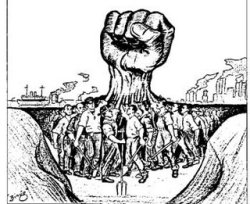
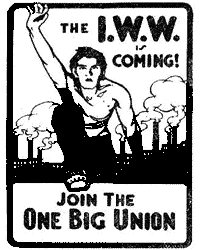
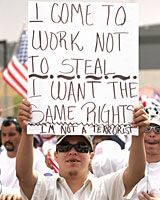
Today is May Day, or International Workers Day, a holiday created by Chicago workers–most of them anarchists–to honor the memory of the Haymarket martyrs and to celebrate the struggle of workers for freedom, a better life, and determination of the conditions of their own labor. It’s also the second annual day of strikes and marches for immigrant workers’ rights. May Day is and ought to be a day of resistance against the arrogance and power of the plutocrats. A day to celebrate workers’ struggles for dignity, and for freedom, through organizing in their own self-interest, through agitating and exhorting for solidarity, and through free acts of worker-led direct action to achieve their goals, marching under the banners of We are all leaders here and Dump the bosses off your back . A day to cheer immigrant workers struggling for their own freedom, in defiance of the attempts by La Migra and freelance nativist bullies to silence and intimidate them, marching under the banners We are not criminals, and We are not going anywhere. A day to remember:

There Is Power In A Union

There is power, there is power,
In a band of working folk,
When we stand
Hand in hand.

–Joe Hill (1913)

In honor of the day, it’s a pleasure to recommend some reading from anti-state radicals–from a history of May Day’s American roots at The Agitator (Lauritz, not Balko), to Kevin Carson’s Organized Capital vs. Organized Labor, to Sheldon Richman’s column Labor’s Right to a Free Market. And I’d especially like to recommend Kevin’s simply brilliant earlier column, The Ethics of Labor Struggle: A Free Market Perspective. Kevin’s and Sheldon’s columns do an especially good job of showing the gulf between the managerial style of establishmentarian business unionism–so familiar to us in these the waning days of Babylon, with Wagner and Taft-Hartley carefully arranged to bring the established unions into the web of State privilege and State regulation–with the older, state-free tradition of wildcat unionism that May Day celebrates. Here’s Kevin Carson:

First of all, when the strike was chosen as a weapon, it relied more on the threat of imposing costs on the employer than on the forcible exclusion of scabs. You wouldn’t think it so hard for the Misoids to understand that the replacement of a major portion of the workforce, especially when the supply of replacement workers is limited by moral sympathy with the strike, might entail considerable transaction costs and disruption of production. The idiosyncratic knowledge of the existing workforce, the time and cost of bringing replacement workers to an equivalent level of productivity, and the damage short-term disruption of production may do to customer relations, together constitute a rent that invests the threat of walking out with a considerable deterrent value. And the cost and disruption is greatly intensified when the strike is backed by sympathy strikes at other stages of production. Wagner and Taft-Hartley greatly reduced the effectiveness of strikes at individual plants by transforming them into declared wars fought by Queensbury rules, and likewise reduced their effectiveness by prohibiting the coordination of actions across multiple plants or industries. Taft-Hartley’s cooling off periods, in addition, gave employers time to prepare ahead of time for such disruptions and greatly reduced the informational rents embodied in the training of the existing workforce. Were not such restrictions in place, today’s “just-in-time” economy would likely be far more vulnerable to such disruption than that of the 1930s.

More importantly, though, unionism was historically less about strikes or excluding non-union workers from the workplace than about what workers did inside the workplace to strengthen their bargaining power against the boss.

The Wagner Act, along with the rest of the corporate liberal legal regime, had as its central goal the redirection of labor resistance away from the successful asymmetric warfare model, toward a formalized, bureaucratic system centered on labor contracts enforced by the state and the union hierarchies.

It’s time to take up Sweeney’s half-hearted suggestion, not just as a throwaway line, but as a challenge to the bosses. We’ll gladly forego legal protections against punitive firing of union organizers, and federal certification of unions, if you’ll forego the court injunctions and cooling-off periods and arbitration. We’ll leave you free to fire organizers at will, to bring back the yellow dog contract, if you leave us free to engage in sympathy and boycott strikes all the way up and down the production chain, boycott retailers, and strike against the hauling of scab cargo, etc., effectively turning every strike into a general strike. We give up Wagner (such as it is), and you give up Taft-Hartley and the Railway Labor Relations Act. And then we’ll mop the floor with your ass.

— Kevin Carson, The Ethics of Labor Struggle: A Free Market Perspective

That’s just a sampling. You really must read the whole thing.


Meanwhile, in the news, some creep in Washington is wandering around proclaiming Loyalty Day and demanding our renewed allegiance; and while the punch-drunk official unions are begging the government for more favors, the captains of industry are begging the government to keep a tight leash on free association. But the most significant events for labor and for human freedom are happening beyond the noise and spectacle of that gladiatorial arena, in the streets of cities all over the country where workers demand their rights in defiance of the so-called immigration law, and in unrecognized, grassroots unions organized along syndicalist lines, where workers have won concrete gains from the biggest corporations in their industry by operating through the use of creative secondary boycotts. There is a lesson here–a lesson for workers, for organizers, for agitators, and anti-statists. One we’d do well to remember when confronted by any of the bosses–whether corporate bosses or political, the labor fakirs and the authoritarian thugs styling themselves the vanguard of the working class, the regulators and the deporters and the patronizing friends of labor all:

Dump the Bosses Off Your Back

Are you cold, forelorn, and hungry?
Are there lots of things you lack?
Is your life made up of misery?
Then dump the bosses off your back!

–John Brill (1916)

Further reading:

Over My Shoulder #34: on parenting a free and autonomous child, from Harry Browne, How I Found Freedom in an Unfree World

Here’s the rules:

  1. Pick a quote of one or more paragraphs from something you’ve read, in print, over the course of the past week. (It should be something you’ve actually read, and not something that you’ve read a page of just in order to be able to post your favorite quote.)

  2. Avoid commentary above and beyond a couple sentences, more as context-setting or a sort of caption for the text than as a discussion.

  3. Quoting a passage doesn’t entail endorsement of what’s said in it. You may agree or you may not. Whether you do isn’t really the point of the exercise anyway.

Here’s the quote. This is from chapter 21 of Harry Browne’s How I Found Freedom in an Unfree World (1973).

Raising the Child

As early as possible, it’s valuable to establish relationships with your child that are similar to the relationship you have with your lover.

The child should have his own world where he is clearly the sovereign. That means a room of his own that is subject to his control alone. If he doesn’t take care of it, he’ll learn the consequences of that sooner or later. But if he’s forced to keep it as his parents wish, he’ll never discover for himself the consequences of alternative courses of action.

He should also have other property to use in whatever way he chooses. Property isn’t owned if it can be used only in approved ways.

You’ll have to decide how he’ll obtain his property. He can earn it, receive an allowance, get outright gifts, or he can receive property in any combination of these ways.

But once he receives something, it’s important that he learn to understand what it means to own something and be responsible for its preservation. He shouldn’t be taught to expect automatic replacement of any of his property that he might destroy.

The importance of his sense of ownership can be seen by observing the difficulties many adults have in dealing with the world. For close to two decades, most people are led to believe that they aren’t sovereign.

Then, suddenly, they’re thrust out into the world, and expected to make far-reaching decisions concerning their lives. It’s no wonder that they have difficulty foreseeing the consequences of their actions and fall back on any authority that appears to be competent to make decisions for them.

I believe the child will be far better equipped to face the world if he understands how the world operates right from the beginning. He can easily learn what it means to make decisions and to experience the consequences of his decisions.

This means, too, that he should be helped to understand that you have your property, also. Show him which areas are off limits to him or require permission before he can use them. Even the dining table he eats on will belong to someone; part of his arrangement with the owner can include table privileges.

Obviously, a two-year-old child won’t have an explicit understanding of these matters. But there are two ways that he can understand them at the earliest possible age. One is that he can learn by example if the entire family operates in this way.

The second way is by never being taught otherwise. For some reason, many parents seem to think it important to change systems at some point in a child’s age. They first teach him he has no authority over his life, and then try later to instill a sense of responsibility in him. In the same way, they first want him to believe that Santa Claus loves and rewards him and then later want him to understand that it’s the parents who love him. I think it would make a considerable difference if the child were never taught anything that you intend to reverse later.

It’s important that each of the three of you be a separate human being with his own life, his own interests, and his own property. None of you is living for the benefit of the others; rather, each should be there because he wants to be. And each will want to be there if it’s a setting where he can live a meaningful life of his own choosing.

It obviously isn’t necessary that each member of the family own his own washing machine, stove, and living-room furniture; nor is it necessary for permission to be requested every time a non-owner wants to use something. Various things can be made available to other members of the household on a till further notice basis. But the ultimate ownership should never be in doubt.

If these principles don’t seem attractive to you, it may be because you’ve never been married. You may never have seen the hundreds of insignificant joint decisions that preoccupy most married people.

I’ve never known a family who used these principles who didn’t find them a great relief and advantage over normal ways of handling such matters.

A Sovereign Child

If you want your child to understand that he lives in a world in which his future will be of his own making, encourage that by letting him deal directly with the world as much as possible. Let him experience the consequences of his own actions.

Naturally, you don’t intend to let him discover first hand a very dangerous consequence of something he wants to do. But it’s important to deciade in advance where you will draw the line. How far will you let him go in making his own decisions? Don’t leave it to decide each time the matter arises. Have a clearly defined policy in advance that will prevent inconsistencies.

Be available to let him know your opinions–without implying that your opinions are binding on him. Let him think of you as a wiser, more experienced person–but not as a moral authority who stands in the way of his living his own life.

Be a source of information and opinion concerning the consequences of acts. Let him learn that the nature of the world he lives in (not the attitudes of people bigger and smarter than he is) sets the limits on what he can and cannot do in the world.

If you recognize him as an individual who is allowed to learn for himself, a genuine friendship can develop between you. He’ll be willing to talk to you about his ideas, plans, and problems–because he won’t have to fear the moral retribution that most parents inflict when they disagree with their children’s ideas and actions.

Parents who fear letting their children make decisions fail to realize that their children do make decisions on their own. You can’t possibly control all your child’s actions. So the best security you can have comes from two conditions: (1) allowing the child to learn as early as possible that his actions have consequences to him; and (2) developing a friendship that will make it possible for him to come to you when he needs help.

If either of these conditions is missing, you shouldn’t be surprised if you find out about crises only after they’ve happened. A child who knows that acts have consequences and who knows that he has a wise friend will be more likely to consult his friend before risking something dangerous.

Love and understanding are important to a child. And you’ll show your love more by respecting his individuality and appreciating him for what he is, not for what you force him to be.

–Harry Browne (1973), How I Found Freedom in an Unfree World, pp. 240–243

Refuge of Oppression #2

Here’s a recent correspondence from a friend of human greatness, apparently in response to my celebrations of Tyrannicide Day on the Ides of March. Here’s what he has to say on behalf of the man who publicly boasted of killing or enslaving one third of the population of Gaul:

From: Paul
Date: 9 April 2007 4:44 AM
Subject: How dare you…

(((This message was submitted by Paul [e-mail address redacted] using the online contact form)))

Just who do you think you are, berating such a man as Caesar? Caesar was a man greater than any of us could ever hope to be, and the anniversary of his murder is a date to be mourned, not celebrated. Of course, most people are so blinded by Shakespeare’s interpretation of Caesar that they can’t even see his greatness. Caesar fought for Rome, and only for Rome; he was kind to those that surrendered, forceful to those that resisted, and vengeful to those that betrayed. What do you expect? Do you expect anyone to simply sit back at swallow betrayal after betrayal with no retaliation? Do you expect anyone of that time to allow Rome’s enemies to threaten Rome and her protected peoples? Do you expect anyone to stand quietly while he is stripped of the power he earned? Pompey and the Senate, despite Caesar’s numerous efforts for peace, forced his hand by not allowing him, a man who had done so much for Rome, to even return to the city. I would have done no differently, and anyone who would has no self-respect and is a doormat. Caesar, in all his greatness, fit neither of these criteria and fought to defend his rights and to secure that which was due him.

Oh, and while I’m at it, I suppose I’ll mention that the Crimean War was a defensive war on Russia’s part; Britain and France landed their troops on the Crimean Peninsula, Russian territory, and Alexander simply tried to fend them off. Czar Alexander may not have been the greatest leader, but don’t bust him on the Crimean War.

–Paul

I would like to say that I am very sorry to the absolutist emperors and military dictators-for-life of the world for any unfair berating that I may have directed against them in the course of my infamous scribbling against my betters. I wouldn’t want anyone to think that I am blinded against the greatness of those who so clearly excel at slaughtering, terrorizing, and dominating their fellow human beings.

Paul asked several questions in the course of his message. The answers to them, as I see it, are, in order: abdication, it depends on what you mean, yes, and I most certainly do.

Further reading:

¡Sí se puede! The CIW wins a groundbreaking wages and conditions agreement with McDonald’s

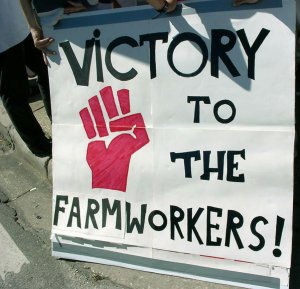
Victory to the Farm-Workers!

The Coalition of Immokalee Workers has scored another major victory in their ongoing campaign to improve wages and conditions for Florida tomato-pickers.

McDonald’s USA, the largest fast-food burger business in the nation, Monday reached agreement with a Florida farmworkers organization to pay about 75 percent more for the tomatoes it buys from state farms.

According to McDonald’s and the Coalition for Immokalee Workers, which waged a two-year campaign for the increase, laborers who now receive 40 to 45 cents for a 32-pound bucket of tomatoes will earn about 72 to 77 cents for that measure, a 1 cent per pound increase.

The company said the hike would not cause it to raise its prices at the counter.

The workers coalition said the agreement would affect between 1,000 to 1,500 workers who labor for several Florida tomato growers. It is the second major victory for the farmworkers – similar to a pact reached in 2005 with Yum! Brands, the owner of Taco Bell and other fast food chains. That agreement, according to the coalition, affected about 1,000 workers

This is a very good day for us, Julia Perkins, a spokeswoman for the coalition, said Monday. What it represents is a glimmer of hope that things can change across the country, with Burger King, Wal-Mart and Subway too.

Those chains also are large buyers of tomatoes, and the coalition is pressing them to raise payments to tomato pickers. The farmworker organization announced that the next company it will target for higher wages for pickers is the arch rival of McDonald’s, Miami-based Burger King.

Lucas Benitez, leader of the farmworkers coalition, was participating in a protest caravan heading for the corporate headquarters of McDonald’s in Oak Brook, Ill., near Chicago, to stage demonstrations when the agreement was reached. He said he would continue the caravan.

When we get up there to Chicago we will announce the good news of the agreement with McDonald’s, he said.

Farmworkers are some of the lowest paid workers in the country. According to Perkins, before the Taco Bell agreement, wages for tomato pickers had hardly moved in 25 years.

Taco Bell, which resisted the coalition demands for about four years, was the object of a nationwide boycott until it reached its agreement. During the boycott, several universities ordered Taco Bell franchises on their campuses to close their doors.

No boycott had been called yet against McDonald’s. Perkins said the campaign had included some picketing outside McDonald’s franchises, a letter-writing effort and meetings on university campuses and at churches. But she made it clear that the campaign had been heading toward a possible boycott.

Yes, it was looking like the campaign was going to get more aggressive, she said.

Perkins said the details of the agreement had not been completed, but she expected it to work much like the Taco Bell pact. She said that Taco Bell pays the extra penny per pound directly to the workers, who receive a separate, second check — a bonus check — for those Taco Bell tomatoes.

She said the increase did not represent a 75 percent increase in total wages for pickers because many of the tomatoes they pick are destined for other buyers who have not agreed to the increase.

But it can make a difference of 15, 30 or even 100 dollars per week for some workers depending on how many of the tomatoes are heading for McDonald’s, she said.

Benitez said the McDonald’s pact, like the Taco Bell agreement, will ensure that all workers picking McDonald’s tomatoes also will have their human rights and civil rights respected and that a system for protesting workplace violations will be instituted between the coalition and McDonald’s.

Benitez identified three growers the pact would affect: Six L’s of Immokalee and Pacific Tomato and Taylor & Fulton, both of Palmetto.

— John Lantigua, Palm Beach Post (2007-04-10): McDonald’s agrees to increase pay for workers who harvest its tomatoes

The CIW isn’t done yet. Taco Bell held out for four years of a long and bitter struggle; the CIW won with McDonald’s after two years of low-intensity pressure that was about to be stepped up into a major campaign. They have already begun to organize their next campaign — to bring Burger King into a similar agreement — and every victory that they win will make the next one faster and easier than the last.

While establishmentarian unions in the AFL-CIO and Change to Win [sic] are fighting (punch-drunk) for their very survival, and begging the political class for yet more government protections, the CIW has won agreements with two of the biggest corporations in their industry — first Yum Brands (owners of Taco Bell) and now McDonald’s — with no government privileges to wield and with members speaking several different languages, organizing across barriers of culture and nationality, amongst workers who are constantly moving and who are amongst the poorest and most exploited workers in the United States. But they’ve won precisely because they aren’t restrained by the smothering patronage of government-approved labor relations: without government recognition, there are no government strings attached, and that has allowed the CIW to make use of fight-to-win tactics — such as secondary boycotts — that are simply illegal for NLRB-recognized unions to use. This win is, in other words, another inspiring example of the real power of wildcat unionism and creative extremism.

Fellow workers, you have both my congratulations and my thanks. Yes, we can do it–ourselves. And we will.

Further reading:

Anticopyright. All pages written 1996–2025 by Rad Geek. Feel free to reprint if you like it. This machine kills intellectual monopolists.