Rad Geek People's Daily

official state media for a secessionist republic of one

Posts filed under Smash the State

You get the general idea

Quick anarchist history quiz. Who said this?

I have proved … that commerce, independently of the service rendered by the material fact of transportation, is in itself a direct spur to consumption, and therefore a cause of further production, a principle of the creation of values.

At first this may seem paradoxical, but it has been demonstrated by economic analysis: the metaphysical act of exchange, in addition to labor, but by a different method from labor, is a producer of real value and of wealth. Furthermore, this assertion will astonish nobody who reflects that production or creation signifies only change of form, and that therefore creative forces, labor itself, are immaterial. So that the merchant who has enriched himself by real speculation, without usurious profit, enjoys the fortune which he has acquired by a perfectly just title: his fortune is as legitimate as that which labor has produced. And pagan antiquity, as well as the Church, has unjustly aspersed commerce, upon the pretext that its rewards were not the remuneration of real services. Once again, Exchange, an entirely immaterial operation, which is accomplished by the reciprocal consent of the parties, cost and distance of transportation being allowed for, is not merely a transposition or substitution, it is also a creation.

Commerce, then, being in itself a producer of wealth, men have engaged in it with ardor in all ages; no need for the legislator to preach its advantages and to recommend the practice of it. Let us suppose, what is not an absolutely absurd supposition, that commerce did not exist, that with our vast means of industrial execution, we had no idea of exchange: it is easy to see that if some one should come to teach men to exchange their products and trade among themselves, he would be rendering them an immense service. The history of humanity mentions no revolutionary who could compare with such an one. The remarkable men who invented the plough, the vine, wheat, did not rank above him who first invented commerce.

… Do you have it yet? If not, here’s another clue. It’s the same author who said this, later in the same work:

You say that you will make but few laws; that you will make them simple and good. That is indeed an admission. The Government is indeed culpable, if it avows thus its faults. No doubt the Government will have engraved on the front of the legislative hall, for the instruction of the legislator and the edification of the people, this Latin verse, which a priest of Boulogne had written over the door to his cellar, as a warning to his Bacchic zeal:

Pastor, ne noceant, bibe pauca sed optima vina. [Pastor, for your health, drink but little wine, but of the best.]

Few laws! Excellent laws! It is impossible. Must not the Government regulate all interests, and judge all disputes; and are not interests, by the nature of society, innumerable; are not relations infinitely variable and changeable? How then is it possible to make few laws? How can they be simple? How can the best law be anything but detestable?

You talk of simplification. But if you can simplify in one point, you can simplify in all. Instead of a million laws, a single law will suffice. What shall this law be? Do not to others what you would not they should do to you: do to others as you would they should do to you. That is the law and the prophets.

But it is evident that this is not a law; it is the elementary formula of justice, the rule of all transactions. Legislative simplification then leads us to the idea of contract, and consequently to the denial of authority. In fact, if there is but a single law, if it solves all the contradictions of society, if it is admitted and acceptedby everybody, it is sufficient for the social contract. In promulgating it you announce the end of government. What prevents you then from making this simplification at once?

One more clue? Later in the same work, the same author wrote:

To be GOVERNED is to be kept in sight, inspected, spied upon, directed, law-driven, numbered, enrolled, indoctrinated, preached at, controlled, estimated, valued, censured, commanded, by creatures who have neither the right, nor the wisdom, nor the virtue to do so…. To be GOVERNED is to be at every operation, at every transaction, noted, registered, enrolled, taxed, stamped, measured, numbered, assessed, licensed, authorized, admonished, forbidden, reformed, corrected, punished. It is, under the pretext of public utility, and in the name of the general interest, to be placed under contribution, trained, ransomed, exploited, monopolized, extorted, squeezed, mystified, robbed; then, at the slightest resistance, the first word of complaint, to be repressed, fined, despised, harassed, tracked, abused, clubbed, disarmed, choked, imprisoned, judged, condemned, shot, deported, sacrificed, sold, betrayed; and, to crown all, mocked, ridiculed, outraged, dishonored. That is government; that is its justice; that is its morality. And to think that there are democrats among us who pretend that there is any good in government; Socialists who support this ignominy, in the name of Liberty, Equality, and Fraternity; proletarians who proclaim their candidacy for the Presidency of the Republic!

The author is Pierre-Joseph Proudhon (1809–1865), the French mutualist and revolutionary socialist, and the first political theorist to describe himself as an Anarchist. The work is his 1851 treatise, General Idea of the Revolution in the Nineteenth Century (as translated by John Beverly Robinson in 1923), in which Proudhon argued that the abolition of all coercive government and the emergence of a decentralized, mutualist economic order were the tacit principles underlying the French Revolution. The completion of the Revolution in the nineteenth century would mean an explicit struggle for these principles and an end to the half-way measures of constitutionalism, liberal republicanism, and representative government: the point was not to constrain authority, or put it under the control of the majority, but rather to end it.

From both an anarchist standpoint and a feminist standpoint, it’s an interesting and maddening work — like a strobe light alternating flashes of brilliance with utter darkness from one section to the next, and sometimes from one sentence to the next. But in any case, it’s interesting, and if you can avoid cognitive seizures, it’s well worth a careful reading.

The reason that I mention all this — other than the interest of the quotations themselves — is that (as Roderick was vexed to find out a couple months ago), you couldn’t find General Idea of the Revolution online for love or money. Until now: I’m pleased to announce that a complete online edition of General Idea of the Revolution in the Nineteenth Century, in Robinson’s English translation, is now available at the Fair Use Repository. (In case you’re wondering, you can find the first quotation in the Third Study, ¶Â¶ 37–39, the second in the Fourth Study, § 2.2 ¶Â¶ 6–10, and the final quotation in the Epilogue, ¶ 39.)

Read, and enjoy!
Moral standards

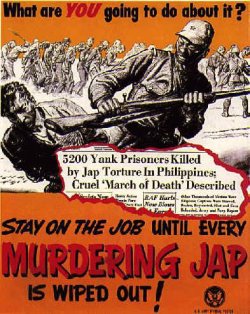
Here’s part of a recent reply to my post on the use of the phrase moral relativism. The original post discussed a controversy over whether or not Harry Truman should be called a terrorist for knowingly and willingly slaughtering civilians — orders of magnitude more civilians than Osama bin Laden (et al.) slaughtered in the attack on the World Trade Center — for the sake of military and political strategy. Here’s how Jamie DeVries tried to make the case that we cannot draw any moral parallels between the two figures:

Here is the question we ought to ask ourselves: )Did Truman have the ability and power to incinerate each and every Japanese citizen, even after a surrender was declared? The answer is: yes. Did he or the U.S have the WILL to do so? The answer: of course not.

Well, that was mighty white of him.

In all seriousness, how much lower could the bar possibly be set for rulers of the Allied governments in World War II? Is there absolutely any atrocity in the name of unconditional surrender that the Court Intellectuals and their countless acolytes would not rush to defend, or at least to excuse? I wish this were merely a bit of pointed rhetoric. But actually I’m asking it as a serious, open question.

Further reading:

International Ignore the Constitution Day festivities

Today is the 219th annual International Ignore the Constitution Day.

Here’s William Lloyd Garrison, in The Liberator, on December 29, 1832:

There is much declamation about the sacredness of the compact which was formed between the free and slave states, on the adoption of the Constitution. A sacred compact, forsooth! We pronounce it the most bloody and heaven-daring arrangement ever made by men for the continuance and protection of a system of the most atrocious villany ever exhibited on earth. Yes—we recognize the compact, but with feelings of shame and indignation, and it will be held in everlasting infamy by the friends of justice and humanity throughout the world. It was a compact formed at the sacrifice of the bodies and souls of millions of our race, for the sake of achieving a political object—an unblushing and monstrous coalition to do evil that good might come. Such a compact was, in the nature of things and according to the law of God, null and void from the beginning. No body of men ever had the right to guarantee the holding of human beings in bondage. Who or what were the framers of our government, that they should dare confirm and authorise such high-handed villany—such flagrant robbery of the inalienable rights of man—such a glaring violation of all the precepts and injunctions of the gospel—such a savage war upon a sixth part of our whole population?—They were men, like ourselves—as fallible, as sinful, as weak, as ourselves. By the infamous bargain which they made between themselves, they virtually dethroned the Most High God, and trampled beneath their feet their own solemn and heaven-attested Declaration, that all men are created equal, and endowed by their Creator with certain inalienable rights—among which are life, liberty, and the pursuit of happiness. They had no lawful power to bind themselves, or their posterity, for one hour—for one moment—by such an unholy alliance. It was not valid then—it is not valid now. Still they persisted in maintaining it—and still do their successors, the people of Massachussetts, of New-England, and of the twelve free States, persist in maintaining it. A sacred compact! A sacred compact! What, then, is wicked and ignominious?

… It is said that if you agitate this question, you will divide the Union. Believe it not; but should disunion follow, the fault will not be yours. You must perform your duty, faithfully, fearlessly and promptly, and leave the consequences to God: that duty clearly is, to cease from giving countenance and protection to southern kidnappers. Let them separate, if they can muster courage enough—and the liberation of their slaves is certain. Be assured that slavery will very speedily destroy this Union, if it be left alone; but even if the Union can be preserved by treading upon the necks, spilling the blood, and destroying the souls of millions of your race, we say it is not worth a price like this, and that it is in the highest degree criminal for you to continue the present compact. Let the pillars thereof fall—let the superstructure crumble into dust—if it must be upheld by robbery and oppression.

— William Lloyd Garrison, The Liberator (1832-12-29): On the Constitution and the Union

Here’s Lysander Spooner, in No Treason (1867-1870):

The practical difficulty with our government has been, that most of those who have administered it, have taken it for granted that the Constitution, as it is written, was a thing of no importance; that it neither said what it meant, nor meant what it said; that it was gotten up by swindlers, (as many of its authors doubtless were,) who said a great many good things, which they did not mean, and meant a great many bad things, which they dared not say; that these men, under the false pretence of a government resting on the consent of the whole people, designed to entrap them into a government of a part; who should be powerful and fraudulent enough to cheat the weaker portion out of all the good things that were said, but not meant, and subject them to all the bad things that were meant, but not said. And most of those who have administered the government, have assumed that all these swindling intentions were to be carried into effect, in the place of the written Constitution. Of all these swindles, the treason swindle is the most flagitious. It is the most flagitious, because it is equally flagitious, in principle, with any; and it includes all the others. It is the instrumentality by which all the others are mode effective. A government that can at pleasure accuse, shoot, and hang men, as traitors, for the one general offence of refusing to surrender themselves and their property unreservedly to its arbitrary will, can practice any and all special and particular oppressions it pleases.

The result — and a natural one — has been that we have had governments, State and national, devoted to nearly every grade and species of crime that governments have ever practised upon their victims; and these crimes have culminated in a war that has cost a million of lives; a war carried on, upon one side, for chattel slavery, and on the other for political slavery; upon neither for liberty, justice, or truth. And these crimes have been committed, and this war waged, by men, and the descendants of men, who, less than a hundred years ago, said that all men were equal, and could owe neither service to individuals, nor allegiance to governments, except with their own consent.

… Inasmuch as the Constitution was never signed, nor agreed to, by anybody, as a contract, and therefore never bound anybody, and is now binding upon nobody; and is, moreover, such an one as no people can ever hereafter be expected to consent to, except as they may be forced to do so at the point of the bayonet, it is perhaps of no importance what its true legal meaning, as a contract, is. Nevertheless, the writer thinks it proper to say that, in his opinion, the Constitution is no such instrument as it has generally been assumed to be; but that by false interpretations, and naked usurpations, the government has been made in practice a very widely, and almost wholly, different thing from what the Constitution itself purports to authorize. He has heretofore written much, and could write much more, to prove that such is the truth. But whether the Constitution really be one thing, or another, this much is certain — that it has either authorized such a government as we have had, or has been powerless to prevent it. In either case, it is unfit to exist.

–Lysander Spooner, No Treason No. 2 and No. 6

Here’s me, from last year’s celebration in the Rad Geek People’s Daily:

You, too, can celebrate Ignore the Constitution Day! Today, completely ignore all claims to authority granted in the Constitution. Live your life as if the Constitution had no more claim on you than the decrees of Emperor Norton. Enjoy your rights under natural law; you have them whether or not the Constitution says one mumbling word for them. While you’re at it, treat the Constitution as completely irrelevant in political arguments too; instead of complaining that unbridled war powers for the President are unconstitutional, for example, complain that they are evil; instead of reciting that damn Davy Crocket bed-time story again and complaining that government-controlled disaster relief is unconstitutional, complain that government-controlled disaster relief is foolish and deadly. (If the Constitution clearly authorized unilateral war powers for the President, or abusive and incompetant government-controlled disaster relief, would that make it okay?) And, hell, while you’re at it, quit complaining that forced Constitution Day celebrations may be unconstitutional; complain instead that they force children to participate in cultish praise for the written record of a naked usurpation.

Just go ahead. Ignore the Constitution for a day. See what happens. Who’s it gonna hurt? And if your political reasoning becomes sharper, your discourse no longer bogs down in a bunch of pseudo-legal mummeries, and you have a pleasant day without having to ask anybody’s permission for it, then I suggest you continue the celebration, tomorrow, and every day thereafter.

— GT 2005-09-17: International Ignore the Constitution Day

I think that legalism is an insidious error that liberals and libertarians alike are all too prone to fall into. In fact the rule of law is something to be hoped for only insofar as the laws are just: rigorously enforcing a wicked law–even if that law is duly published and generally formulated–is just relentlessness, not virtue. And in our bloodstained age it is as obvious as anything that many laws are very far from being just. But one way of trying to accomodate this point, while entirely missing it, is to throw your weight behind some Super-Duper Law that is supposed to condemn the little-bitty laws that you consider unjustifiable. Besides taking the focus away from creative extremism and direct action, and leaving power in the hands of government-appointed conspiracies of old white dudes in black robes, this strategy also amounts to little more than a stinking red herring. It diverts the inquiry from the obvious injustices of a State that systematically robs, swindles, extorts, censors, proscribes, beats, cuffs, jails, exiles, murders, bombs, burns, starves countless innocent people in the name of its compelling State interests, and puts the focus the powers that are or are not delegated to the government by another damn written law. As if the contents of that law had any more right to preempt considerations of justice than the subordinate laws supposedly enacted under its authority. Those who have spent their days trying to find a lost Constitution under the sofa cushions are engaged in a massive, sophisticated, intricately argued irrelevancy. I’d compare it to debating how many angels can dance on the head of a pin, but that would be grossly unfair–to Scholastic metaphysicians.

Further reading:

… but the streets belong to the people!

Here is the latest communiqué from United for Peace and Justice. This will be interesting ….

From: UFPJ Action Alerts
To: Charles Johnson
Date: September 14, 2006 5:39 PM

Please forward as widely as possible!

On Tuesday, Sept. 19, President Bush will be speaking at the United Nations as part of an election-year public-relations push on his disastrous Iraq War.

The New York City Police Department has refused to grant a permit to United for Peace and Justice to march anywhere near the United Nations. ]Based on feedback from our member groups and supporters][1], we have come to a decision: We are marching anyway. Permit or no permit, we will stand up against this immoral war and for our right to dissent.

While the Bush Administration has pursued its belligerent policy of preemptive war abroad, attacking a country that posed no danger to us, our Constitutional rights have been steadily eroded here at home, with peaceful protesters treated as security threats. In New York City, the NYPD and other agencies have systematically declared one location after another off-limits to protest — no rallies in most of Central Park, no marches on Fifth Avenue, no pickets in Times Square, and so on endlessly.

We know there are serious security issues to consider when the president and other heads of state are in town. But those needs must be balanced against protecting the right to assemble, the right to protest, and the right to dissent. The NYPD said no to every alternative we put on the table and simply refused to give us a permit for a reasonable location for our march next Tuesday.

Enough is enough. We are marching — marching to demand that the troops come home now, and to assert our right to peaceful protest. Marching without a permit amounts to nonviolent civil disobedience, and those of us who participate in the march on Tuesday will place ourselves at risk of arrest.

We also know and respect the fact that many people cannot participate in an activity that does not have a permit. And so we are seeking a permit for a rally starting at 8:30 a.m. in Herald Square, one of the busiest locations in Manhattan. This will enable anyone who wishes to protest the war and the restriction of our civil liberties to join us without risking arrest.

There are important details to work out, but this we know for certain: we will not be silenced, we will call for an immediate end to the war in Iraq, and we will be on the streets of New York City on Tuesday, September 19th!

WE NEED YOUR HELP:

  1. Please share this email message as widely as possible. Help make sure that everyone knows about the rally and march on Sept. 19th and the denial of our request for a march permit.

  2. Especially if you are in the NYC area, make plans now to join us next Tuesday morning. If you would like to participate in the march, please take a moment to call our office at 212-868-5545 so we can give you information about nonviolence trainings. We would rather take this risk than allow our rights to be undermined.

  3. Check the UFPJ website for updates on the details for Sept. 19th, including the exact time and location of the rally and the plans for the march. If you are looking for or would like to offer a ride to NYC, please visit our ride board.

  4. And, of course, all of this work takes money. Whether or not you are able to participate in person on Tuesday, you can show your support by making a financial donation today! Make an online contribution, call our office at 212-868-5545 to make a credit card donation over the phone, or send a check or money order to UFPJ, P.O. Box 607, Times Square Station, NY NY 10108.

One man’s reductio

Here’s widely-published, reportedly libertarian columnist Walter Williams on the need for political will in the War on Terror:

Does the United States have the power to eliminate terrorists and the states that support them? In terms of capacity, as opposed to will, the answer is a clear yes.

Think about it. Currently, the U.S. has an arsenal of 18 Ohio class submarines. Just one submarine is loaded with 24 Trident nuclear missiles. Each Trident missile has eight nuclear warheads capable of being independently targeted. That means the U.S. alone has the capacity to wipe out Iran, Syria or any other state that supports terrorist groups or engages in terrorism — without risking the life of a single soldier.

Terrorist supporters know we have this capacity, but because of worldwide public opinion, which often appears to be on their side, coupled with our weak will, we’ll never use it. Today’s Americans are vastly different from those of my generation who fought the life-and-death struggle of World War II. Any attempt to annihilate our Middle East enemies would create all sorts of handwringing about the innocent lives lost, so-called collateral damage.

Such an argument would have fallen on deaf ears during World War II when we firebombed cities in Germany and Japan. The loss of lives through saturation bombing far exceeded those lost through the dropping of atomic bombs on Hiroshima and Nagasaki.

— Walter E. Williams (2006-08-23): Will The West [sic] Defend Itself?

I’d like to thank Mr. Williams for helping to illustrate an important point about logical inference.

Two of the most important rules of inference are the modus ponendo ponens (p !!!@@e2;2020;2019; q. p. ∴ q) and the modus tollendo tollens (p !!!@@e2;2020;2019; q. ~q. ∴ ~p). Something that people often don’t realize is how the very same reasoning could be used to set up either a modus ponens or a modus tollens in the last step. Here’s an example drawn from real life. Walter Williams argues:

  1. If there were something wrong with slaughtering hundreds of thousands of innocent people in the name of military victory today, there would have been something wrong with the Allied governments’ massacre of half a million or more innocent people in the name of military victory during the firebombing campaigns of World War II. (lemma)
  2. There was nothing wrong with the Allied governments’ massacre of half a million or more innocent people in the name of military victory during the firebombing campaigns of World War II. (premise)
  3. Therefore, there must be nothing wrong with slaughtering hundreds of thousands of innocent people in the name of victory today. Q.E.D. (M.T. 1, 2)

But someone or another just might use the same line of inferences that Williams drew in order to establish a different conclusion:

  1. If there were something wrong with slaughtering hundreds of thousands of innocent people in the name of military victory today, there would have been something wrong with the Allied governments’ massacre of half a million or more innocent people in the name of military victory during the firebombing campaigns of World War II. (lemma)
  2. There is something wrong with slaughtering hundreds of thousands of innocent people in the name of military victory today. (premise)
  3. Therefore, there must be something wrong with the Allied governments’ massacre of half a million or more innocent people in the name of military victory during the firebombing campaigns of World War II. You dick. (M.P. 1, 2)

For some people’s argumentative purposes the Allied war effort in World War II is not so much just as the paradigm for justice itself; like the meter stick in Paris, it doesn’t even make sense to say that it is just, because the possibility that it even might have been less than just is simply unintelligible. Those who have a less reverent view of the single most destructive total war in the history of the entire world may not share the same premises. And thus may draw quite a different conclusion. I’m just sayin’.

I’d like to thank the War Party for offering yet another opportunity for an important lesson on informal logic.

Update 2006-09-02: Commenter Adam B. pointed out that the full Latin name for modus tollens is the modus tollendo tollens, not modus ponendo tollens as I’d originally written. This has been fixed in the text.

Further reading:

Anticopyright. All pages written 1996–2026 by Rad Geek. Feel free to reprint if you like it. This machine kills intellectual monopolists.