Rad Geek People's Daily

official state media for a secessionist republic of one

Monday Lazy Linking

  • Anarchists in Space. Roderick, Austro-Athenian Empire (2010-02-07). Paul Raven reviews Ursula K. Le Guin's classic novel The Dispossessed, a tale of the confrontation between an anarcho-syndicalist culture and a state-capitalist culture. (CHT François.) Though Le Guin's personal sympathies were with the anarchists, she doesn't stack the deck (unlike most political science fiction): the anarcho-syndicalist culture is actually… (Linked Monday 2010-02-08.)
  • Comment on Anarchists in Space by Roderick. Roderick, Comments for Austro-Athenian Empire (2010-02-08). Back in 1980, when Broach came out, perhaps Kolko's Triumph of Conservatism or Railroads and Regulation, and then follow it up with stuff from Left & Right and the early years of Libertarian Forum. If it were nowadays, Kevin Carson's books would obviously be essential. The crucial point is this:… (Linked Monday 2010-02-08.)

ALL out for the Bay Area Anarchist Bookfair

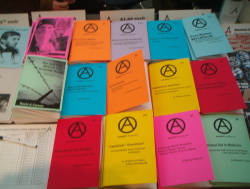
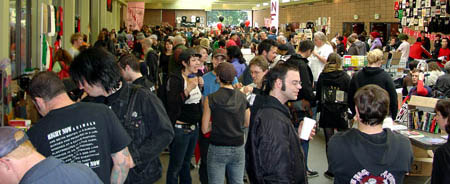
The Bay Area Anarchist Bookfair is going to be held the weekend of March 13-14 in San Francisco at Golden Gate Park. It’s a great time; it’s also one of the largest annual Anarchist community events in North America. And I’m in the process of organizing a table for A.L.L. at the bookfair.

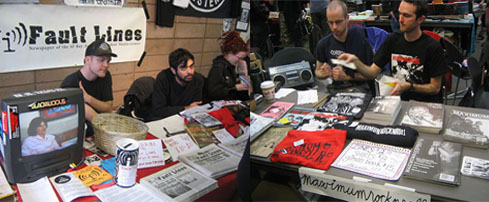
In addition to a great lineup of speakers, panels and workshops, the main event (this is a bookfair, after all) will be the space in main hall with dozens of vendors with tables to show off their Anarchist books and materials from 10:00am–6:00pm on Saturday, March 13 and 11:00am–5:00pm on Sunday, March 14. Among them will be us — members of the Alliance of the Libertarian Left from Vegas, California, and around the Western U.S. I’ll be there, along with fellow Anarchists from Southern Nevada ALL. We’ll have books, journals, buttons, and more from the Southern Nevada ALL Distro available for sale as fundraisers, along with a lot of free pamphlets, smaller pieces to give away, and information about ALL as an organization and what we do back in our hometowns.

This will be Southern Nevada A.L.L.’s third appearance at an Anarchist bookfair (after appearances at last year’s Bay Area bookfair, and this year’s Los Angeles bookfair). These bookfairs are a real blast to work: partly because the bookfair a great opportunity to make connections with fellow Anarchists and to get the good word out about individualist anarchism, market anarchism, mutualism, counter-economics, to an audience of engaged radicals and movement anarchists. And also because, for a dispersed, Internet-coordinated network like the A.L.L., working the bookfair table is great opportunity to posse up with ALLies from many different towns, meet folks you’ve only known online, have some great conversations, and work together on some practical counter-economic outreach. (It’s also a good opportunity for local organizing on the ground — since we can put out a sign-up sheet and get contacts for people who are interested in ALLiance in the Bay Area.)

Anyway. If all this sounds like something you’re down with, interested in, excited by, here’s three things you can do:

  1. If you’re in the Bay Area, or will be around March 13-14, drop on by the table and say hi and see what we’re doing.

  2. If you’ll be there and you’re interested in selling books or merchandise for your hometown Alliance of the Libertarian Left local — or if you’re interested in hanging out with ALLies from other towns and helping with the table — then get in touch with me to coordinate. We’ll definitely have space for you, and it’d be great to posse up.

  3. If you want to help support the A.L.L. presence at the Bay Area Anarchist Bookfair (and other bookfairs in the future), you can help us out by covering the costs of the table and the transport. Bound Together Books just recently boosted the cost of reserving a table (last year it was $100 for both days; now it’s $150). We’re doing this on as thin a shoestring as possible. With support from y’ALL, we can make the most of these opportunities to do local organizing, make connections between our locals, and put the word out and about among our fellow Anarchists.

    Here’s the shoestring, for reference.

    ALL @ Bay Area Anarchist Bookfair 2010 shoestring budget
    Cost Description
    $150 Table reservation (Saturday and Sunday)
    $87 Car rental for transport from Vegas (driving up Friday; returning car Monday).
    $86 Cheap hotel in Bay Area (Friday and Saturday night)
    ~$0~ Gas costs will be covered by carpooling ALLies and our allies from Vegas up to the Bookfair and to the Empowering Women of Color conference, which is being held at UC Berkeley the same weekend. Food costs will be covered through Food Not Bombs.
    $333 Total costs

Hope to see y’ALL there!

bookfairvendors

We’ll be here. Will you?

Shameless Self-promotion Sunday

Happy Sunday, y’all. Ready for some Shamelessness?

This week has been a week of getting back into activism after time away — time for the holidays, time for conferences, and time to just chill out and try to get some solitary work done for a while. But this week I made it out to UCIR and to Vegas Anarchist Cafe for the first time in 2010; and today I’m back for Food Not Bombs. After that — onward to some work (printing, folding, announcing, etcetera) in preparation for an ALL table at this year’s Bay Area Anarchist Bookfair. Also, there’s a new Market Anarchy zine in preparation.

¿Y t?@c3;ba;? What have you been up to this week? Write anything? Leave a link and a short description for your post in the comments. Or fire away about anything else you might want to talk about.

Against legalization (cont’d)

Here’s an O.K. video featuring Hernando de Soto, on shantytowns and the global countereconomy:

I say that the video is just O.K. because it’s a good introduction to the situation (which is important and interesting, and which de Soto has done a lot of really fascinating work on), but it flounders around with some weak reformist platitudes when it comes to figuring out what to make of the situation, and where to go from it. In the presence of a massive exercise of countereconomic industry and ingenuity, De Soto rightly sees that government paper mazes and the government force which back them up have constrained extralegal workers — marginalizing their livelihoods, burning out their homes and property, and excluding them from access to sustaining and stabilizing resources like capital, credit, and reliable arbitration of disputes. Extralegal workers have responded by creating their own parallel cities and institutions through which they can produce non-statist alternatives — proudly unauthorized homes, neighborhoods, cities, informal microcredit, contracts, and ad hoc private mediation. It has allowed the poorest and most marginalized and exploited people in the world to build thriving parallel metropolises up from nothing, sometimes numbering in the millions of people, through their own labor and creativity out of little more than cardboard and scrap wood.

That’s awesome. (It’s awesome because people are awesome.) Faced with indifferent or hostile governments and exploitative plutocrats, workers respond with all kinds of hustle and creativity to make a living for themselves anyway beyond the sight or the control of state authorization. De Soto, seeing all this, is right to think it’s awesome — but then he can’t think of anything better to say or do about it than to suggest that we should reward them by straightening out and simplifying the government paper so that what they do can be incorporated into the straight economy and they can all get government paper just like the rest of us. If people’s livelihoods are extralegal, then the idea is that we should legalize them, so that they can be folded, stamped, taxed, and regulated just like the rest of us — because (we are told) we need them as much as they need us.

If you’re wondering about all those scare-quotes, they’re there because the we in de Soto’s sentence doesn’t really mean us. It’s a false we, the statist we, which people in the legally-regulated straight economy all too often use to grab at an illusion of control, and thus to identify themselves with their own oppressors. One result of which is dull reformist proposals, which have nothing better than legalization to propose as a solution to the problems that arise from living outside the government law.

It’s not just that legalization campaigns mostly don’t work.[1] And it’s not just that their end results will inevitably be to sink millions more people into a slightly-liberalized version of the same exploitative government-corporate bureau-economy that legalized workers are already sunk into.[2] The real problem here is that legalization is just plain boring, and lazy, as a recommendation. It’s always supposedly motivated by a concern for practicality — but practically speaking, what illegalized people need is not to get good and legalized like everyone else. What they need is not government recognition, it’s social solidarity and minimal security. Specifically, security against the threat of government violence against those who don’t have official papers. And there are two ways to try and get that. One way is to try to get everybody papers. The other way is to make it so that you don’t need papers to live your life.

The first approach — the out of the shadows sort of approach — treats poor people as if what they’ve built for themselves isn’t good enough, as if they need to be admitted to the legally-authorized official economy in order for what they do to matter. The second approach says that what poor people have built is not just some half-real shadow economy, but a real social achievement worth defending. De Soto has it exactly wrong: the regulated economy depends on black markets and spontaneous economies to keep from imploding under its own bureaucratic weight. But the countereconomy doesn’t need the regulated economy at all. Or, more to the point, it doesn’t need the regulators.

Instead of protecting people’s homes and livelihoods with government paper, they can be protected by organized people, We need new techniques, new institutions, and new social relationships that will ultimately help us to insure against, to evade, to undermine, to resist, and ultimately to disarm government coercion when it comes for our homes or our jobs. Barn-raising instead of bank credit to build unlicensed homes, and social solidarity and people-powered blockades to protect them from government demolitions. Tools for confidential exchanges, underground communication, and mediation outside of political courts. Networks for wildcat strikes and boycotts and shop floor actions to resolve labor disputes rather than bureaucratic arbitration. Solidarity and safety can really mean anything your awesomeness can devise; but it sure doesn’t need to mean more government paper. We don’t need their stinking legality. What we need is a consensual alternative.

There ain’t nothing wrong with illegality that can’t be fixed with more extralegal grassroots social organization.

Don’t legalize; organize.

[1] Although, of course, they mostly don’t. Governments have little reason to change their procedures to suit the needs of people who are already politically marginalized.

[2] Although, of course, it will. Governments that legalize never actually leave people free; they just loosen some of the constraints here and there as a means of getting as many people as possible into the constraints that remain. Government can often exercise much more control over licensees than it can over simple outlaws.

See also:

Wednesday Lazy Linking

Anticopyright. All pages written 1996–2026 by Rad Geek. Feel free to reprint if you like it. This machine kills intellectual monopolists.