Siege mentality
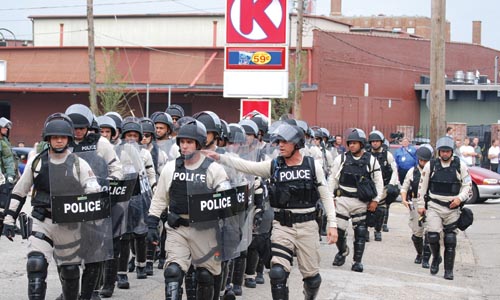 Last month, POLICE: The Law Enforcement Magazine published another ill-tempered tirade by retired L.A. cop Dean Scoville in the magazine’s
 Patrol Tactics
section. (You may recall Sergeant Scoville from his previous ill-tempered tirade in which he openly praised police brutality against captive prisoners.) This most recent tirade, Four More Cops Killed: Where Is The Outrage?
launches into this subject with the following claims of imminent and growing danger that people
(non-police) pose to government police:
Shortly before I retired, I openly speculated that we were on the cusp of a new era where people would increasingly bring the fight to us. Moreover, I said they would prove to be greater threats, less predisposed to
gangsta-style shooting and actually recognize the significance of sight alignment and trigger control.I also noted that technology has helped the people who want to kill us develop better eye-hand coordination and tactics via video games and other poor man’s combat simulators, …. They have also become more sophisticated in their choice of weaponry, and are fast becoming better armed than us, accessorizing with everything from laser sights to cop-killer bullets.
… More recently, economic stress, racial strife, a resurrection of militia types, and spillover from Mexican cartel activity have made this toxic cocktail even deadlier.
He closes the article with the following credo:
Yes, I believe that the job is increasingly dangerous. And it is made more so by what is put out there about it.
(This is used as a springboard for a couple pages’ worth of rambling complaints against society
at large
for our willingness to embrace anti-cop sentiments and stereotypes,
with a special focus on the
alleged anti-cop drum beating of Hollywood, rap music, and those segments of society who have fundamentally failed
to hold their own [sic] accountable
— and, just so we’re clear, by those segments
of society,
Scoville means black people.
[1]
Also, I guess he’s pissed off that Dick Wolf decided to cast Ice-T as a cop in Law and Order: SVU.)
Scoville’s claim that being a government cop is increasingly dangerous
is not an isolated claim. For example,
down in the comments section on the article, another retired government cop, mtarte,
writes:
I’m retired now and still wish I could do the job, but today’s cops are in much more dangerous situations than ever before.
In Milwaukee, by way of explanation for why Milwaukee Police Department had begun arming regular patrol cops with semiautomatic rifles:
It’s obvious that our officers are facing an increasingly dangerous threat to their safety as well as the safety of the community as represented by these weapons ….
— Police Chief Ed Flynn, quoted in Officer.com (2009-04-24): Milwaukee Police Increase Firepower
CRIPT Academy, a tactical training outfit for government cops, says that it:
… provides cutting edge training, information, and service that is continually updated to adapt to today’s fluid environment which is becoming increasingly dangerous for those professionals that must operate in harm’s way.
— Officer.com Directory: CRIPT Academy Mobile Training Teams
If you spend much time at all reading articles and public statements by government police, you’re likely to see this received factoid over and over again. Time never alters it; things only get more and more dangerous. No matter what year it is, it’s always this year that’s poised to become the most dangerous year for police ever; in 2007, in an article on how government cops can better confuse detained Suspect Individuals about their rights to refuse searches, former government cop and government prosecutor Devallis Rutledge offered the following:
So far, 2007 is the deadliest year for law enforcement officers in nearly three decades.
The thing is that all these claims are false. Both in factual detail and in overarching narrative. They could easily have been discovered to be false by taking even a cursory glance at statistics about police deaths in the line of duty. In fact, 2009, when Dean Scoville declared the job
to be increasingly dangerous,
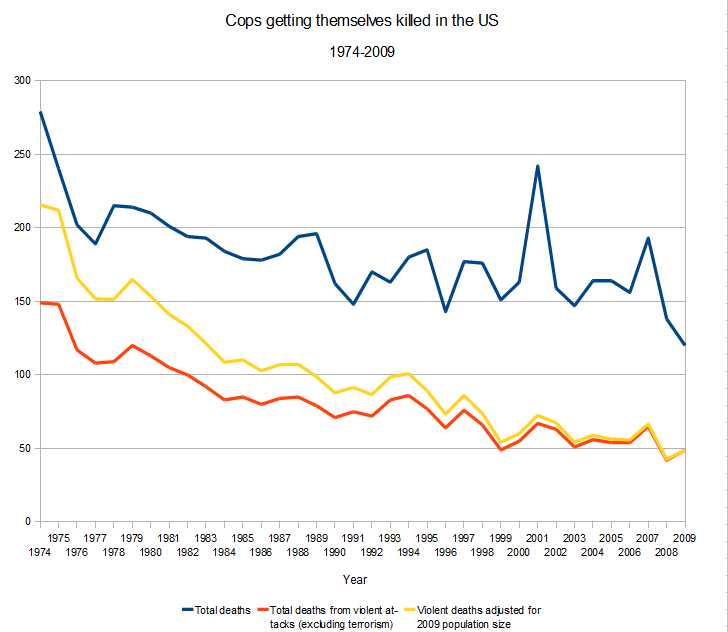
was the safest year for government police in the U.S. since 1959, in terms of absolute numbers of police officers killed while on duty. With only a few exceptions, the number of government police killed on the job had been decreasing steadily for the past 35 years. Here’s the annual data for the past 35 years, as reported by the Officer Down Memorial Page yearly reports.[2]
| Year | Total line-of-duty deaths | Deaths from violent attacks (Excluding terrorist attacks.) |
Total violent deaths adjusted to 2009 population |
|---|---|---|---|
| 1974 | 279 | 149 | 215.48 |
| 1975 | 240 | 148 | 211.93 |
| 1976 | 202 | 117 | 165.92 |
| 1977 | 189 | 108 | 151.63 |
| 1978 | 215 | 109 | 151.42 |
| 1979 | 214 | 120 | 164.87 |
| 1980 | 210 | 113 | 153.44 |
| 1981 | 201 | 105 | 141.18 |
| 1982 | 194 | 100 | 133.18 |
| 1983 | 193 | 92 | 121.41 |
| 1984 | 184 | 83 | 108.59 |
| 1985 | 179 | 85 | 110.23 |
| 1986 | 178 | 80 | 102.79 |
| 1987 | 182 | 84 | 106.97 |
| 1988 | 194 | 85 | 107.26 |
| 1989 | 196 | 79 | 98.75 |
| 1990 | 162 | 71 | 87.76 |
| 1991 | 148 | 75 | 91.47 |
| 1992 | 170 | 72 | 86.60 |
| 1993 | 163 | 83 | 98.53 |
| 1994 | 180 | 86 | 100.84 |
| 1995 | 185 | 77 | 89.22 |
| 1996 | 143 | 64 | 73.30 |
| 1997 | 177 | 76 | 86.00 |
| 1998 | 176 | 66 | 73.82 |
| 1999 | 151 | 49 | 54.18 |
| 2000 | 163 | 55 | 60.13 |
| 2001 | 242 | 67 | 72.45 |
| 2002 | 159 | 63 | 67.41 |
| 2003 | 147 | 51 | 54.22 |
| 2004 | 164 | 56 | 58.99 |
| 2005 | 164 | 54 | 56.37 |
| 2006 | 156 | 54 | 55.84 |
| 2007 | 193 | 65 | 66.56 |
| 2008 | 138 | 42 | 42.62 |
| 2009 | 120 | 49 | 49.00 |
Or, if you prefer, here’s the chart. The blue line represents the absolute number of cops killed that year in the line of duty;
the yellow line best represents the overall danger to cops from violent attacks (specifically, the number killed in violent attacks against police, adjusted to the U.S. population at the end of 2009).
Coming back to Devallis Rutledge’s deadliest year in nearly three decades,
it’s true that 2007 saw a sudden jump in the number of police killed, compared to 2006. (The next two years saw a sudden drop back to the trend of decreasing police deaths.) But the main reason for that was a jump in deaths due to automobile accidents and other accidental deaths; the number of cops killed in violent attacks — 65 total — was less than the total number killed in 2001, let alone the much higher rates of violent deaths in the 1970s, 1980s, and 1990s. And in fact, if you adjust for the increases in the total population, and the absolute number of police on the streets, it turns out that the increasing safety of government police over the past 35 years is only the tail end of a general trend that has been going on since 1921. (The temporary uptick in violent police deaths from the early 1960s to the mid-1970s never ended up producing more per-capita violent deaths than there had been in 1935.) Following the yellow line, you can see that 2008 and 2009, at the tail end of this trend were the safest years to be a police officer in over 110 years.
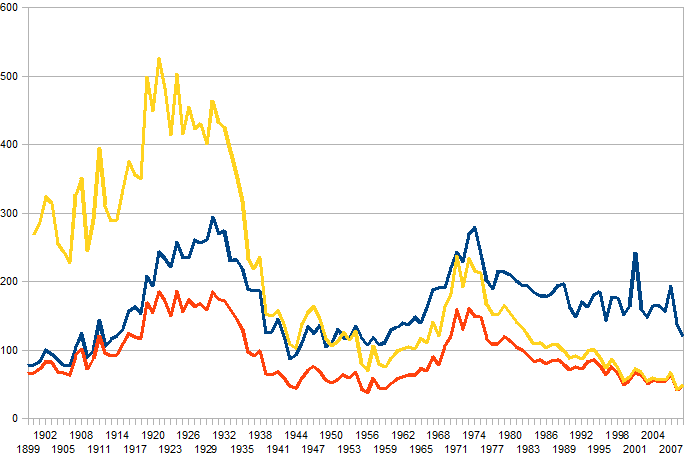
In other words, it’s never been safer to be a cop in America than it has been over the past 2 years. Yet boss cops, spokespeople for the government police, and articles written by cops and for cops, constantly repeat the demonstrably false claims that criminals are more violent than ever before, and that government cops somehow face more danger on their patrols now than they ever have before. That this is a complete lie would be obvious to anyone who had spent 15 minutes perusing the police’s own institutions and resources for honoring their fallen comrades.
The interesting question, then, is what kind of purpose the constant refrain of this unfact from government police serves — what it means when ever-more-heavily-armed government cops keep insisting on a completely mythical ever-present, ever-increasing danger to their politically-sacred persons, in spite of the evidence of the senses and the consistent trends over the last century of historical reality. When you see heavily-armed, well-protected men trying so very hard to psych themselves up to believe in a growing danger that does not actually exist — and when this constantly repeated Big Lie is used to slam pop-culture for any attempt to portray any abuse of police power; to swat down real-life complaints about police belligerence or invasions against civil liberties; to explain the alleged need for assault rifles, tanks, cordoning off strategic hamlets in inner cities, and a niche industry in warrior mindset
trainings — I couldn’t much blame you if you did see some real danger in this concerted effort to inculcate and reinforce a consciously-constructed, fact-resistant permanent siege mentality among patrol cops. But not danger for the cops.
Do you feel safer now?
[1] These cop haters are often composed of those segments of society who have fundamentally failed to hold their own accountable, the likes of whom celebrated the King riots, the O.J. acquittal, and the Oakland shootings.
This is followed up by out-of-left-field references to
Al Sharpton, Jesse Jackson, and Earl Ofari Hutchinson.
[2] If you’re interested in getting the dataset in spreadsheet format, just drop me a line and I’ll send it along. For what it’s worth, if you compare thse figures with figures from other sources, like the National Law Enforcement Officers Memorial Fund annual statistics, the numbers are typically very similar, but differ by a few. I presume that this is from differences over which agencies to count as law enforcement officers
(Officer Down, for example, counts MPs deployed on overseas assignments.) In
any case, the numbers tend to reveal the same trends over time. I used Officer Down’s numbers because they provided an easily-accessible breakdown on causes of
death over the years they covered.
See also:
- Radley Balko, The Agitator (2007-12-28): Just how dangerous is police work?
- GT 2008-10-06: No, seriously, I could swear the water in this pot is getting a little hotter... (#7)
- GT 2010-01-18: In Their Own Words: Master and Commander edition
- GT 2009-05-28: How cops see themselves (#2). National Police Memorial Week and El Monte, California.
- GT 2009-06-02: The Police Beat
- GT 2008-09-25: How cops see themselves
- GT 2008-09-19: No, seriously, I could swear the water in this pot is getting a little hotter… (#6)
- GT 2008-08-22: No, seriously, I could swear the water in this pot is getting a little hotter… (#5)
- GT 2008-07-12: No, seriously, I could swear the water in this pot is getting a little hotter... (#4)
- GT 2008-06-05: Neighborhood Safety Ghettoes in D.C.
- GT 2008-05-15: No, seriously, I could swear the water in this pot is getting a little hotter... (#3)
- GT 2008-05-12: No, seriously, I could swear the water in this pot is getting a little hotter... (#2)
- GT 2008-05-06: No, seriously, I could swear the water in this pot is getting a little hotter...
- GT 2008-04-28: Is it just me or is the water in this pot getting a little hotter?