You are here:
Geekery Today: posts tagged Harry Truman
Over My Shoulder #41: Paul Buhle on establishmentarian unionism, the decline of labor organizing, and the rise of Labor PAC. From Taking Care of Business: Samuel Gompers, George Meany, Lane Kirkland, and the Tragedy of American Labor. (posted 20 February 2008)
Pick a quote of one or more paragraphs from something you’ve read, in print, over the course of the past week. (It should be something you’ve actually read, and not something that you’ve
read
a page of just in order to be able to post your favorite quote.)Avoid commentary above and beyond a couple sentences, more as context-setting or a sort of caption for the text than as a discussion.
Quoting a passage doesn’t entail endorsement of what’s said in it. You may agree or you may not. Whether you do isn’t really the point of the exercise anyway.
Here’s the quote. These are a couple of passages from the final chapters of Paul Buhle’s book, Taking Care of Business: Sam Gompers, George Meany, Lane Kirkland, and the Tragedy of American Labor. They have a lot to say on the logical end-point of establishmentarian unionism and how, within the tripartite planning system of Big Government, Big Business, and Big Labor—particularly after the corporate merger and consolidation known as the AFL-CIO—the top union bosses tacked further and further away from industrial organization towards political organization — in effect, ceasing to be workers’ unions, and instead operating as an enormously wealthy but crumbling and increasingly irrelevant sort of Labor PAC.
The departure of Reuther and the UAW from the AFL-CIO in 1964 not only meant no charismatic personality was left combat meaning but also no block of aggressive unionists to offer significant, concerted resistance to rightward-drifting union leadership and social policies. The executive committee functioned as a glorified rubberstamping agency rather than a representative body. Seen in retrospect, centralization of power was the inner logic of the subsequent institutional consolidation. Neither William Green nor Walter Reuther nor even Samuel Gompers, an expert autocratic manipulator in his day, wielded as much personal control is to Meany and his entourage. One traditional labor historian, admiring the advance of the bureaucracy, put it most politely: labor evidently no longer had any great need for services beyond negotiation and enforcement of existing contracts. Everything else could more safely and efficiently be handled better from above. In December 1977 at the last national convention where Meany played an active role, the only names offered in nomination for president and secretary were Meany and Lane Kirkland. Neither was resistance offered to any of the nominees for the thirty-three vice presidencies. A lone dissident of sorts who did manage to get onto the council, the socialistic machinists’ president, William Winpisinger, was widely regarded as window-dressing for the steady rightward drift. Carefully directing his political views toward the public sphere, Winpisinger restrained his personal criticisms of Meany, much as some socialist craft unionists of the 1910s insisted that Gompers was a symptom and not the cause of labor conservatism, better endured than combated. Meany responded by savaging Winpisinger’s favorite views without mentioning Winpisinger himself.
By the 1970s, Meany grew more candid—or perhaps merely more arrogant. He held his ground proudly against his internal enemies and gleefully watched the mass social movements of the 1960s fade away. Admittedly, he also saw power within the Democratic Party slipped further from his potential grasp and the AFL-CIO fall precipitously by any measurement of size and influence. Asked in 1972 why AFL-CIO membership was thinking as a percentage of the workforce, he responded,
I don’t know, I don’t care.When a reporter pressed the issue,Would you prefer to have a larger proportion?Meany snapped,not necessarily. We’ve done quite well without it. Why should we worry about organizing groups of people who do not appear to want to be organized? If they prefer to have others speak for them and make the decisions which affect their lives… that is their right.Asked whether he expected labor’s influence to be reduced, he responded,I used to worry about the… size of the membership…. I stopped worrying because to me it doesn’t make any difference… The organized fellow is the fellow that counts. This is just human nature.Unorganized and lower-paid workers were less-than-irrelevant to Meany; they were unwanted.Never particularly supportive of strikes except those protecting jurisdictions, Meany became steadily more hostile to walkouts as time went on. (He made one key exception urging political strikes by merit time workers against, of all things, we being loaded onto Russian ships.) In 1970, he observed,
where you have a well-established industry and a well-established union, you are getting more and more to the point where strike doesn’t make sense.Rather than strikes and organizing, Meany put his eggs into the basket of electoral campaigns, legislative activity, and involvement in a panoply of government-management-labor commissions and agencies in the Nixon, Ford, and Carter administrations. In some circles these activities actually reinforce the myth of the powerful Meany, labor statesmen and public figure. They did demonstrably little for labor. And no amount of them could quite dispel the image of the narrow-minded unabashedly feminist-baiting and gay-baiting labor boss eating at four-star restaurants and puffing a high-priced class of cigars once restricted to capitalists and mobsters.The AFL-CIO politicked actively for Jimmy Carter in 1976, after its leaders have expressed their real preference for
ScoopJackson. Ironically, the Georgia Democrat’s narrow margin of victory actually made the support of labor, the African-American community, and feminists, among others, the crucial margin between defeat in victory. Once more, given a different approach, it might have been a moment for the labor movement to flex very real muscles and work for legislative assistance and breaking down barriers to organizing the unorganized, just as the women’s movement reached in early apex and as assorted movements among people of color looked to advances within the mainstream. For that kind of enterprise, however, Meany had no stomach whatever.Once in office, Carter offered symbols instead of substance: a modest assortment of anti-poverty pilot programs amid a generalized retreat from the Great Society promises. Secretary of Labor Ray Marshall would be remembered not for his speeches saluting labor but because he was the last labor secretary who apparently believed the unions were necessary for working people. As so often, labor had rewarded its friends, gaining little in return. Meany soon let it be known that he was giving Carter a
C-as president. Did he wish to see anyone else in the race for 1980?Yes,he shot back,Harry Truman. I wish he were here.To be fair, the old strike-breakingGive ‘Em Hell Harrycould not likely have accelerated the growth of American weaponry any faster than Carter did after the Russian invasion of Afghanistan in 1979. He might have bombed Iran into oblivion, and he surely would have sounded tougher. That kind of rhetoric, joined perhaps with robust new liberal-led red-scare against peaceniks, feminists, and radicals at large, would surely have had more appeal to the frustrated, aging bully that Meany had become.…
The AFL-CIO issued dire warnings before and after the crucial 1980 election. Union activists worked although with less enthusiasm than anxiety for Carter’s re-election. The aftermath of Reagan’s triumph (by a relatively small margin, it should be remembered, and due to the Iran crisis and the economy rather than any great public fondness for the former California Governor) quickly justified the forebodings. As the new president broke the air controllers’ strike and sent a message to the labor movement both Reagan’s rhetoric and policies proved brutal. The Republican administrations appointees to the National Labor Relations Board notoriously slanted against unions, moved quickly to remove restraints upon opposition to unionization and to all but encourage fresh efforts at decertification. Especially for people of color, disproportionately poor and barely-working class, the prospect of factory shutdowns and worsening health care with few resources was aggravated by their being depicted as the ungrateful recipients of various undue privileges and taxpayer largesse. Union membership fell for an assortment of other reasons as well, but heightened employer resistance stood near the head of the pack. And yet, if labor leaders distrusted or even despise Reagan’s allies, many experienced an unanticipated degree of self realization and hating Reagan’s enemies, those feminists, peaceniks, and assorted left-liberals to assistant to become radio host Rush Limbaugh’s favorite targets.
Besides, labor did have an elusive, thoroughly institutional fallback on the national political stage. In 1981, in the wake of Reagan’s victory, a hard-pressed Democratic National Committee granted the AFL-CIO 25 at-large seats and four out of 35 seats on its executive body. Within a diminished party suffering an early bout of Reaganism (and whose congressional delegation would indeed vote for so many of Reagan’s programs), the AFL-CIO became in return the largest single Democratic financial donor, supplying the DNC with more than a third of its annual budget. The defeat of a modest labor reform bill in Congress in 1978 showed that the conservative counteroffensive had begun in earnest with simultaneous Democratic president and Congress for the last time in at least a generation. Wall Street analysts warned that a new era of militant labor leadership might emerge a political defeat.
Instead, defeat bred timidity and an eagerness to shift foreign of rightward to recuperate the
Reagan Democrats.As along with an increasingly unrealistic hope for a major change of labor laws, the specter of protectionism—which labor’s top leaders did not themselves particularly desire—offer the only popular fight-back issue imaginable. In the absence of a real internationalist program of protecting working people across borders, the new protectionism mainly added us mean-spiritedness to organized labor’s perennial self-concern. The downward spiral of labor’s claim to special protection within the liberal coalition thereby lead further and further to its isolation.—Paul Buhle (1999), Taking Care of Business: Sam Gompers, George Meany, Lane Kirkland, and the Tragedy of American Labor, pp. 195–198, 219–220.
Moral standards (posted 27 September 2006)
Here’s part of a recent reply to my post on the use of the phrase moral relativism
. The original post discussed a controversy over whether or not Harry Truman should be called a terrorist
for knowingly and willingly slaughtering civilians — orders of magnitude more civilians than Osama bin Laden (et al.) slaughtered in the attack on the World Trade Center — for the sake of military and political strategy. Here’s how Jamie DeVries tried to make the case that we cannot draw any moral parallels between the two figures
:
Here is the question we ought to ask ourselves: )Did Truman have the ability and power to incinerate each and every Japanese citizen, even after a surrender was declared? The answer is: yes. Did he or the U.S have the WILL to do so? The answer: of course not.
Well, that was mighty white of him.
In all seriousness, how much lower could the bar possibly be set for rulers of the Allied governments in World War II? Is there absolutely any atrocity in the name of unconditional surrender
that the Court Intellectuals and their countless acolytes would not rush to defend, or at least to excuse? I wish this were merely a bit of pointed rhetoric. But actually I’m asking it as a serious, open question.
Further reading:
Evildoers (posted 4 January 2006)
For the past week, there’s been a lot of hubbub over All Things Beautiful’s Ten Worst Americans challenge. For a lot of reasons, I don’t have a comprehensive list, and I’m not that keen on the whole project (there’s lots of evil and ugliness in the world without going out of your way to seek it out, compile it, and cross-index it; I have no idea what the criteria would be for choosing ten people as more evil than any others; and I think that most of us are already far too fascinated with and fixated on demonology as it is). So I don’t have a Worst Ten list to provide. But I do have a list of additions that I think ought to be there, if lists are to be made. Coming out for the left-liberal corner we have Ampersand at Alas, A Blog (2005-12-27) with a list of seven villains, Patrick at Tiberius and Gaius Speaking… with a list of ten, and Glenn Greenwald and Hypatia at Unclaimed Territory (2005-12-28) with another ten to throw on the barbie. With the exception of Glenn’s silly inclusion of Harry Blackmun, they are pretty much right, as far as it goes, but there are some notable names that I notice tend to get left out. I suggested some additions at Alas and some dishonorable mentions at Tiberius and Gaius, which have been followed up with some debate.
Here’s my contribution of evildoers. I make no attempt to be comprehensive — there are lots of truly rotten people who aren’t on the list, mainly because they are mentioned elsewhere. But these folks are truly rotten, and often overlooked — sometimes because they get shoved out of the way by contemporary contenders that contemporary writers tend to give disproportionate space to, sometimes because the villains are overlooked by pop history anyway, and sometimes simply because political blinders prevent their names from being given serious consideration. The interesting thing is that the blinders rarely constitute defenses of their deeds — although in at least two of the three cases I discuss with Patrick that is what’s happening. It’s just that, for whatever reason, some folks whose crimes are readily admitted, if mentioned, aren’t thought of when you sit down thinking Who should I put down as a terrible evil-doer?
I have some ideas about the reasons behind that, but I’d be interested to hear what you think in comments, too.
In any case, here’s my unordered list of overlooked evildoers, cobbled together from my suggestions elsewhere:
Harry S. Truman. He ordered or approved the murders of 500,000 - 1,000,000 Japanese civilians over the course of half a year in 1945.
Curtis LeMay. He carried out the murder of 500,000 - 1,000,000 Japanese civilians over the course of half a year in 1945. He planned and carried out the low-altitude firebombing of Kobe, Tokyo, and 65 other Japanese cities. A nuclear maniac who explicitly denied that there were any innocent bystanders in war, went on to coin the phrase
bomb them back into the Stone Age
(in reference to the Vietnam War), and went on to become George Wallace’s running mate in 1968, on a platform of white supremacy and more militant anticommunism. During World War II, he repeatedly indicated his belief that the Japanese deserved wholesale slaughter of civilians, and his own public statements and the reminiscences of the soldiers who served under him reveal him as simply reveling in death and destruction.Franklin Delano Roosevelt, a pseudo-leftist demagogue who created the military-industrial complex; imprisoned political opponents; seized sweeping censorship powers; pandered to the worst sorts of racism, first in his political alliances with arch-segregationist Dixiecrats and then in whipping up war fever for war against Japan; ordered internment of Japanese-Americans; happily allied with, propagandized for, and consigned 1/2 of Europe to the totalitarian terror of, Joseph Stalin; and became one of the three men who came the closest to becoming a dictator in the United States.
Woodrow Wilson, unreprentant liar and war-monger, KKK fan, arch-segregationist, ardent anti-feminist. His published academic work delighted in white supremacist myth-making; his warmongering drew the United States needlessly into one of the worst and most senseless wars in world history; he built a slave army with the second federal draft in American history, and shredded civil liberties with abandon, happily imprisoning political opponents both during and after the War and presiding over the devastating Palmer Raids. Wilson is one of the three men who came the closest to becoming a dictator in the United States.
George Fitzhugh, who fused the worst elements of statist utopian socialism with a nostalgic view of feudal hierarchy to provide the most militant theoretical defense of white supremacy and race slavery in the prewar South. He authored Slavery Justified, Sociology in the South, and Cannibals All!.
William Tecumseh Sherman, one of the inventors of modern scorched-earth warfare, ravager of the South and murderer of Southern civilians. Sherman followed up his most famous role by pursuing genocidal campaigns against the Plains Indians and Indians in the Southwest from 1869 until his retirement in 1884.
James Eastland, the militant white supremacist Senator from Mississippi, mad dog McCarthyist, and founding father of the White Citizens Councils.
In addition to another Alas commenter’s suggestion of Larry Flynt, I’d also like to add Chuck Traynor, the pimp / pornographer / rapist / batterer / slave-driver who forced Linda Boreman into Deep Throat (among other pornography) and played an instrumental role in founding the mass-market, above-ground film pornography industry in the U.S. through repeated filmed rapes.
Sergio Méndez reminded me that Ronald Reagan certainly needs a mention, yet he seems notoriously absent from many of the lists. I mention him here not because I think he’s often overlooked on lefty lists of rotten people, but rather because I think the primary reasons to include him — his complicity in the formation of the death squads of El Salvador and the plainly genocidal massacre of some 200,000 Indians in Guatemala — is often overlooked in favor of a frankly silly focus on his contributions to the rhetoric of the contemporary Right in America.
The exercise, whatever its demerits, does seem to be a good conversation-starter. What do you think?
Lazy linking on Leftist labor libertarianism (posted 20 December 2005)
Try saying that three times fast.
For a while now I’ve been urging libertarians and the labor movement to take a more serious and sympathetic look at one another. (Cf. GT 2004-05-01: Free the Unions (and all political prisoners!), GT 2005-03-23: El pueblo unido jamás será vencido! and GT 2005-03-31: Anarquistas por La Causa for representative examples.) Just as with radical libertarianism and radical feminism I think that the supposedly obvious and unbridgeable opposition between the two is the result more of terminological difficulties and shifting political alliances over the course of the 20th century than any deep or principled gulf. The best way to see this is with more engaged discussion: fewer polemics, more history, more earnest questioning, and more listening. So I’m excited to see a lot of interesting new material just in the past couple of weeks from libertarians (mostly but not exclusively left-libertarians) trying to get clear on the questions and hammer out some of the answers about the prospect for a libertarianism that has a place for workers organizing freely, and a wildcat labor movement that frees itself from the smothering patronage of the State. Here’s a bit of lazy linking to the discussion so far.
Brad Spangler (2005-12-03): War, Socialism, and Precision in Thinking writes on the need to disentangle the different meanings attached to the words
capitalism
andsocialism
(each of them has at least one traditional meaning that’s perfectly consistent with the peaceful economic cooperation, and one that’s directly antagonistic to it). Brad protests the fuzzy thinking that typically comes about from running the terms freely together, and urges libertarians to realize thatIf anything that is voluntary on all sides is, at the very least, acceptable to the point that it at least can not righteously be opposed by force, then one has to come to grips that a stateless society will have
capitalistic
andsocialistic
aspects in practice. Hippy communes. Farmers co-ops. Employee owned enterprises. Workers syndicates. Unions. … Ultimately, vulgar libertarians, on this point anyway, fail to distinguish libertarianism from personal preference for a particular class of business models.Roderick Long at Austro-Athenian Empire (2005-12-04): Freedom and the Firm asks
What will firms look like in a free society?
He points out the important trade-off that you face when you decide whether to get business done with a centralized, amalgamated firm, or a small-scale, decentralized operations like family shops and worker’s co-ops: larger size can mean lower transaction costs, but it also comes at the cost of calculational chaos. (The incentive problems and knowledge problems that libertarians have pointed out in central planning don’t evaporate when the central planning is done by corporate rather than government bureaucrats.) Roderick points out some of the ways in which state capitalism distorts the trade-off in favor of big, centralized firms; Leviathan, as always, is Behemoth’s greatest ally:We don’t have a free market, however; instead we have a highly regulated market. For familiar reasons, such regulations hamper the less affluent more than the more affluent, and so successful firms will tend to become somewhat insulated from competition by less established firms, thus removing one check on their inefficiency. And as Kevin Carson points out, regulatory standardisation also decreases competition among the successful firms — a form of de facto cartelisation. Government regulation thus lowers the costs associated with size and hierarchy more than it lowers the associated benefits; it stands to reason, then, that firms in a genuine free-market context could be expected to be smaller and less hierarchical than they tend to be today. This is doubly true once one takes into account the increased competition for workers that a less regulated economy would presumably see (assuming that workers generally prefer less hierarchical work environments).
Kevin Carson (2005-12-08): Socialist Definitional Free-for-All: Part I reviews a recent donnybrook over the meaning of
socialism
and whether voluntary workers’ co-ops and other forms of state-free direct worker control over the means of production are (1) instances of socialism, and (2) compatible with libertarianism. Bithead makes an ass of himself; Knapp holds his own; John T. Kennedy directs some good critical questions at Knapp; Knapp offers some good replies. Carson adds his ownExtended Commentary,
placing the debate in the historical context of the thought of late-19th and early-20th century libertarians such as Thomas Hodgskin, Benjamin Tucker, and Franz Oppenheimer, who explicitly considered themselves (1) socialists, (2) supporters of organized labor, and (3) radical advocates of laissez-faire in economics. Carson also offers some interesting historical notes on the individualists’ economic thoughtIndividualist anarchism, the strand of socialism that most closely approximates my own position, doesn’t place that much importance on ownership of the means of production (leaving aside the views of Tucker et al on occupancy-based ownership of land, anyway). Although some strands of mutualism tended toward a much more active affinity for cooperative organization of production, and considered explicitly cooperativist arrangements would likely predominate in a stateless society, the American individualist branch of mutualism placed much more emphasis on the conditions of exchange than the organization of production. … What mattered to him was that, without state enforcement of special privileges for capital, and without artificial scarcity rents resulting from such privileges, the natural wage of labor in a free market would be its full product. And without the state’s enforcement of artificial scarcity in land and capital, jobs would be competing for workers instead of the other way around.
And Carson points out that the debate is often confused by the fact that all sides tend to talk about
coercion
andproperty
as if everyone already had a perfectly clear and common conception of what sorts of things can count as your property and under what conditions. Libertarians tend to broadly agree on central cases, but when the debate is about something more substantial than name-tags or banner colors, it usually comes down to substantive disagreements over peripheral cases:All the parties to the debate tend to throw around the term coercion, in discussing whether coercion is essential to collective ownership of the means of production, without addressing the prior question of what constitutes coercion. Now I would argue that whether the establishment and enforcement of collective ownership is
coercive
depends on what set of property rights rules you start out with. Forcibly invading someone’srightful
property, by definition, is coercion; but using force to defend one’srightful
property claims against invasion is not. So the question of whether force is coercive depends on who therightful owner
is. When the parties to the dispute adhere to two separate sets of rules for property rights, they will disagree on who is the aggressor and who is the defender.Kevin Carson (2005-12-08): Socialist Definitional Free-for-All, Part II offers a lengthy follow-up where he assembles quotes from posts Roderick, Brad, and me on definitions of
socialism
andcapitalism,
the size of firms, and organized labor, and adds his own exposition and commentary. Among other things, he points out one of the important ways in which unionization can serve as a road to, rather than a roadblock against, workers adjusting pay, security, and conditions to something like the marginal product of their labor:Regardless of the long-run market incentives to pay labor its full product and treat people like actual human beings, in the short run the uncertainty and potential disruption of being an at-will employee can be quite a hassle. For the benefit of those who have been living on Planet Cato these many years and never had direct experience working for a boss, I’d like to point out that the average boss can fuck your life up in some really unpleasant ways before the market disadvantages of doing so are finally brought home to him. And, as some radical historians of workplace relations have pointed out, a management policy of harassing selected subgroups of workers and dividing them against each other may produce benefits, in the form of reduced labor solidarity and bargaining power, that outweigh the alleged
irrationality
costs. On the other hand, the benefits of contractually-enforced stability and predictability are just as real to a wage-laborer as they are to the parties to any other kind of contract.
That’s a rather dense thicket of interlinking posts; moving aside from this mutualist admiration society, there’s also been good discussion elsewhere:
Joshua Holmes at No Treason (2005-12-09): Open Question about Libertarians and Unions asks
What do libertarians have against labour unions? This question struck me the other day (because it was better than studying for Business Associations) and I wondered why libertarians have so much bile for labour unions.
Holmes has a good breakdown of common corporatarian objections to unions and responses to them. A vigorous go-around on semantics, tactics, and principles follows in the comments.Irfan Khawaja at Theory and Practice (2005-12-15): The Taylor Law and the Transit Strike: Some Questions asks for further discussion from libertarians and classical liberals about the status of strikes and work stoppages, and laws (such as the Taylor Law) which ban strikes by government employees:
Is a strike—as Howard Dickman suggests in his book Industrial Democracy in America—just a glorified form of breach of contract? In that case, libertarianism justifies strike-breaking and scabdom, period. (Cf. Truman’s breaking up the railway and miner’s strikes in 1946.) Or does striking have a deeper justification in libertarian principles? To the best of my knowledge, there isn’t much normative discussion of this subject in the contemporary libertarian literature—a shame, considering the centrality of the issues.
In comments, I suggest a focus on questions about individual rights to refuse to work and move on to the status of strikes from there; Irfan replies with more helpful questions and commentary.
This doesn’t end here. A week from now — 28 December 2005, 11:15 a.m.-1:15 p.m — The Molinari Society will be holding a symposium at APA Eastern Division in New York. The topic is going to be the debate between thick
and thin
libertarianism, and the thick
side will be represented by Jack Ross’s Labor and Liberty: A Lost Ideal and an Unlikely New Alliance. Ross will read and I’ll be commenting on the essay. (Shorter me: the outline of Ross’s argument is correct and important; I’m not so confident about the details and I think there are some important questions and distinctions to be raised about the kind of labor organizing that libertarians should ally with.)
Hope to see you there!
A day that will live in infamy (posted 9 August 2005)
The easiest way to begin is with the numbers.
Some 60 years ago today, at 11:02 in the morning, the American B-29 bomber dropped a 10,200 pound plutonium bomb (nicknamed Fat Man
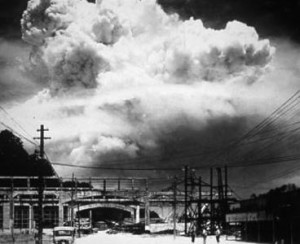
) over the city of Nagasaki, a tourist destination, industrial center and sea-port in southwestern Japan with a population of about 230,000. The bomb exploded about 500 yards above Nagasaki, creating a fireball, a shockwave, and a massive burst of radiation. Some 74,000 civilians — about 1/3 of the population of Nagasaki — were burned alive, crushed to death by the shockwave, or sickened and died over the next few months due to severe radiation poisoning (the burning away of their internal organs by intense radiation) and cancer.
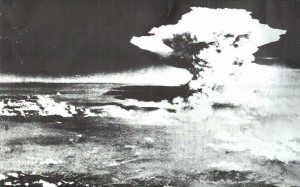
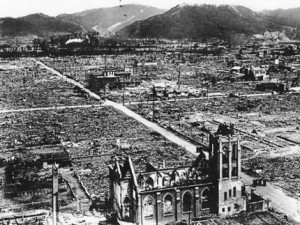
Three days before, with no prior warning, a B-29 bomber had dropped an enriched uranium bomb over Hiroshima, an industrial center in western Japan, with a population of about 255,000. The bomb had exploded about 670 yards above the city. 80,000 civilians were burned alive or crushed to death by the explosion. By the end of 1945, another 60,000 people died due to severe radiation poisoning and cancer, raising the death toll to about 140,000—about 55% of the city’s population.
One of the reasons that Hiroshima and Nagasaki were chosen as targets is that they were considered to be good sites to demonstrate the killing power of the Bomb: they had been mostly untouched during the six months of low-altitude firebombing of Japanese cities. The first major raid of that campaign was the firebombing of Tokyo in the middle of the night on March 9-10, 1945. 334 American B-29 bombers raced over the city at about 7,000 feet, and dropped about 1,700 tons of napalm bombs. It is estimated that about 100,000 civilians were burned to death in one (1) night. Over the next 6 months, from March 10 to Japan’s surrender on August 15, over 100 Japanese cities were firebombed; about 500,000 civilians were burned to death.
All told, the firebombing and nuclear attacks and conventional
air raids on Japan killed somewhere between 800,000 and 1,000,000 Japanese civilians over the course of half a year.
Then there are the names.
Curtis LeMay
Henry L. Stimson, Secretary of War
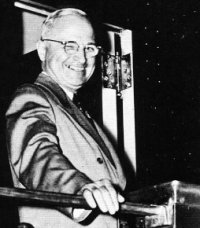
Harry Truman, President
The B-29 Bockscar
, which incinerated one third of the people of Nagasaki, was piloted by Major Charles Sweeney. The actual dropping of the bomb was carried out by the plane’s bombadier, Captain Kermit Beahan.
The B-29 Enola Gay
, which incinerated over half of the people of Hiroshima, was piloted and commanded by Colonel Paul Tibbets. The plane’s bombadier, Major Thomas Ferebee, dropped the bomb over Hiroshima.
Sweeney, Beahan, Tibbets, and Ferebee were members of the XXI Bomber Command, directed General Curtis LeMay. LeMay opposed the nuclear attacks, but he directed it under orders from Secretary of War Henry L. Stimson and President Harry S. Truman, who had made the decision to use atomic weapons in order to terrorize Japan into unconditional surrender. LeMay was also the architect of the low-altitude firebombing campaign, acting on advice and research from his subordinate, Lt. Col. Robert McNamara.
We will never know the names of most of the 1,000,000 or so civilians who were killed in the onslaught. The Japanese government was in disarray in the closing months of the war, and many of the records were consumed by the flames along with the lives of the victims.
Then there are the statements of intent.
The purposes of the bombing was to achieve victory through catastrophic bloodshed and terror. LeMay, when asked about his bombing campaigns, stated There are no innocent civilians, so it doesn’t bother me so much to be killing innocent bystanders.
(He also mused, later, I suppose if I had lost the war, I would have been tried as a war criminal.
) The interim committee deciding to drop the bomb stated, on May 31, 1945, that we could not give the Japanese any warning
before the atomic bombing of Hiroshima. About 24 hours before the incineration of Nagasaki, U.S. planes began dropping leaflets all over Japan, threatening more destruction but naming no targets that could be evacuated. The leaflets did not reach Nagasaki at all until August 10, the day after it was destroyed. The leaflets read:
TO THE JAPANESE PEOPLE:
America asks that you take immediate heed of what we say on this leaflet.
We are in possession of the most destructive explosive ever devised by man. A single one of our newly developed atomic bombs is actually the equivalent in explosive power to what 2000 of our giant B-29s can carry on a single mission. This awful fact is one for you to ponder and we solemnly assure you it is grimly accurate.
We have just begun to use this weapon against your homeland. If you still have any doubt, make inquiry as to what happened to Hiroshima when just one atomic bomb fell on that city.
Before using this bomb to destroy every resource of the military by which they are prolonging this useless war, we ask that you now petition the Emperor to end the war. Our president has outlined for you the thirteen consequences of an honorable surrender. We urge that you accept these consequences and begin the work of building a new, better and peace-loving Japan.
You should take steps now to cease military resistance. Otherwise, we shall resolutely employ this bomb and all our other superior weapons to promptly and forcefully end the war.
Shortly before the leaflets were dropped, Harry Truman also publicly declared his aims: It was to spare the Japanese people from utter destruction that the ultimatum of July 26 was issued at Potsdam. Their leaders promptly rejected that ultimatum. If they do not now accept our terms, they may expect a rain of ruin from the air the likes of which has never been seen on this earth.
Of course, no specific warning was given to the civilians of Nagasaki, at any point.
After the war, Truman defended his decision to burn nearly 1,000,000 civilians to death on the grounds that it was necessary to secure the unconditional submission of Japan to surrender and occupation without a costly marine invasion of the home islands.
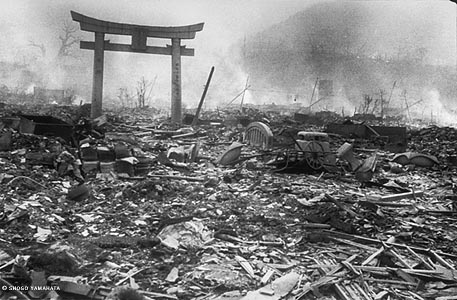
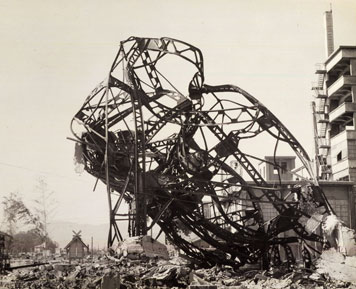
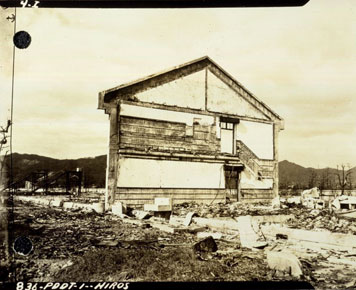
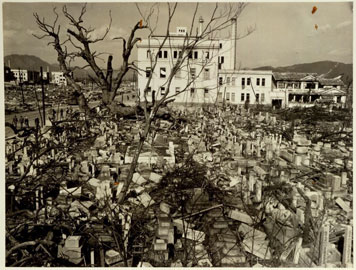
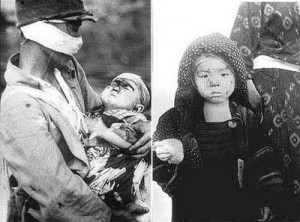
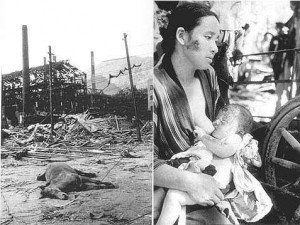
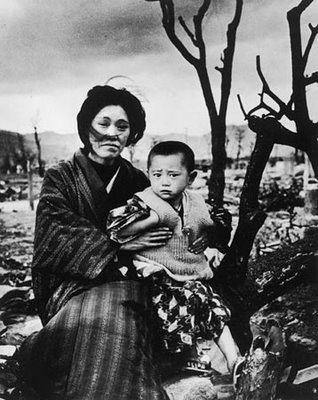
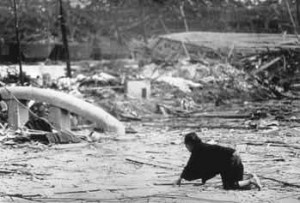
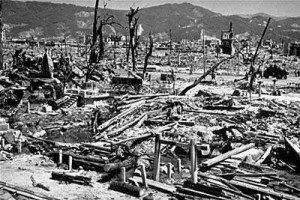
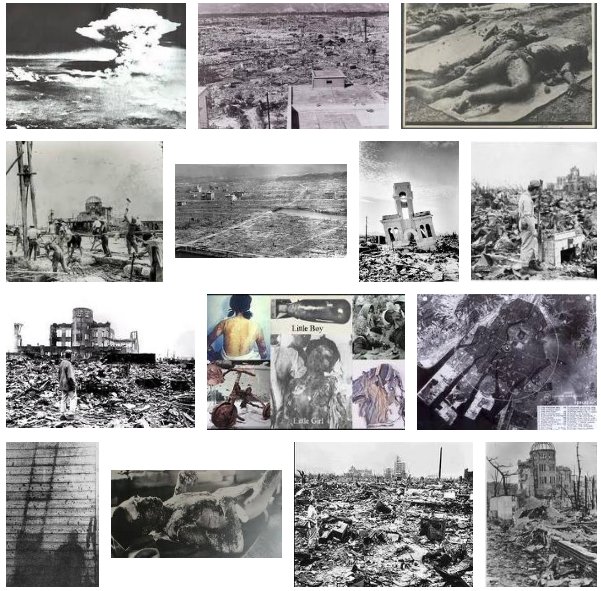
Then there are the effects. For most of these there are no words.
Aftermath of the Tokyo firebombing, 10 March 1945
Aftermath of the atomic bombing of Hiroshima, 6 August 1945
A boy caught by the bombing in Hiroshima
The explosion and mushroom cloud, seen from ground level in Nagasaki on 9 August 1945.
Nagasaki railroad station
A clock from Nagasaki, stopped at 11:02 AM
A woman caught by the bombing in Nagasaki
Iwakawa-machi residential neighborhood, Nagasaki
Here are some facts you do not need to remind me of today: that the government of the Empire of Japan launched a war of aggression against American territory and killed both American military and civilians; that they conducted a brutal war of conquest against China in which hundreds of thousands of civilians were mercilessly tortured and killed; that some fanatical elements of the military regime wanted to fight the United States down to the last man. That’s all true, but it’s quite beyond the point. None of these vicious acts by a vicious government justifies doing this to people, to civilians who had no meaningful role in either the decision-making or in the fighting. Nothing could. If you want to make a plea on behalf of terror-bombing, fine; do so. But not here. I’ll post again tomorrow or in a couple days, and we can argue there about the merits and demerits of burning 1,000,000 innocent people alive when you think you can get good results from it. But for now, the dead deserve at least a day of quiet mourning.
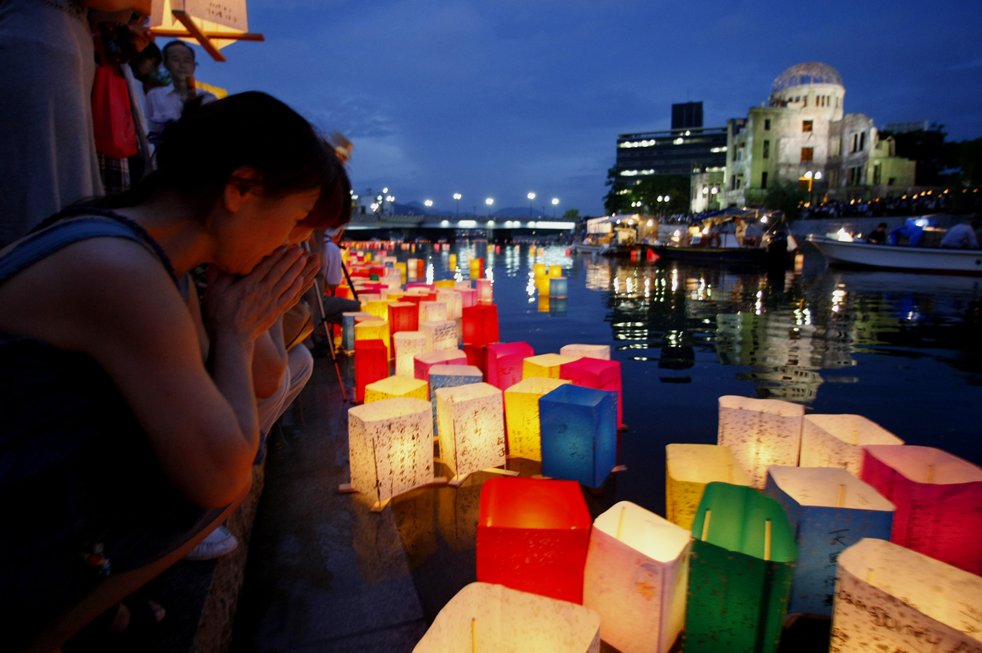
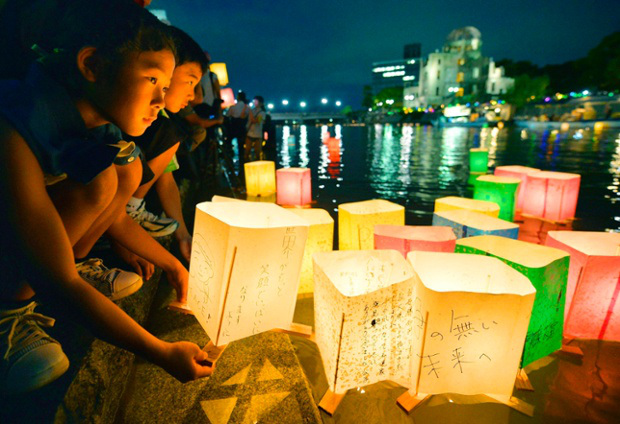
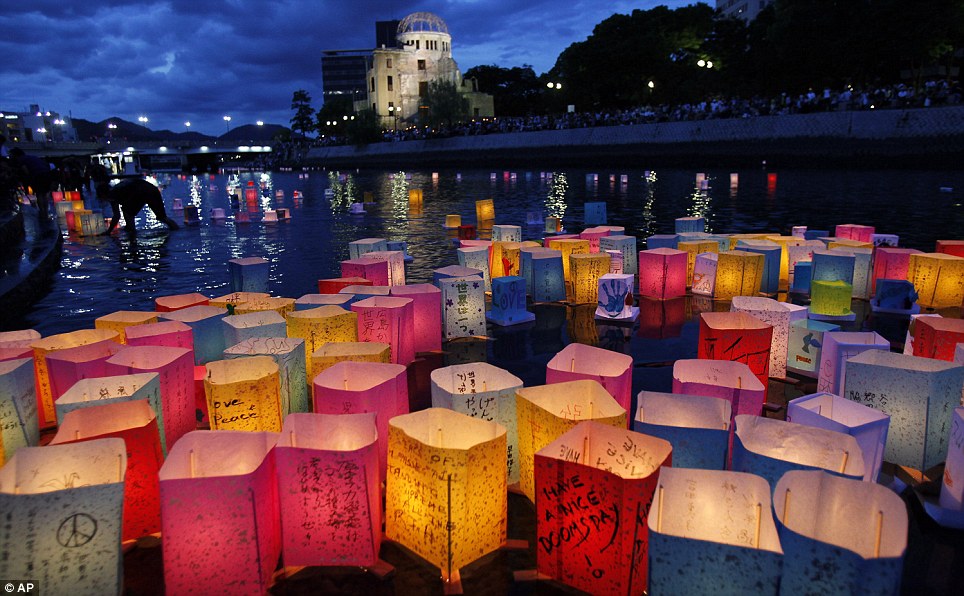
Today there’s a memorial for the victims standing in the Hiroshima Peace Park, with an inscription that reads Rest in peace, for this mistake will not be repeated.
Let us remember the dead, and pray that those words are true.