Posts tagged Radley Balko

Wednesday Lazy Linking

  • So Long. Radley Balko: Reason Magazine articles and blog posts. (2011-05-03). "I'm particularly excited about my final project here, a themed issue Jacob Sullum and I put together and co-edited. The July issue of Reason will take an in-depth look at the criminal justice system and the ramifications of America's massive prison population. Look for it in your mailbox or on newsstands at the beginning of next month." - Radley Balko (Linked Tuesday 2011-05-03.)

Legal lynching (cont’d)

Supreme Court Firms Up State Immunity From Wrongful Conviction Lawsuits. Radley Balko: Reason Magazine articles and blog posts. (2011-04-25):

By a ideologically right-left, 5-4 vote, the U.S. Supreme Court ruled today (PDF) that a wrongly convicted Louisiana man—who at one point was just weeks away from execution—isn't permitted to sue the DA's office that for 14 years sat on the evidence proving his innocence. Jacob Sullum wrote about Connick...

We need government courts instead of private protection and arbitration because private protection associations would be accountable to the rich and powerful instead of being accountable to the people.

Friday Lazy Linking

Siege Mentality (Cont’d)

Here’s some of Radley Balko’s recent story on mendacious War on Cops trend reporting. The footnotes, where present, were added by me.

Some police advocates have drawn unsupported conclusions from this rash of attacks, claiming that they are tied to rising anti-police sentiment, anti-government protest, or a lack of adequate gun control laws. Media outlets also have been quick to draw connections between these unrelated shootings. While these incidents are tragic, the ensuing alarmism threatens to stifle much-needed debate about police tactics, police misconduct, and police accountability.

Jon Shane, a professor at the John Jay College of Criminal Justice, told NPR the January shootings follow some bit of a larger trend in the United States, which he described as an overriding sense of entitlement[1] and don’t tread on me. Craig W. Floyd, chairman of the National Law Enforcement Officers Memorial Fund, told UPI, It’s a very troubling trend where officers are being put at greater risk than ever before. The same article summarized the opinions of other police leaders who think the shootings reflected a broader lack of respect for authority.

Richard Roberts, spokesman for the International Union of Police Associations, told MSNBC, It’s not a fluke….There’s a perception among officers in the field that there’s a war on cops going on. Police critic William Grigg notes that Smith County, Texas, Sheriff J.B. Smith told the NBC station in Tyler, I think it’s a hundred times more likely today that an officer will be assaulted compared to twenty, thirty years ago.[2] It has become one of the most hazardous jobs in the United States, undoubtedly—in the top five.[3]

… Dig into most of these articles, however, and you will find there is no real evidence of an increase in anti-police violence, let alone one that can be traced to anti-police rhetoric, gun sales, disrespect for authority, or “don’t tread on me” sentiment. (CNN is one of the few media outlets that have covered the purported anti-police trend with appropriate skepticism.) Amid all the quotes from concerned law enforcement officials in MSNBC’s War on Cops article, for example, is a casual mention that police fatality statistics for this month are about the same as they were in January 2010. Right after suggesting to NPR that the recent attacks were related to anti-government rhetoric, Shane acknowledged there has been little research into the underlying causes of police shootings.

In truth, on-the-job police fatalities have dropped nearly 50 percent during the last 20 years, even as the total number of cops has doubled. According to the National Law Enforcement Officers Memorial Fund, 279 cops were killed on the job in 1974, the worst year on record. That number steadily decreased to just 116 in 2009. The leading cause of death for cops on duty is car accidents, not violence. For the last several years, the number of officers intentionally killed on the job each year has ranged from 45 to 60, out of about 850,000 cops on the beat. That makes police officers about 50 percent more likely to be intentionally killed than the average American. But contrary to Sheriff Smith’s claim, the job isn’t among the 10 most dangerous in the country,[4] let alone the the top five, even if you include officers unintentionally killed in traffic accidents.

Radley Balko, reason.com (2011-01-31): The Anti-Cop Trend That Isn’t

You should read the whole thing.

As I said about this time last year, the years go by but the trend story rhetoric never changes. It never stops being the most dangerous year ever for cops, and criminals never stop getting more and more dangerous and desperate. Whenever there is a rash of reporting “civilian” violence against police, no matter how small or localized, this is always taken as conclusive evidence of a growing and troubling trend. Writers and spokesmen will grasp at even the slenderest evidence to assert one.[5] But whenever there is a rash of well-documented police violence against us civilians, it is always an anomaly — a scandal, perhaps, but an aberration, nothing more than a few more bad apples involved in yet another isolated incident, which is not to be related in any way to the institutional culture of policing or taken to reflect, in the least, general conditions in the hundreds of police departments where these things happen over, and over, and over again. The little people like us don’t merit trends, and to even suggest that we might is itself taken as an expression anti-cop bias — as, indeed, contributing to the very War on Cops that the police trendsters are denouncing. But for the armed agents of the state, trends are a vital part of the job, and if the trends do not exist, then it will be necessary to invent them.

As I said about this time last year:

In other words, it’s never been safer to be a cop in America than it has been over the past 2 years. Yet boss cops, spokespeople for the government police, and articles written by cops and for cops, constantly repeat the demonstrably false claims that criminals are more violent than ever before, and that government cops somehow face more danger on their patrols now than they ever have before. That this is a complete lie would be obvious to anyone who had spent 15 minutes perusing the police’s own institutions and resources for honoring their fallen comrades. The interesting question, then, is what kind of purpose the constant refrain of this unfact from government police serves — what it means when ever-more-heavily-armed government cops keep insisting on a completely mythical ever-present, ever-increasing danger to their politically-sacred persons, in spite of the evidence of the senses and the consistent trends over the last century of historical reality. When you see heavily-armed, well-protected men trying so very hard to psych themselves up to believe in a growing danger that does not actually exist — and when this constantly repeated Big Lie is used to slam pop-culture for any attempt to portray any abuse of police power; to swat down real-life complaints about police belligerence or invasions against civil liberties; to explain the alleged need for assault rifles, tanks, cordoning off strategic hamlets in inner cities, and a niche industry in warrior mindset trainings — I couldn’t much blame you if you did see some real danger in this concerted effort to inculcate and reinforce a consciously-constructed, fact-resistant permanent siege mentality among patrol cops. But not danger for the cops.

Do you feel safer now?

GT 2010-01-23: Siege Mentality

  1. [1] Sic! Hearing a retired cop boss like Jon M. Shane, a member of the most entitled and perpetually outraged and demanding class in America, complaining about the public’s overriding sense of entitlement is rather like listening to Frollo denouncing Esmeralda. —R.G.
  2. [2] A hundred times! In fact there were 21 percent fewer assaults on cops in 2009 than there were 20 years ago in 1990 (57,268 in 2009; 72,091 in 1990). Thirty years ago, in 1980, about as many cops were assaulted as were assaulted in 2009 (57,268 in 2009; 57,847 in 1980), but since the number of cops has more than doubled during that time, the per-capita likelihood that a cop would be assaulted in the past few years is much lower than it was thirty years ago. Cf. the FBI’s annual LEOKA reports for the numbers year over year. —R.G.
  3. [3] No, it hasn’t. —R.G.
  4. [4] It’s more dangerous to be a farmer or a garbage collector in America than it is to be a cop. —R.G.
  5. [5] There are, for example, the percentage games that Radley talks about in his article; I have also read articles in cop magazines repeatedly predicting one of the deadliest years for law enforcement which were published in Spring or Summer, based on about 3-6 month’s worth of data. This predictions are almost invariably wrong — for example, when it was predicted that 2010 would be one of the deadliest years for law enforcement since the late 1980s, it turned out instead that 2010 was the deadliest year for law enforcement since … 2005.

Dr. Anarchy Answers Your Rhetorical Questions

Today’s question comes from The Agitator (2011-01-20), about a recent police raid on a medical marijuana dispensary in the suburbs of Metro Detroit:

Dear Dr. Anarchy:

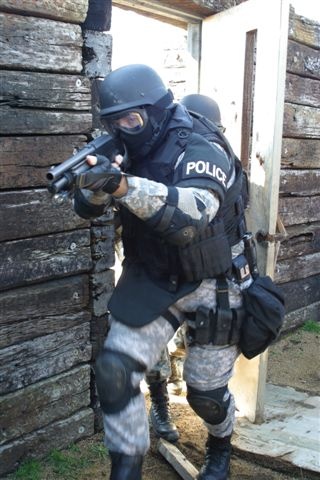
Earlier this month, police in Oakland County, Michigan raided a medical marijuana dispensary in the town of Oak Park. The deputies came in with guns drawn and bulletproof vests, with at least one wearing a mask.

They made no arrests, but they did clean the place out. The confiscated all of the dispensary’s cash on hand and—in a particularly thuggish touch—also took all of the cash from the wallets and purses of employees and patients.

… Under Michigan’s asset forfeiture law, 80 percent of the cash the deputies seized will go directly to the Oakland County Sheriff’s Department. The other 20 percent goes to the local prosecutor. Medical marijuana is legal under Michigan law but is of course still illegal under federal law. And apparently there’s some debate about the legality of dispensaries. All of which means this particular dispensary will have a hard time proving it earned the seized cash legitimately. I doubt the patients and employees will get their cash back, either. The cost of challenging the seizure is likely several times more than the amount of money most people carry on their person.

In light of all this, Balko asks, So how is this different from armed robbery?

The short answer to the rhetorical question is that it isn’t. The longer answer is that, aside from the gang colors, there are two differences between an official armed robbery like this one, and the stereotypical armed robbery carried out by freelancers.[1] The first difference is that when gangsters without badges rob you, you could in principle go to the police about it and try to get the robbers arrested. But when the gangsters who robbed you are the police, and are happy to arrest you if you complain about the robbery, then who do you go to?

The second difference is that after gangsters without badges rob you, at least they usually let you go on your way; they spend the money on private indulgences, and leave you alone. But when gangsters with badges rob you, they take the money and use it to finance the more raids, more arrests, more brutality, and more efforts to control the behavior of people like you and force you to submit to their insane and arbitrary laws. As Spooner writes in No Treason 6.3.5:

The highwayman takes solely upon himself the responsibility, danger, and crime of his own act. He does not pretend that he has any rightful claim to your money, or that he intends to use it for your own benefit. He does not pretend to be anything but a robber. He has not acquired impudence enough to profess to be merely a “protector,” and that he takes men’s money against their will, merely to enable him to “protect” those infatuated travellers, who feel perfectly able to protect themselves, or do not appreciate his peculiar system of protection. He is too sensible a man to make such professions as these. Furthermore, having taken your money, he leaves you, as you wish him to do. He does not persist in following you on the road, against your will; assuming to be your rightful “sovereign,” on account of the “protection” he affords you. He does not keep “protecting” you, by commanding you to bow down and serve him; by requiring you to do this, and forbidding you to do that; by robbing you of more money as often as he finds it for his interest or pleasure to do so; and by branding you as a rebel, a traitor, and an enemy to your country, and shooting you down without mercy, if you dispute his authority, or resist his demands. He is too much of a gentleman to be guilty of such impostures, and insults, and villainies as these. In short, he does not, in addition to robbing you, attempt to make you either his dupe or his slave.

So, the only difference between police forfeiture raids and the more stereotypical forms of armed robbery is that police forfeiture raids are worse.

  1. [1] Stereotypical, not typical. Armed robbery by government officials is just as typical as armed robbery carried out by freelancers. It’s just not discussed to the same extent.