Posts tagged Voting

Countereconomics on the shopfloor

So lately I’ve been reading through a cache of syndicalist and autonomist booklets that I picked up a couple years ago from a NEFACker friend of mine who was soon to move out of Vegas. Partly for my own edutainment, but also because I am doing some prep work for possibly introducing a sort of Little Libertarian Labor Library to the ALL Distro.[1] Anyway, here’s a really interest passage I ran across in a booklet edition of Shopfloor Struggles of American Workers — a talk by the Detroit auto-worker and autonomist Marxist Martin Glaberman — on the difference between asking workers to vote on an issue and asking them to strike over it, taking as an example the internal conflicts over the union bosses’ no-strike pledge during World War II.

One of the things I want to start with, because it does provide a framework, and is not simply an event from the past, is something I did some work on a number of years ago about auto workers in the United States during World War II, the kinds of struggles that went on on the shop floor, within the union, between the workers and the government, a complex reality. What it revolved around was the struggle against the no-strike pledge in the UAW When the United States entered World War II, virtually all of America’s labor leaders graciously granted in the name of their members a pledge not to strike at all during the war.

In the first months of the war, the first year, there was an actual drop off in strikes. The end of 1941 through 1942 was a period that put a finish to the late thirties, the massive organizational drives, the sit-down strikes, the violence, all the things that created the big industrial unions. The job hadn’t been entirely done. Ford wasn’t organized until early 1941. Little Steel wasn’t organized, unionized, until the war was well under way, and so on.

Gradually, however, as the war went on, the number of strikes, (by definition all of them were wildcats, all of them were illegal under union contracts and under union constitutions) began to escalate until by the end of the war, the number of workers on strike exceeded anything in past American labor history. What was distinct about the UAW wasn’t just that the wildcat strikes were larger in number and more militant, but the fact that something took place which made it possible to make a certain kind of record. It was the only union in which, because there were still two competing caucuses, leaving rank and file workers a certain amount of democratic leeway to press for their point of view, an actual formal debate and vote took place on the question of the no-strike pledge.

A small, so-called rank and file, caucus was organized late in 1943 and early 1944, to begin a campaign around a number of issues, but the central issue was the repeal of the no-strike pledge. … So[2] they proceeded to have a referendum. This referendum was in some respects the classic sociological survey. Everyone got a postcard ballot. Errors, cheating, etc. were really kept to a minimum. Everyone on the commission thought that it was as fair as you get in an organization of a million or more members. It took several months to do. When the vote was finally in, the membership of the UAW had voted about two to one to reaffirm the no-strike pledge.

The conclusion any decent sociologist would draw is that autoworkers on the whole thought that patriotism was a little bit more important than class interests, that they supported the war rather than class struggle and strikes, etc. There was a little problem, however, and this is why this is such a fascinating historical experience. The problem was that at the very same time that the vote was going on, in which workers voted two to one to reaffirm the no-strike pledge, a majority of autoworkers struck ….

To visualize it is fairly simple: you’re not voting on the shop floor; you get this postcard, you’re sitting at the kitchen table, you’re listening to the radio news with the casualty reports from Europe and the Pacific and you think, yes, we really should have a no-strike pledge, we’ve got to support our boys. Then you go to work the next day and your machine breaks down and the foreman says, Don’t stand around, grab a broom and sweep up, and you tell him to go to hell because it’s not your job and the foreman says he’s going to give you time off and the next thing you know, the department walks out. … The reality is that in a war which was probably the most popular war that America took part in, workers in fact, if not in their minds or in theory, said that given the choice between supporting the war or supporting our interests and class struggle, we take class struggle.

—Martin Glaberman, Shopfloor Struggles of American Workers (1993?)

Glaberman puts this out as a distinction between what workers say in their minds or in theory and what they say or do in fact. I’m not sure that’s right — doesn’t the story about the foreman involve the workers’ mind and beliefs just as much as the story about the kitchen table? — but I think the most important thing here is Glaberman’s attention to the context at the point of decision, and how that shapes what kind of decision a worker thinks of herself as making. Not just the outcome of the choice, but really the topic, whether the worker is asked to make some kind of political choice about what she ought, in some general and detached sense, she ought to value (isn’t Patriotism important?), or she finds herself making an engaged, personal choice about what’s happening — what’s being done — to her and her fellow workers right now, on the margin. There is a lesson here for counter-economists.

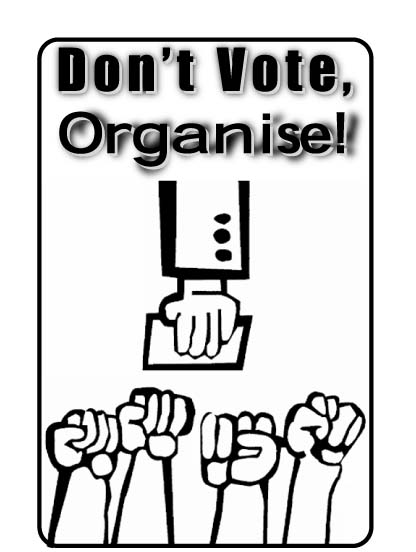
Freedom is not something you vote on. It’s something you struggle for. And what’s far more important than trying to figure out how to get people to endorse the right ideology, or, worse, the least-bad set of policies and candidates to each other across the kitchen table, is figuring out how you and your neighbors can best cooperate with each other, practice solidarity and withdraw from maintaining and collaborating with the state. People who would never respond to a smaller-government candidate or a libertarian ideological pitch often will act very differently when you open up opportunities to support grassroots alternatives and withdraw from the day-to-day inhumanities of war taxes, regulations, police, prisons, borders, and the state-supported and state-supporting corporate capitalist economy. Meanwhile, those who talk all day about changing votes, and building parties to more effectively capture a few more votes here and there, and have nothing else to offer, are wasting time, resources, and organizing energy on efforts that are not merely futile, but in fact actively lethal to any hope of motivating and coordinating effective practical action.

See also:
  1. [1] The basic idea: L4 would encompass some of the material we already have (Chaplin’s General Strike, Carson’s Ethics of Labor Struggle) and a lot of new and classic material, with new titles published at regular intervals, all with the basic underlying goal of (1) providing some decent labor-oriented materials for ALL locals, and (2) providing a decent source (mostly, currently, lacking) for IWW local organizing committees and other radical labor efforts to find some decently produced, low-cost booklet-style materials for lit drops and outreach tables, beyond just the IW, Anarcho-Syndicalist Review, and the relatively expensive books you can purchase through GHQ.
  2. [2] [After an inconclusive floor debate in convention. —RG]

Re: On the Road to Nowhere With Johnson and Paul

On the Road to Nowhere With Johnson and Paul. Center for a Stateless Society (2011-05-05):

Is it just me, or is the silly season of electoral politics — the presidential election cycle — arriving earlier and earlier in each successive four-year stretch? Last time around, it was nearly Memorial Day of the year preceding the election before pundits started speculating about when the obvious odd...

I have only two real objections. First, it just isn't true that Republicans are the party that says government doesn't work. They've spent decades being the most militant faction in favor of bigger, badder, more violent government. What they actually say is that government doesn't work at helping people, so government ought to be killing and torturing and imprisoning people instead. Lots and lots of people.

My second objection is that ABBA is a marvelous band and if what Gary Johnson and Ron Paul were actually planning to do was just to sit in a car all night listening to ABBA cassettes, I'd think they were pretty cool guys with a remarkably good social agenda.

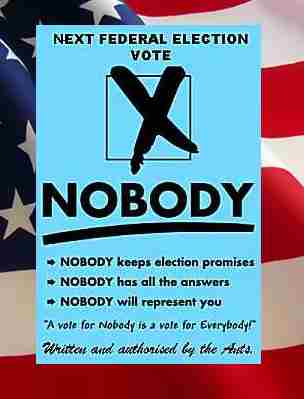
Don’t Vote

I’ve never opposed voting on moral principle. Of course, I oppose government on moral principle, but, Patriotically Correct mythology to one side, the notion that casting a vote has any meaningful relationship to controlling the apparatus of government is one of the more ridiculous lies that representative democracies — that is, elective oligarchies — such as the United States government love to promote. Defensive voting is not immoral; it’s a strategy. But strategies may be foolish. And if the last few election cycles have proved anything, they’ve proved that this is a strategy with no pay-off. No matter how many times you change out the party in power, the interests of power remain the same, and even when you win, you lose.

So I am boycotting the election today. I hope that you will too. I will not vote for any candidate for political office, Democrat, Republican, or other, no matter what promises they make, and no matter what party they come from. I do not support them as candidates, and I do not support the oligarchical political machine they represent. If the last few election cycles prove anything, they prove that power-plays beat promises every time. It’s not just a few radicals who have noticed that something is deeply wrong; it’s not just a handful of malcontents who know that we need a radically different direction, away from the insane and destructive Beltway consensus — away from this government’s wars, this government’s bail-outs, this government’s secret surveillance, corporate health-insurance cartels, PATRIOT Acts, runaway police powers, catastrophic economic policeis, shameless fear-mongering and constant, unremitting power-grabs. But people have HOPEd and parties have CHANGEd and if it all accomplished anything at all, it was only to prove that we’re never going to get anything but more of the same as long as we maintain a false hope in electoral politics. If what you want is social progress, there is no shortcut around principled agitation, grassroots social movements, community organizing, civil disobedience and direct action. There is no low-calorie political substitute for D.I.Y. social transformation. Elections and party politicking are no way to make a revolution. They’re not even a way to make small change.

No matter who you vote for, the winner is always the government.

Predictive value

According to a theory popular among certain kinds of anti-voting anarchists, anarchists shouldn’t vote, and should encourage other people not to vote, because general participation in voting creates the perception that the elected government is legitimate, whereas if only a tiny handful of people voted, or nobody voted, it would expose democratic government as illegitimate, and spur people to resist them or simply shrug them off.

If that’s true, then we ought to expect anarchy to be breaking out any… day… now… in Pillsbury, North Dakota.

Somehow, though, I expect that what we’re much more likely to see is that the lack of a clear No will just be taken as good enough for a Yes, and the same old assholes will go on doing the same old thing and collecting the same old taxes anyway.

(Story via Lew Rockwell 2008-06-16.)

Please note, by the way, that this post is not intended as a brief in favor of voting. If everyone in town had showed up and voted against every candidate on the ticket, that would still be interpreted as legitimation for the State. There is literally nothing you could do with respect to a government election, whether voting for, or voting against, or abstaining from voting entirely, that statists will not interpret as legitimating the State. Statists will interpret any damn thing you could possibly do as legitimating the State; that’s just what statists do.

WWLSD?

(Link via Austro-Athenian Empire 2008-01-23.)

happylee, in comments (2008-01-22) on Randy Barnett’s Volokh Conspiracy post on Lysander Spooner 200th birthday:

And we all know who Lysander Spooner would support for President in 2008: Ron Paul.

Happy Birthday indeed.

Rahul, in comments (2008-01-22) on the same post:

Amen HappyLee - ironically some folks who do appreciate Lysander Spooner find it difficult to support Ron Paul. One of the mysteries of this election cycle to me has been the abandoning of Ron Paul by most influential libertarians. Sad, but true.

Lysander Spooner, in comments (1886-05-15) on President Grover Cleveland’s inaugural address:

SIR, — Your inaugural address is probably as honest, sensible, and consistent a one as that of any president within the last fifty years, or, perhaps, as any since the foundation of the government. If, therefore, it is false, absurd, self-contradictory, and ridiculous, it is not (as I think) because you are personally less honest, sensible, or consistent than your predecessors, but because the government itself — according to your own description of it, and according to the practical administration of it for nearly a hundred years — is an utterly and palpably false, absurd, and criminal one. Such praises as you bestow upon it are, therefore, necessarily false, absurd, and ridiculous.

… You have not so much as the honest signature of a single human being, granting to you or your lawmakers any right of dominion whatever over him or his property.

You hold your place only by a title, which, on no just principle of law or reason, is worth a straw. And all who are associated with you in the government — whether they be called senators, representatives, judges, executive officers, or what not — all hold their places, directly or indirectly, only by the same worthless title. That title is nothing more nor less than votes given in secret (by secret ballot), by not more than one-fifth of the whole population. These votes were given in secret solely because those who gave them did not dare to make themselves personally responsible, either for their own acts, or the acts of their agents, the lawmakers, judges, etc.

These voters, having given their votes in secret (by secret ballot), have put it out of your power — and out of the power of all others associated with you in the government — to designate your principals individually. That is to say, you have no legal knowledge as to who voted for you, or who voted against you. And being unable to designate your principals individually, you have no right to say that you have any principals. And having no right to say that you have any principals, you are bound, on every just principle of law or reason, to confess that you are mere usurpers, making laws, and enforcing them, upon your own authority alone.

… But the falsehood and absurdity of your whole system of government do not result solely from the fact that it rests wholly upon votes given in secret, or by men who take care to avoid all personal responsibility for their own acts, or the acts of their agents. On the contrary, if every man, woman, and child in the United States had openly signed, sealed, and delivered to you and your associates, a written document, purporting to invest you with all the legislative, judicial, and executive powers that you now exercise, they would not thereby have given you the slightest legitimate authority. Such a contract, purporting to surrender into your hands all their natural rights of person and property, to be disposed of at your pleasure or discretion, would have been simply an absurd and void contract, giving you no real authority whatever.

… Every man has, by nature, the right to maintain justice for himself, and for all other persons, by the use of so much force as may be reasonably necessary for that purpose. But he can use the force only in accordance with his own judgment and conscience, and on his own personal responsibility, if, through ignorance or design, he commits any wrong to another.

But inasmuch as he cannot delegate, or impart, his own judgment or conscience to another, he cannot delegate his executive power or right to another.

The result is, that, in all judicial and executive proceedings, for the maintenance of justice, every man must act only in accordance with his own judgment and conscience, and on his own personal responsibility for any wrong he may commit; whether such wrong be committed through either ignorance or design.

No one could justify, or excuse, his wrong act, by saying that a power, or authority, to do it had been delegated to him, by any other men, however numerous.

For the reasons that have now been given, neither any legislative, judicial, nor executive powers ever were, or ever could have been, delegated to the United States by the constitution; no matter how honestly or innocently the people of that day may have believed, or attempted, the contrary.

… Such, Mr. Cleveland, is the real character of the government, of which you are the nominal head. Such are, and have been, its lawmakers. Such are, and have been, its judges. Such have been its executives. Such is its present executive. Have you anything to say for any of them?

Yours Frankly, LYSANDER SPOONER. BOSTON, MAY 15, 1886.

Lysander Spooner, in comments (1877-02-04) in J.M.L. Babcock’s New Age, on woman suffrage:

Women are human beings, and consequently have all the natural rights that any human beings can have. They have just as good a right to make laws as men have, and no better; AND THAT IS JUST NO RIGHT AT ALL. No human being, nor any number of human beings, have any right to make laws, and compel other human beings to obey them. To say that they have is to say that they are the masters and owners of those of whom they require such obedience.

The only law that any human being can rightfully be compelled to obey is simply the law of justice. And justice is not a thing that is made, or that can be unmade, or altered, by any human authority. It is a natural principle, inhering in the very nature of man and of things. It is that natural principle which determines what is mine and what is thine, what is one man’s [sic] right or property and what is another man’s right or property. It is, so to speak, the line that Nature has drawn between one man’s rights of person and property and another man’s rights of person and property.

… The excuse which the women offer for all the laws which they propose to inflict upon us is that they themselves are oppressed by the laws that now exist. Of course they are oppressed; and so are all men—except the oppressors themselves—oppressed by the laws that are made. As a general rule, oppression was the only motive for which laws were ever made. If men wanted justice, and only justice, no laws would ever need to be made; since justice itself is not a thing that can be made. If men or women, or men and women, want justice, and only justice, their true course is not to make any more laws, but to abolish the laws—all the laws—that have already been made. When they shall have abolished all the laws that have already been made, let them give themselves to the study and observance, and, if need be, the enforcement, of that one universal law—the law of Nature—which is the same at Rome and Athens—in China and in England—and which man did not make. Women and men alike will then have their rights; all their rights; all the rights that Nature gave them. But until then, neither men nor women will have anything that they can call their rights. They will at most have only such liberties or privileges as the laws that are made shall see fit to allow them.

If the women, instead of petitioning to be admitted to a participation in the power of making more laws, will but give notice to the present lawmakers that they (the women) are going up to the State House, and are going to throw all the existing statute books in the fire, they will do a very sensible thing,—one of the most sensible things it is in their power to do. And they will have a crowd of men—at least all the sensible and honest men in the country to go with them.

But this subject requires a treatise, and is not to be judged of by the few words here written. Nor is any special odium designed to be cast on the woman suffragists; many of whom are undoubtedly among the best and most honest of all those foolish people who believe that laws should be made.

You don’t have to agree with what Lysander Spooner says about legal or presidential authority in order to count as a libertarian (in at least some meanings of that term). You don’t even have to agree with what Spooner says about politicking or voting in government elections, as a matter of strategy, to count as an anarchist. But if you are going to confidently assert that we all know that, were he alive today, Lysander Spooner would favor efforts to get Ron Paul named President of the United States, and if you sneer at libertarians who don’t agree with the position that you imagine Lysander Spooner would be holding, then I do think that you ought to at least show some sign of having read something or another by Lysander Spooner that touches on the matters under discussion.

The only reasonable explanation I can give for these assertions is that the people making them have simply never gotten it into their head, in any way that matters, that someone with passionately held political views might not favor any political candidate at all, might in fact object on principle to the elective oligarchy that we fatuously term our democratic government, and might indeed believe that worthwhile political change must be achieved through means entirely different from any form of majoritarian party politics. Indeed, they’ve likely never gotten it into their heads, in any way that matters, that there even are other means for achieving political change. If I’m right, then maybe reading some Spooner, as they ought to anyway, will help them break out of narrow-minded devotion to electoralism and legalism. If not, as would be best, by changing their convictions, then, at very the least, by expanding their imagination.