Rad Geek People's Daily

official state media for a secessionist republic of one

Posts filed under Politics

U.S. Supreme Court grants reprieve to Troy Davis

The United States Supreme Court has issued a stay of execution to stop, at least for the time being, the State-mandated murder of Troy Davis.

The State of Georgia was planning to murder Troy Davis about an hour ago. They were planning to do so even though his conviction was based entirely on the testimony of nine eye-witnesses, seven of whom have since recanted their testimony and claimed that they were intimidated into giving false testimony by threats from the cops. Neither physical evidence nor a murder weapon was ever produced by the police. But the Georgia Board of Paroles and Pardons refused to give Davis a new evidentiary hearing, to investigate whether or not this man was about to be murdered based on nothing but lies, because a man’s life means nothing next to the importance of finality in the State’s criminal system. Yesterday the Georgia Supreme Court refused to stay the execution because, in their view, U.S. Supreme Court properly has jurisdiction over Davis’ pending petition, and a man’s life means nothing next to the importance of due deference to another judge’s turf. Never mind that, under normal circumstances, the U.S. Supreme Court would not even have been ready to hear Troy Davis’s plea for a new evidentiary hearing until after the State of Georgia killed Davis. Thankfully, after agreeing to an emergency hearing, the Supreme Court did the right thing and put a halt to the killing, at least until after Davis’s petition can be heard.

JACKSON, Georgia (CNN) — The U.S. Supreme Court granted a last-minute reprieve to a Georgia man fewer than two hours before he was to be executed for the 1989 slaying of an off-duty police officer. Troy Anthony Davis, 39, has his execution stayed by the U.S. Supreme Court on Tuesday.

Troy Anthony Davis learned that his execution had been stayed when he saw it on television, he told CNN via telephone in his first interview after the stay was announced.

He said he was thankful to God for the news that came during an emergency session the U.S. Supreme Court convened.

Davis said everyone should pray for the slain officer’s family.

The 39-year-old also said that he is very grateful for everything that everyone is doing for him and that he would accept whatever decision the Supreme Court rendered in the coming days about his case.

At the Diagnostic and Classification Prison in Jackson, a crowd of Davis’ supporters, led by the Rev. Al Sharpton, erupted in cheers when Sharpton announced the stay. Some shouted Hallelujah!

— Rusty Dornin, CNN (2008-09-23): U.S. Supreme Court stays Georgia execution

And Amen.

(Thanks to mi hermana for making my day better with this story.)

See also:

ALLy ALLy oxen free….

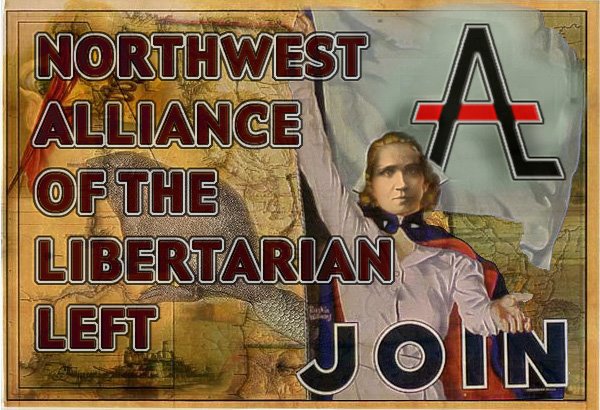
Guess who wins a government award, from the Ministry of Cultural Exchange in this secessionist republic of one, for the most attractive ALL local outreach logo?

The answer is Shawn Wilbur, of the Northwest Alliance of the Libertarian Left, with his call for ALLiance in Occupied Cascadia:

Northwest Alliance of the Libertarian Left - Join!

Sure beats my photoshop defacements of tourist traps and paint company logos, anyway. Congrats, Shawn!

Alliance of the Libertarian Left Ad Hoc Global Organizing Committee

Now, then. Do you know any individualist anarchists, agorists, mutualists, left-Rothbardians or others on the libertarian left in or nearby any of the following metropolitan areas, who might be interested in getting involved, or getting more involved, in local activism and organizing? (If that description matches you yourself, that's good enough, too.)

If so, please drop me a line with their contact information. I have some requests from prospective local organizers who are looking for people to start locals for the Alliance of the Libertarian Left. I would love to be able to put them in touch with anyone locally who might be interested.

On the subject of the Organizing Committee website, I’ve been getting some very good suggestions from other ALLies about materials to make available up there, and sketching out a few ideas of my own on paper. Most of these I hope to be adding over the next several days.

The main one that is now available, more or less live, is a feature to provide contact pages specific to each location where the Organizing Committee has gotten inquiries (click through on the links to each city above — for example, Baltimore — to see what it looks like). The main point is to have a landing-pad for each place we get an inquiry from, and to give prospective ALLies more information about how many people are interested in getting organized. Right now, this consists of a landing page, a map with one or more pins representing inquiring ALLies, and a quick count of the number who have inquired. My hope is to make this somewhat more sophisticated over time (right now, it’s mainly just some pretty wrapper over an e-mail form; I hope to add some features to find, e.g., how many people are interested in a particular state, possibly some sort of public Wall feature, etc.). But this will do for a start.

What I’d like to work on for the next few days is adding advice on getting started, on organizing, on ideas for activism, and so on. I’ll be incorporating some of the suggestions I’ve gotten already, and I’d like to put together some pages specifically on:

  1. A step-by-step guide to starting a new ALL local (along the lines of guides like Seven Steps To Starting A Food Not Bombs Group);

  2. Some advice focusing on organizing locals on college campuses, in particular;

  3. A sampler platter of actions and projects that existing ALLs have worked on, with an eye to giving people ideas for what they can do to kick off their ALL local, and what they might do as they get themselves established.

Which leads me to ask you all, gentle readers:

  1. If you have any suggestions, either for particular ideas or pieces of advice to add, or for focused sections that you think would be particularly useful, let me know. Let’s discuss in comments. And…

  2. If you were to pick out a sampler of four or five actions or projects that your own ALL local has worked on, or that some ALLies you know about have worked on, which you would like to add as suggestions for ALL organizers trying to make plans for a new ALL local, what would you pick? Let’s discuss in comments.

Onward.

See also:

You got served and protected #4: how Portland Police Bureau Officers Joseph Cook and Judy McFarlane used a “welfare check” to throw Contia Orsby out on the streets

(Via private correspondence from an ALLy in Occupied Cascadia.)

Here’s something I wrote about last year in my article for The Freeman:

Had the city government not made use of its supposed title to the abandoned land [to fence off the lot that the Umoja Village shanty-town had been built on], it no doubt could have made use of state and federal building codes to ensure that residents would be forced back into homelessness—for their own safety, of course. That is in fact what a county health commission in Indiana did to a 93-year-old man named Thelmon Green, who lived in his '86 Chevrolet van, which the local towing company allowed him to keep on its lot. Many people thrown into poverty by a sudden financial catastrophe live out of a car for weeks or months until they get back on their feet. Living in a car is cramped, but it beats living on the streets: a car means a place you can have to yourself, which holds your possessions, with doors you can lock, and sometimes even air conditioning and heating. But staying in a car over the long term is much harder to manage without running afoul of the law. Thelmon Green got by well enough in his van for ten years, but when the Indianapolis Star printed a human-interest story on him last December, the county health commission took notice and promptly ordered Green evicted from his own van, in the name of the local housing code.

Or, hell, they might not even bother with the regulatory formalities. Sometimes the cops just roll up on you for a welfare check and then take the opportunity to steal your home.

For example, Contia Orsby is a 58 year old black woman, who has spent most of her life helping sick people and, as far as I know, never did any real harm to anybody. She’s originally from Louisiana, and now living in Occupied Portland. She used to work as a geriatric nurse, but three years ago, she hurt her back so bad on the job that she couldn’t work anymore. The hospital gave her $14,000 to live off of for the rest of her life and then pawned her off on the state welfare bureaucracy, because they could, and the state welfare bureaucracy gave her the usual waiting time of forever, because they could. (They stay paid no matter how they act, and where else is she going to go?) When the money ran out, she got some help from her church, and when that ran out, she started living in her car. Which is cramped, and unpleasant, but sometimes safer and easier than trying to find people to put you up, and certainly safer than living on the streets.

Until July 4, 2008, when a pair of Gangsters in Blue decided to roll up on her and search her as part of a welfare check. Here’s how they looked out for her welfare–by stealing her car and throwing her out on the street.

On July 4, Portland Police Bureau Officers Joseph Cook and Judy McFarlane rolled up on Orsby at 2 pm as she was slumped in her car outside an apartment complex on SE 122nd. They searched Orsby and found a pair of brass knuckles in her pocket, which she claimed she was using as a key ring. The officers charged Orsby with having a concealed weapon, driving with a suspended license, and driving without insurance. Instead of taking her to jail, they towed her car, handed her the citations and drove off, leaving her homeless on the street.

All three charges against Orsby were thrown out last Thursday, September 11, after the district attorney’s office declined prosecution.

Matt Davis, Portland Mercury (2008-09-18): Towing the Line: Cops Take Car, Leaving Older Disabled Woman Homeless

In real life, outside of statist power-trip La La Land, if you fuck something up that doesn’t belong to you, for no good reason, you pay for it. Normally, if a pair of gang-bangers rolled up you and rousted you out of your car, against your will, when you weren’t doing anything at all to harm a single living soul, sanctimoniously claiming it was for your own good, then searched you, and rifled through your papers, then demanded to know why you were carrying a pair of brass knuckles (as if it mattered–if she were carrying them for her own protection, what’s wrong with that?), then called you a liar and declared your papers insufficient justification for your existence, and then, finally, used all this as an excuse to jack your car and threaten you with a fine you can’t pay or forced confinement in a jail–if they did all this, I say, and they got caught out, those gangsters would be in jail and they would be expected to return the car they’d stolen and pay for what they did out of their own pockets. But because these gang-bangers were Gangsters in Blue, and because they acted with the biggest gangster of all, the State Law-and-Order Protection Racket, at their back, when these charges were dropped, and the whole thing declared a big mistake, Portland Police Bureau Officers Joseph Cook and Judy McFarlane are virtually guaranteed never to suffer a single adverse consequence for their obvious, pointless, and cruel violation of poor people’s property rights. And neither they nor their bosses, the collaborationist puppet government of Occupied Portland, will do anything to make it right, beyond an Oops, our bad; in fact, they feel perfectly happy to force Contia Orsby to pay hundreds of dollars that she doesn’t have, just to recover her own property from the fence they sold it to.

CONTIA ORSBY, 58, stood with the deacon of her church on the lot of Andy’s Towing on SE 82nd last Friday afternoon, September 12. She was there to retrieve her all-white 1988 four-door Cadillac Brougham, bought five years ago for $4,700 from a used car lot up the street, during more fortunate times. It had briefly been her home, until police confiscated the vehicle on Independence Day.

Orsby had already handed over $400 to the towing firm, and $225 to get a release for her vehicle from the courthouse. Still owing $600 more, the manager of the towing company had generously cut her a deal.

He told me if I promised him $200 from my next disability check, I could come and get the car today, she said.

Too bad, because the towing firm had lost the keys: They called a locksmith, and tried to charge Orsby for the cost of cutting some new ones.

We’re doing you a favor, the manager told her. We’re only supposed to keep the car, technically, for 30 days.

Orsby refused to pay for the locksmith, and ultimately, the towing company handed over her car. Her deacon, Albert Woods, from the Emmanuel Church of God in Christ United on NE 30th, had taken the afternoon off to drive Orsby to the towing lot. He shook his head.

They wouldn’t treat her like this if she were the president, that’s for sure, he said.

Matt Davis, Portland Mercury (2008-09-18): Towing the Line: Cops Take Car, Leaving Older Disabled Woman Homeless

It’s true, and the management were certainly acting like dicks to her. But why can they get away with that kind of behavior? Simply because, as the fence for the cars stolen by the State, they have no reason to care about making things easy on you, or Contia Orsby, or anybody else. Why should they? They get most or all of their business from people like the President, not from people like you–people who are part of the State, a monopoly outfit which pays for itself through extortion rackets and robbery just like the screwjob they pulled on Contia Orsby, and who use their positions of political power to evade taking any responsibility for their own violations of the liberty and security that their cops and their so-called Law and Order are supposed to protect. Like any other fence, this one doesn’t much care about your life or your livelihood, and he doesn’t much care about helping you recover your stolen property. He serves the racket, not you. Do away with the racket, and you’ll do away with the other petty criminals and hangers-on that take their cuts from the loot.

You can contact the Portland Police Bureau to let them know what you think of their welfare checks and of Joseph Cook and Judy McFarlane’s efforts to force poor people out onto the street, at:

Portland Police Bureau
1111 S.W. 2nd Avenue
Portland, Oregon 97204

You can send comments to Chief Rosie Sizer at chiefsizer@portlandpolice.org, or call her office at (503) 823-0000, or send a FAX to (503) 823-0342.

I’ve said before that urban poverty as we know it is exclusively the creation of the State, and now I’ll add that this is especially true of homelessness as we know it. I don’t mean to claim that in a genuinely free society, with freed people, freed labor, and freed markets, with freedom for the poor and with no political patronage for the rich, that nobody would ever have to scratch by on short money. And I don’t mean that nobody would ever have to live without a house or apartment for a while due to short money. That would be a lot less common if people were free to scratch money together through creative hustling, to lower their fixed costs of living, and to join together for voluntary, neighborhood-based mutual aid, without having to bear the burdens of State-imposed taxes, usury laws, vagrancy laws, prohibition laws, border laws, business license laws, zoning laws, business laws, professional licensing laws, building codes, health and hygiene codes, fines and forfeitures, eminent domain land grabs and politicized development rackets, welfare bureaucrats, social workers and cops, and the rest of the whole taxation-and-regimentation government apparatus that constantly robs, cages, and busybodies poor people, all while sanctimoniously declaring that it’s all For Their Own Good, like one big welfare check on the Contia Orsbys of the world. If people were free of all that, hard times would be a lot less hard, but nobody can realistically promise an end to all tough times or shitty situations, whether by Anarchy or by any other means. Some people might lose their jobs, some people might go hungry, and some people might lose the roof over their heads. But homelessness as we know it — as a long-term, self-reinforcing downward spiral of destitution, in which hard times force people out onto the street, exposed to the elements and to danger from other people, or into overcrowded and dangerous institutional shelters — only exists because the State — the city and state governments, in particular — has a fixed policy of repeatedly sending gangs of thuggish police and busybody case-workers and bureaucratic inspectors around to hassle so-called vagrants; to subject them to constant citations, fines, arrests, and pointless humiliations; to roust them up out of any place that they settle in to stay; to violate their rights to homestead unused land, and to obstruct, invade, trash, or tow away any transitional, intermediate, or otherwise informal sort of shelter that poor people might try to arrange for themselves. It’s one thing not to be able to afford the sorts of houses and apartments and long-term rooming arrangements that journalists and economists and sociologists count as homes for the purposes of statistics and public debate. It’s quite another to be thrown out on the street without any kind of reliable shelter, and we all ought to recognize that as the child of the State. In that sense, all homelessness is forced homelessness, and all homeless people are the internally displaced refugees of the State’s ongoing War on Poverty and campaigns of economic cleansing.

But a rich man he says that Pig Hollow must go:
It’s a place where the crooks rendezvous.
But don’t you suppose if they burned down the bank,
They might flush a scoundrel or two?

And don’t you suppose if a bum with a torch
Set fire to some big fancy hall,
The cops’d come down like a blood-thirsty hound
And flat nail his hide to the wall?

It seems like the laws are all made for the rich;
They’ve got you, boys, win, lose, or draw.
Try as you may to keep out of the way,
You just get burned out by the law.

— Utah Phillips, Pig Hollow, on The Telling Takes Me Home (1975)

That’s how Contia Orsby got served and protected by Portland cops: by being thrown out of the car that is her home, on the excuse of a bunch of petty so-called crimes with no identifiable victims, having it towed away, and then, months later, when the State magnanimously allowed her to be left the hell alone, by being forced to pay to get it back even though she was never convicted of any crime, victimless or otherwise. If you're baffled that cops could get away with these kind of outrages, it may help to remember that in a lot of American cities, there just is no such thing as a civil police force. What we have would be better described as thuggish paramilitary units occupying what they regard as hostile territory: like any occupying force, the people they go after the first and the hardest are generally the people who are most vulnerable, and like any other occupying force there is no real recourse for anything they may choose to do on their patrols. Here as elsewhere, they are going to serve and protect us, whether we want them to or not, and if we don't like it then they've got plenty of guns and clubs and cuffs to make sure they can protect the hell out of us all anyway.

See also:
Internet Anarchist Revision Brigade: how Burt Green tried to write about statist anti-imperialism and blocked his sink with tea leaves

Here’s something George Orwell wrote back in 1946 dealing with, among other things, the political writing of his day.

Bad writers, and especially scientific, political, and sociological writers, are nearly always haunted by the notion that Latin or Greek words are grander than Saxon ones, and unnecessary words like expedite, ameliorate, predict, extraneous, deracinated, clandestine, subaqueous, and hundreds of others constantly gain ground from their Anglo-Saxon numbers. The jargon peculiar to Marxist writing (hyena, hangman, cannibal, petty bourgeois, these gentry, lackey, flunkey, mad dog, White Guard, etc.) consists largely of words translated from Russian, German, or French; but the normal way of coining a new word is to use Latin or Greek root with the appropriate affix and, where necessary, the size formation. It is often easier to make up words of this kind (deregionalize, impermissible, extramarital, non-fragmentary and so forth) than to think up the English words that will cover one’s meaning. The result, in general, is an increase in slovenliness and vagueness.

. . . As I have tried to show, modern writing at its worst does not consist in picking out words for the sake of their meaning and inventing images in order to make the meaning clearer. It consists in gumming together long strips of words which have already been set in order by someone else, and making the results presentable by sheer humbug. The attraction of this way of writing is that it is easy. It is easier — even quicker, once you have the habit — to say In my opinion it is not an unjustifiable assumption that than to say I think. If you use ready-made phrases, you not only don’t have to hunt about for the words; you also don’t have to bother with the rhythms of your sentences since these phrases are generally so arranged as to be more or less euphonious. When you are composing in a hurry — when you are dictating to a stenographer, for instance, or making a public speech — it is natural to fall into a pretentious, Latinized style. Tags like a consideration which we should do well to bear in mind or a conclusion to which all of us would readily assent will save many a sentence from coming down with a bump. By using stale metaphors, similes, and idioms, you save much mental effort, at the cost of leaving your meaning vague, not only for your reader but for yourself. This is the significance of mixed metaphors. The sole aim of a metaphor is to call up a visual image. When these images clash — as in The Fascist octopus has sung its swan song, the jackboot is thrown into the melting pot — it can be taken as certain that the writer is not seeing a mental image of the objects he is naming; in other words he is not really thinking. Look again at the examples I gave at the beginning of this essay. . . . In [the example from a Communist pamphlet], the writer knows more or less what he wants to say, but an accumulation of stale phrases chokes him like tea leaves blocking a sink.

Here’s an example of exactly that kind of writing, which I’ve taken from an article in Anarchy: A Journal of Desire Armed. Unfortunately, the writing in this article is a lot like the writing in a lot of articles that appear in AJODA (right alongside an Anarchist Media Review media review section that constantly complains about jargony or dreary writing in other, less widely distributed anarchist zines). I’ve chosen this passage in particular because the writer clearly seems to know what he wants to say, and what he’s got to say is basically true, but–well, let’s just try to read it.

As long as Anti-Imperialism is presented as the foremost or central contradiction of capitalism, it will have innate limitations which are constitutionally incapable of supercession.

In the first instance, Anti-Imperialism still has to account for the way it was used in the past, and will always for that reason bear the heavy burden of the crimes committed in its name. To those who fought against imperialism in the Philippines and Chile, in South Africa and Vietnam, one must take care to add those in East Germany, Poland, and Hungary, and those who fight today in Tibet.

The uncritical assumption of statist perspectives implicit in the positioning of the organization of the National Liberation Struggle as the revolutionary subject, conceals both the class divisions between the forces that make up this organization — especially those between the bureaucratic class-in-formation on the one hand and the working class, peasantry and those sections of the intelligentsia supporting independence on the other — and the common interest all proletarians have in the elimination of their elites, regardless of nationality. The establishment of sovereign government (that is, a state) as the revolutionary objective, carries with it similarly bourgeois assumptions. It partakes with enthusiasm of the artificial and arbitrary separation in the activities of capitalist national and international political economies created by international law. Anti-Imperialists declare the extra-national colonization of markets, polities, societies, and cultures to be somehow worse or different in essence from the exercise of the same principles of capitalist economy in the country of its origin (a contradiction is not overcome by references to internal colonies). They take the borders of capitalist states more seriously, especially in the present epoch, than capitalists do themselves.

On the other side of the equation, then, Anti-Imperialism has been a means of avoiding recognition of the independent interests and struggles of the working class and peasantry in the imperial dependencies, save from the point of view of distortions created by the advancement of exogenous imperial interests. This lack of proletarian perspective allows Anti-Imperialism to become a weapon to be used against (competing) foreign exploitation without a critique of local inequalities and forms of domination, much less of the political economy as a whole. This kind of Anti-Imperialism is easy for the likes of Vladimir Putin (the pacifier of Chechnya) and the misogynists of Hezbollah to employ without damage to themselves. It also provides useful ammunition to that most perfect of modern princes, Hugo Chavez, in whom are embodied both the Leftist, pseudomodern authoritarianism of his friend and political patron, Fidel Castro, the Maximum Leader of Cuba, and also the right-wing pseudotraditionalism of fascism, as imparted by his mentor, the Argentine anti-semite Norberto Ceresole, author of Caudillo, ejercito, pueblo. La Venezuela del presidente Chavez [Leader, Army, People, the Venezuela of President Chavez.]o

o It is high time that revolutionaries make proper acknowledgement of the complementary parts played by Marxism-Leninism and Fascism, as two wings of the same general movement of reaction against the rising proletarian, peasant, and intellectual insurgency of thel ate 19th and early 20th centuries. The earliest conscious expressions of these twin tendencies, those of Lenin on the one hand and Mussolini on the other, grew from the same source: (Marxian) social-democracy. The use of conspiratorial, quasi-military organization, of fronts and the infiltration of strategic organizations as a means to establishing influence, and then otion of themselves as the general staff of some kind of alleged revolution embodied in their own seizure of state power, unite these post-social-democratic factions. So does their presumption that the working class itself, incapable of more than a trade-union consciousness in Lenin’s infamous words, or unwilling to embark on crusades of national greatness (eg campaigns of forced capital accumulation, war), needs the Party, composed of this or that constellation of petit-bourgeois elements, at its head to lead it. To think that such tendencies, then or now, can be the allies of antiauthoritarian, anti-capitalist revolutionaries, is to ignore not just the overwhelming weight of the historical experience of the world’s proletarian revolutions, but the very material nature of the political economies and quality of life in the regimes created by these hyper-authoritarian Symbionese twins.

–Burt Green, Anti-Imperialism or Anti-Capitalism, in Anarchy: A Journal of Desire Armed 26.1 (Spring/Summer 2008). pp 41, 43.

How did you feel when you tried to read through this passage and the footnote? It actually makes several important points; I think at least one or two of the points it makes are both new and important. (For example, I think that the footnote at the end is really very sharp.) That’s the sort of thing that ought to be both fun and exciting to read. But in the entire passage I can think of only two places where the writing made me feel anything than a dull pounding on my forehead — They take the borders of capitalist states more seriously, especially in the present epoch, than capitalists do themselves, and that most perfect of modern princes, Hugo Chavez. The second phrase manages to be funny precisely because the pretense is watered by the sarcasm; the rest of the passge gives you the straight stuff and demands you drink it down. If we want to say the things we need to say, then we need to find better ways of saying it than this.

If you were going to try to rewrite a passage like this to try to make it more clear to those who haven’t spent years reading and writing in Marxist jargon, and more enjoyable to read even for those who have — to rewrite a passage like this so that the author’s point about anti-imperialist politics makes more of an impression than the dull, thudding drumbeat of his language — how would you go about it?

There are some obvious easy changes that you can make. Anytime someone writes a phrase like in the present epoch you can just about always cross it out and write in today; worker or working-class can be put anywhere that the author chose to put down proletarian, and you can strike exogenous and write in outside, or replace the whole phrase save from the point of view of distortions created by the advancement of exogenous imperial interests with something like except when the bosses are foreigners. But other stale fixed phrases (This lack of proletarian perspective …, … carries with it similarly bourgeois assumptions, … the working class, peasantry and . . . intelligentsia …) are harder to deal with. You could pretty them up a little by trimming unnecessary verbal filler and by taking out obviously pretentious words and replacing them with simpler ones. You can put lipstick on a pig, too. But the problem is that the dreariness of the writing has a lot to do with the dreariness of the thought itself. It’s not that the points being made are wrong, or even hackneyed, exactly. It’s that the approach to the point is hackneyed, that the writer can find no way of expressing what he wants to say except by leading you through this cut-and-paste collage of phrases from Marxist pamphlets and whitepapers. (As Orwell said, You see, he feels impelled to write — feels, presumably, that he has something new to say — and yet his words, like cavalry horses answering the bugle, group themselves automatically into the familiar dreary pattern.) That kind of writing needs more than copyediting; it needs to be rearranged or rewritten from the start, with paragraphs either thrown out entirely or transformed into something that you wouldn’t know for a rewriting of the original.

For example, let’s look at paragraph 3 and think about what you might do about a paragraph like this.

The uncritical assumption of statist perspectives implicit in the positioning of the organization of the National Liberation Struggle as the revolutionary subject, conceals both the class divisions between the forces that make up this organization — especially those between the bureaucratic class-in-formation on the one hand and the working class, peasantry and those sections of the intelligentsia supporting independence on the other — and the common interest all proletarians have in the elimination of their elites, regardless of nationality. The establishment of sovereign government (that is, a state) as the revolutionary objective, carries with it similarly bourgeois assumptions. It partakes with enthusiasm of the artificial and arbitrary separation in the activities of capitalist national and international political economies created by international law. Anti-Imperialists declare the extra-national colonization of markets, polities, societies, and cultures to be somehow worse or different in essence from the exercise of the same principles of capitalist economy in the country of its origin (a contradiction is not overcome by references to internal colonies). They take the borders of capitalist states more seriously, especially in the present epoch, than capitalists do themselves.

Instead of that, you might write something like this:

The picture of the world that anti-imperialist rhetoric paints is a picture seen through the eyes of warring states. If you want to know who will make the revolution, it forces you to look for a national fighting force, organized by geographical or ethnic borders. If you want to know what kind of revolution they will make, it forces you to look for a new government — a government run by locals, after the foreign governments have been forced back over the border.

The only way that anti-imperialist has to talk about revolution is to stand at made-up borders and yell Stop! — as if it made any difference whether it happens to be foreign bosses or local bosses who take control over workers’ jobs, culture, and living arrangements. Anti-imperialism takes the borders of capitalist states more seriously than the capitalists do themselves. This kind of revolution has nothing to say about what powerful people within the nation do to their victims — and particularly not what aspiring bureaucrats do to workers and intellectuals. It’s a distraction from workers’ real interest in getting out from under bosses, no matter where the bosses come from.

As far as I can tell, this would convey almost exactly the same meaning. There are some losses — for example, (a contradiction is not overcome by references to internal colonies). But I threw out the parenthetical because someone who was making the point clearly would not think that you could just stick that point where Green tried to stick it. It may have seemed like a good idea at the time, but if it did, it’s only because the rest of the paragraph consists of so many stock phrases strung together that just stringing another one in may have seemed like logic. But the comment in between the parentheses has to do with a particular way that some anti-imperialist writers have tried to adapt their rhetoric in order to avoid glossing over the internal forms of oppression that Green says anti-imperialist rhetoric glosses over. For example, people who used this line often said that the white man’s government treats black people inside the borders of the U.S.A. the same way that it treats foreign people in the Phillippines or Vietnam; and you might say the same thing about groups of people who are oppressed within a post-colonial country when a more powerful group takes over power from the old colonial government. But the parenthetical mentions this position without explaining any of that, or making any of it clear to anybody who isn’t already familiar with a lot of anti-imperialist jargon. And it just states that this adaptation of anti-imperialist rhetoric doesn’t actually solve the problem, without saying why it fails. If talking about internal colonies doesn’t help, then you need to say something about why it doesn’t help, and it would probably take long enough that it belongs in a new paragraph or a footnote. If you can’t do that much, then you’d be better off not mentioning it at all.

And there are also some additions — a couple of attempts at shifting the emphasis or making use of some imagery. Because if I just stopped at cutting out the parts that had gone bad, then the leftovers would be wholesome enough, but not enough to be filling — a single paragraph that’s short and clear, but also a paragraph with nothing to really drive the point home. That would be fine if this passage was a brief stop along the way to some other conclusion. But it’s actually supposed to be about half of the essay’s conclusion.

And now that I mention it, that brings up another problem. If the simple statement of the point is as simple and boring as the simple statement of this point is (so–it’s a mistake for radicals to use an approach that doesn’t deal with oppression inside national boundaries, because it’s the bossing that really matters, not where the boss comes from) then maybe the essay needs to say more than what it does, insead of just leaving off on such an obvious point. (For example, why spend so long making a point like this, when you could use that space to make a genuinely novel point, like the point about the similarities between conspiratorial Leninism and conspiratorial Fascism, instead of hiding that point away in a footnote?) So even this kind of rewriting, paragraph by paragraph, can only do so much. What a passage like this needs, in the end, is rethinking. What do you think? How would you do it? Given what he wants to say, how would you say it well?

No, seriously, I could swear the water in this pot is getting a little hotter… (#6)

Quick quiz. Try to identify where this photograph was taken, and what military force the people pictured in it are members of.

Here is a photograph of several men in dark uniforms with helmets and body armor, in combat posture, with assault rifles pointed directly at the camera. They are posed in front of a large tank. One man is standing in front of the tank, smiling, in a normal suit and tie.

The photograph was taken in Richland County, South Carolina. The people in the photograph are Richland County Sheriff Leon Lott and his Special Response Team. They are posed in front of their recently acquired Army-surplus Armored Personnel Carrier, which has a top speed of 30 miles per hour and a turret-mounted .50-caliber belt-fed machine gun. They call it the Peacemaker, apparently because this is exactly the sort of military hardware Jesus would use to terrorize or kill suspected meth addicts.

Sheriff Leon Lott told the Columbia State newspaper that he hoped the vehicle, named The Peacemaker, would let the bad guys know that his officers are serious.

We don’t look at this as a killing machine, Lott told the paper. It’s going to keep the peace. We hope the fact that we have this is going to save lives. When something like this rolls up, it’s time to give up.

— Police: The Law Enforcement Magazine (2008-03-06): S.C. Sheriff’s Department Armored Vehicle with Belt-Fed Machine Gun

Take another look at that photograph, and let me know whether that’s what peace looks like to you. Please keep in mind, if you happen to be in Richland County, South Carolina, that, in the view of the Sheriff’s Department, keeping the peace means putting so much firepower in the hands of government police that their capacity for violence terrorizes the rest of the populace out of any thought of defying or resisting their orders.

The Richland County Sheriff’s department got their new armored personnel carrier through a federal government program which provides military surplus weapons to local law enforcement agencies.

As Radley Balko said back in May, in response to another story:

I'm afraid this intermingling of domestic police and military is well beyond the point of no return.

Do you feel safer now?

(Via John Markley 2008-09-04, Radley Balko 2008-09-01, and Pete Guthier 2008-09-01.)

See also:

Anticopyright. All pages written 1996–2026 by Rad Geek. Feel free to reprint if you like it. This machine kills intellectual monopolists.