Rad Geek People's Daily

official state media for a secessionist republic of one

National holidays

Allowing people into a nation who do not identify themselves as part of that nation–who do not speak the language, who do not observe the holidays, who do not know or care about the history and ideals and cultural icons–is simply suicidal.

— Timothy Sandefur Illegal Alienation, at Positive Liberty (30 March 2006)

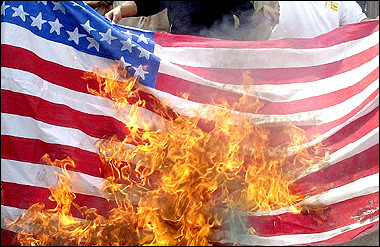
Now I am sure that all of you properly assimilated Americans realized that June 14th is Flag Day — a national commemoration of the military colors of this bayonet-bordered Union, first recognized in 1916 by the rabid white supremacist xenophobe, warmongering political persecutor, and President of the United States Thomas Woodrow Wilson. And I do hope that you all have observed this civic holy-day in a manner befitting the solemnity of the occasion, and the importance of such cultural icons to the flourishing — indeed, the survival — of so great a nation.

So perish all compromises with tyranny! And let all the people say, Amen! —William Lloyd Garrison

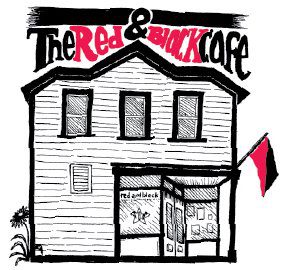
Support needed for The Red & Black in Portland

I just read this note from the Red & Black Cafe’s page on Facebook. If you’re not familiar, the Red & Black is a worker-owned co-operative restaurant in Portland, Oregon. The food’s all vegan; the ingredients are mostly organic, and either locally sourced or Fair Trade. The worker-owners are organized as an IWW shop, and directly manage their own workplace. It’s also an important hub for the anarchist community in Portland, providing a venue for regular talks, films, and other community events. I just sent $50; which is more than I can really afford right now, but the Red & Black, and places like it, matter. A lot. Any mutual aid you can send their way — or anyone you can tell about this situation — will really help. (The website doesn’t seem to have a post about the current situation yet; but you should be able to use the PayPal donation buttons in this post. I just attached a note to the donation asking them to put it to use wherever it would be most helpful.)

From the Red & Black collective, via Facebook:

The Red & Black is in trouble. Our finances have reached a crisis point. This situation has been brewing for many months as our cash flow slowly dried up. To be blunt: we are unable to make our mortgage payment on time and we've bounced checks to some of our vendors and staff. A couple of days ago at our collective meeting we contemplated shutting our doors for good.

So what happened? Like many other local restaurants after 4+ years of recession (depression?): we need more business. In this economy many people have less money to eat out. Our situation is compounded by the fact that we have never had anything near a comfortable amount of working capital. We attempted to raise sufficient capital during the fundraising drive we held when we decided to buy our building. While we did raise enough money to make our down payment, we were far from our goal. This left the collective financially vulnerable to the point that a slow month could bankrupt us. . . .

While there are several things we do that don't make a lot of business sense, financially, they are things we refuse to compromise on. We are welcoming to unhoused folks who often can't afford to spend money at the cafe. We make most of our food from scratch which is labor intensive and because our ingredients are (mostly) organic, they are more expensive.

We are also much more than just a restaurant. We are a community space; specifically we are a radical, queer-positive safer space; an important hub for many overlapping grassroots political projects, a cop-free zone, an amazing vegan restaurant, a music venue, a hangout and meeting space for Industrial Workers of the World union members, a low income collective household upstairs— the list goes on.

In order to meet this challenge head on we're making changes that we believe will not only avert catastrophe, but put us on a path of financial sustainability. The most dramatic and immediate change is that we've decided to work without pay until we can turn this situation around. This decision is both difficult and easy to make. Difficult because we, as individuals, can't afford it for long and because we are a closed union shop with the goal of paying ourselves a living wage. But the decision is also easy because the alternative is something none of us want: losing the Red and Black.

So we are fundraising $20,000 in donations, gift certificates and merchandise sales. This amount would not only cover our current obligations, it would mean having an adequate amount of working capital for the first time. We would be able to afford to go back to a paid wage, to purchase adequate equipment, fix the window, and keep the building. This is a crucial time for the Red and Black and we need your help! . . .

Please visit our website www.redandblackcafe.com to donate and Twitter @redandblackcafe for updates on our hours and menu. . . .
Shameless Self-promotion Sunday: Vines, Poisoned and Unpoisoned, Edition

This week — and for that matter this weekend — has mostly been a matter of desk-clearing for me. L. and I took a trip to Asheville — for the town, and for the mountains — over a wonderful, long weekend. We’re going out of town again, for a fairly long stretch, to visit family in the far North and for a couple of conferences. Anyway, the in-between time has been devoted to trying to fulfill some commitments, discharge some debts, and (to-day) going through a lot of web server error logs in an effort to clear up as many outstanding issues as possible before I skip town. The summer here in Alabama is still producing a mix of the gorgeous days and the lightly stultifying ones; but if the first kind are running out, the consolation is that gardens are coming around to their first harvests. Mean-while, though, for the moment I’m stuck inside, trying to prune off some less pleasant growths from computers while I’m around to take care of it.

How about y’all? What’s up with you this week? What have you been up to? Write anything? Leave a link and a short description for your post in the comments. Or fire away about anything else you might want to talk about.

CFP: Affinities, on “Challenging the rhetoric of non-State actors, political violence and ‘terrorism'”

Received to-day via the North American Anarchist Studies Network e-mail list. Feel free to distribute widely.

From: Michael Loadenthal
Subject: CFP: “Challenging the rhetoric of non-State actors, political violence, and ‘terrorism'”
Date: 28 May 2012 11:49am

Affinities: A Journal of Radical Theory, Culture, and Action
www.affinitiesjournal.org

Call for papers for Issue #6: "Challenging the rhetoric of non-State actors, political violence and !!!@@e2;20ac;2dc;terrorism'”

Affinities, a journal of contemporary radical politics, is now accepting submission proposals from individuals or collectives interested in contributing to a special edition focused on non-State actors, political violence and ‘terrorism.’ The purpose of this special edition of Affinities is to reengage critical anti-authoritarian scholarship with themes that challenge Statist attempts to control discourses around violence. Who is a terrorist? What is terrorism? When does resistance become violence? How does one label direct action movements? This special issue seeks to create space for an evolving discourse beyond the !!!@@e2;20ac;2dc;violence versus non-violence,' debate. How can we move stagnant conversations about tactical efficacy, the ethics of non-violence, the strategy of economic sabotage and direct action forward?

Submissions are warmly invited for this special issue as it our intent to open up a space for reflection, critique and revolutionary analysis. Submissions can come from any and all !!!@@e2;20ac;2dc;disciplines' including but not limited to: anarchist studies, critical theory, Marxist studies, Queer theory/LGBT studies, public anthropology, cultural studies, terrorism studies, security studies, peace studies, conflict analysis or others. We also accept nonpeer reviewed submissions from artists, activists, journalists and others outside of the academy.

Possible topics for submission include (but are not limited to):

  • Effective challenges to statist monopolization of discourses involving violence, terrorism, and the ethics of state vs. non-state violence
  • Anti-statists and their relationships to nationalist (liberation?) movements
  • What is militant non-violence and can it be effective?
  • Anarchist and other perspectives or critiques of violence in the Palestinian intifada, the Chechen jihad, the Angry Brigade, the Occupy movement...
  • How can radical communities respond to State terrorism and/or non-State violence?
  • What role can horizontal direct action movements have in mediating conflict?

To see previous issues of Affinities, or for more information on the journal, please visit www.affinitiesjournal.org. To propose a paper, please submit an abstract (500 words max.) no later than June 30, 2012, to Michael.Loadenthal@gmail.com. Authors whose abstracts are accepted for the special issue will be contacted by mid-July, with final articles to be due mid-October.

Please direct inquiries & abstracts to the issue editor: Michael Loadenthal (Michael.Loadenthal@gmail.com)

Universal health care does not mean government health care.

I’ve seen this note that I wrote a while back at ThinkProgress.org popping up here and there on the Internet. I’m glad that people have found it useful. Since it is currently locked up in a horrible Facebook-based dynamically transcluded comment thread thingy, I figured that I would re-copy and re-print here, so that the point, if it was worth making, can have a something of a real home on the Internet. The comment was in reply to a reply to Matt Yglesias’s reply to Roderick Long’s reply to a conversation between Wolf Blitzer and Ron Paul about healthcare policy. Roderick (rightly) thought that Paul’s answer to the questions betrayed a serious mistake about how to think about free-market healthcare. Yglesias (wrongly) thought that Roderick was encouraging libertarians to avoid the important question. A commentator called ds_at_yglesias chimed in:

If you oppose universal health care, you by definition support letting people who can’t afford health care die.

Most conservatives are socialized to not say such things in public, but of course they believe it.

–ds_at_yglesias, 15 September 2011, 7:39pm

Of course, I don’t give a tinker’s cuss about saving the reputation of political conservatives. But there’s an important conceptual issue for anti-authoritarians. So I replied (emphasis added):

Maybe so. (Certainly, there are plenty of conservatives who are all too comfortable with — or even enthusiastic about — a lot of needless suffering in the world.)

But I hope that you realize that not everyone who supports universal healthcare supports government healthcare, and not everyone who opposes government healthcare opposes universal healthcare. The one might follow from the other if the only way to get universal coverage were by means of a political guarantee of coverage. But that’s not so: there are folks who oppose government healthcare because they think corporate healthcare is awesome and they don’t mind if people die; but there are also folks who oppose government healthcare because they support non-governmental, non-corporate universal coverage through grassroots social organization and community mutual aid. (See for example http://radgeek.com/gt/2007/10/25/radical_healthcare/ or the closing sections of http://www.thefreemanonline.org/headline/health-care-debate-meaningful/.)

Of course, that leaves open the question of whether they (we — I’m one of ’em) are right about the best means for getting universal coverage. Maybe social means are inadequate; or maybe there is some reason, which has yet to be mentioned, why governmental control is preferable, as a means for getting it, to voluntary associations for mutual aid. But whether the position is right or wrong, it’s certainly not one that can be answered simply by defining it out of existence, as you do when you pretend that the only alternatives available are (1) corporate coverage of only those who can afford it; or else (2) universal coverage by means of government mandates; as if there were no (3) universal coverage by non-governmental means.

–Charles Johnson, 16 September 2011, 10:32pm

Also.

Anticopyright. All pages written 1996–2026 by Rad Geek. Feel free to reprint if you like it. This machine kills intellectual monopolists.