Isolated incidents
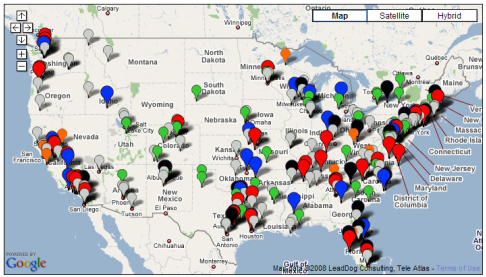
 Death of an innocent. Death of an innocent. |
 Death or injury of a police officer. Death or injury of a police officer. |
 Death of a nonviolent offender. Death of a nonviolent offender. |
 Raid on an innocent suspect. Raid on an innocent suspect. |
 Other examples of paramilitary police excess. Other examples of paramilitary police excess. |
 Unnecessary raids on doctors and sick people.
 |
official state media for a secessionist republic of one
Politics
| Death of an innocent. |
Death or injury of a police officer. |
Death of a nonviolent offender. |
| Raid on an innocent suspect. |
Other examples of paramilitary police excess. |
Unnecessary raids on doctors and sick people. |
Fed Chairman Ben Bernanke announced Sunday night Wall Street’s largest investment banks could borrow directly from the Fed just as commercial banks do now — and use questionable collateral, such as mortgage-backed securities, to boot.
Many critics say the central bank is pledging to rescue Wall Street without demanding an end to excesses that contributed to Monday’s jittery markets, creating a
moral hazardthat could lead to more excesses.
The Federal Reserve continues to give aid to the irresponsible,said one critic, Peter Morici, business professor at the University of Maryland. Others said the U.S. government seemed much quicker to bail out Wall Street bankers than people who cannot afford their mortgages.As it moved swiftly Sunday to bring about the sale of Bear Stearns, Wall Street’s fifth-largest investment house, the Fed allowed JPMorgan to use Bear Stearns’ mortgage-backed securities as collateral for some $30 billion in financing.
The central bank also reduced the interest rate on these loans to 3.25 percent and lengthened the payback term from 30 to 90 days.
When reporters asked Treasury Secretary Henry Paulson whether the Fed and the administration seemed more inclined to bail out big banks than Americans facing a home foreclosure, he noted Bear Stearns stockholders are going to lose on their investments.
…
Bernanke and his colleagues have concluded these Wall Street firms have become too big to fail and so need backup assistance from the Fed when needed, said Naroff.
You, on the other hand… well, sorry, honey, but you’re small enough to fail.
In fact, you’re small enough to get stuck with the bill for government efforts to prop up teetering financial titans.
Barry Bosworth, economist at the Brookings Institution, raised another question: Suppose another Wall Street firm gets into trouble over mortgage-backed securities and no one wants to buy them? Fed intervention might not be enough to save such a firm, he said.
This is a big break with the past,Bosworth said.Their job is to protect the overall economy on the financial side, and they can’t make distinction [between commercial and Wall Street banks] anymore.Some fear the Federal Reserve might be forced into bailing out troubled firms directly, by buying mortgage-backed securities or assets, rather than offering easy-term loans. But that’s seen only as a last resort.
The lesson to learn here is not, ultimately, that the federal government ought to be bailing out homeowners facing foreclosure instead of (or in addition to) Bear Stearns. It shouldn’t be doing anything of the sort. Government economic intervention is precisely what has caused this crisis, by using its money monopoly to systematically favoring large-scale, consolidated, irresponsible financial firms, and to forcibly smooth out the normal churning and higgling of capital markets for those firms’ benefit, at the expense of working people’s income and cash savings. They do it through the extortion racket that keeps a steady flow of cash to holders of government securities; they also do it through the counterfeiting racket that passes for money in these days, the supply of which a handful of politicians and banking bureaucrats can manipulate at will, so as to suck every last drop of purchasing power out of working people’s wages and cash savings, in order to disgorge it into the dollar-denominated accounts of the kind of people who get big loans of finance capital. Government economic intervention and the money monopoly in particular have been deliberately calibrated to redirect resources and control upwards into the responsible
hands of politically-connected investment banks and speculators, and then to send you the bill (either visibly in your taxes or invisibly through inflation) for the massive screwjob that they’ve perpetrated on you. These interventions, which amount to the black ops of the class war, go on because in the explicit ideology of the ruling class, political economy should be rigged to safeguard the interests of the biggest, richest, most entrenched incumbents, no matter how royally they screw up and how recklessly they play with other people’s money, while the rest of us, little folk that we are, are expected to eat the costs of not only our own mistakes, but the bankers’ and politicians’ too, because we are somehow better off being extorted or defrauded in order to ensure that all of us keep on living with our economic fortunes perpetually dependent on the engorgement of these corporate behemoths. Shifting that dependency, in the particular case of home foreclosures, from businessmen to the very politicians who have spent all these years robbing us for the businessmen’s benefit will not help the problem. It will only mean that the businessmen are able to pawn off one more liability on the government, while the rest of us are forced to pay through the nose for a government-structured solution
that changes nothing fundamental, and leaves us dependent on the good will of government bureaucrats instead of banking bureaucrats.
And that is the real lesson of this story: the class structure of the State and its economic regimentation. In Anarchy, with freed labor and freed markets, there is another way. A way for working people to be free to take control of their own lives, and to live by their own work, in their own homes, by voluntary mutual aid, and by gifts freely given. In which none of us, no matter how small,
will be forcibly corralled into depending, for our security, healthcare, homes, retirements, and livelihoods, on the interests of entrenched big
players–neither the economic fortunes of self-aggrandizing robber barons, nor the tender mercies of the political appropriations process. In which we will not be shaken down for extorted charity to cover the gambling debts of predators, parasites, and fools. That way is dumping the bosses off your back–both economically and politically–and the way to move forward on it is to move toward building a vibrant counter-economy, which can feed us while we starve out the monopolists, manipulators, and the rest of those who want to take our money, by force or fraud, so that they can go on living in the style to which they have become accustomed.
(Via La Chola 2008-03-17.)
Francisco Castaneda, a refugee from the civil war in El Salvador, died on February 16, 2008, from metastatic penile cancer.
He died because he went without getting a biopsy or receiving any medical treatment for about a year after obvious and excruciatingly painful symptoms began to show up. He went without the biopsy and the treatment because the United States government’s immigration Securitate had him locked in a cage at the time, and they repeatedly refused to let him get any treatment.
I came to the United States from El Salvador with my mother and siblings when I was ten years old to escape from the civil war. my family moved to Los Angeles where I went to school and began working at the age of 17. My mother died of cancer when I was pretty young, before she was able to get us all legal immigration status. After my mom died, I looked to my community for support, and found myself wrapped up in drugs instead, which, today, I deeply regret. I worked, doing construction, up until I went to prison on a drug charge, where I spent just four months before I was transferred into ICE detention.
When I entered ICE custody at the San Diego Correctional Facility in March 2006, I immediately told them I had a very painful lesion on my penis. After a day or two, Dr. Walker examined me and recognized that the lesion was a problem. He said he would request that I see a specialist right away.
But instead of sending me directly to a specialist, I was forced to wait, and wait, and wait, and wait. All the while, my pain got worse. It started to bleed even more and smell really bad. I also had discharge coming out of it. Aparrently the Division of Immigration Health Services was deciding whether to grant the request. Dr. Walker submitted the request more than once and, after more than a month, it was finally granted. When I saw an oncologist he told me it might be cancer and I needed a biopsy. He offered to admit me to a hospital immediately for the biopsy, but ICE refused to permit a biopsy and told the oncologist that they wanted to try a more cost-effective treatment.
I was then referred to a urologist, Dr. Masters, but I only got to see that urologist two-and-a-half months later, after I filed sick call requests and grievances with ICE. The urologist said I needed a circumcision to remove the lesion and sop the pain and bleeding, and also said I needed a biopsy to figure out if I had cancer. ICE and the Division of Immigration Health Services never did either of those things. They said that it was
elective surgery.My pain was getting worse by the day. When you are in detention, you can't help yourself. I knew I had a problem, but with everything you have to ask for help. I tried to get medical help everyday. Sometimes I would show the guards my underwear with blood in it to get them to take me to medical, but then they would say they couldn't do anything for me. All they gave me was Motrin and other pain pills. At one point, the doctor gave me special permission to have more clean underwear and bedsheets, because I was getting blood on everything. A guard from my unit once told me he would pray for me because he could see how much I was suffering.
Several more requests for a biopsy were denied. They told me in writing that I could get the surgery after I left the facility–when I was deported.
In late November 2006, I was transferred from San Diego to San Pedro Service Processing Center. When I got there I immediately filed sick call slips about my problem. after a few days I saw the doctors. I told them about my pain and showed them the blood in my boxer shorts and asked them to examine my penis. They didn't even look at it–one of them said I couldn't be helped because I needed
elective surgery.They just gave me more pain pills.In the middle of December, I noticed a lump in my groin. It hurt a lot and was a little bit smaller than a fist, so I filed a sick call slip about it. Another detainee told me it could be a hernia. I never got any treatment for it, and I later found out that was a tumor, because the cancer had already spread.
In the beginning of January, one of the guards told me I was going to Harbor-UCLA Medical Center. They put me in handcuffs and leg shackles and drove me in a van to the emergency room. When I got there the officer walked all around trying to find someone to see me, but he was told I would have to wait in line like everyone else. After about an hour of following him all chained up, he took me back to San Pedro and I didn't get to see anyone.
Back when I was in San Diego, another detainee gave me the phone number for the ACLU and said they might be able to help me. I called them, and spoke with Mr. Tom Jawetz, here, and told him my story about how much pain I was in. When I got to San Pedro he sent letters and called the people at the facility to try to help me get medical care. Finally, around the end of January, immigration agreed to let me get a biopsy. They made an appointment with the doctor, but just before the surgery they released me from custody. A doctor actually walked me out of San Pedro and told me I was released because of my serious medical condition and he encouraged me to get medical attention.
The first thing I did was call the doctor to see whether I could still get my biopsy. The secretary told me ICE had cancelled it. I then went back to the emergency room at Harbor-UCLA–the same place they had left me in the waiting room in shackles–and I waited to see a doctor and finally get my biopsy. A few days later, the doctor told me that I ahd cancer and would have to have surgery right away to remove my penis. He said if I didn't have the surgery I would be dead within one year. On February 14–Valentine's Day–nine days after ICE released me from custody, I had the surgery to remove my penis. Since then, I have been through five aggressive week-long rounds of chemotherapy. Doctors said my cancer spreads very fast–it had already spread to my lymph nodes and maybe my stomach.
I’m sure you can at least image some of how this feels. I am a 35-year-old man without a penis with my life on the line. I have a young daughter, Vanessa, who is only 14. She is here with me today because she wanted to support me–and because I wanted her to see her father do something for the greater good, so that she will have that memory of me. The thought that her pain–and mine–could have been avoided almost makes this too much to bear.
I had to be here today because I am not the only one who didn't get the medical care I needed. It was routine for detainees to have to wait weeks or months to get even basic care. Who knows how many tragic endings can be avoided if ICE will only remember that, regardless of why a person is in detention and regardless of where they will end up, they are still human and deserve basic, humane medical care.
In many ways, it's too late for me. Short of a miracle, the most I can hope for are some good days with Vanessa and justice. My doctors are working on the good days and, thankfully, my attorneys at Public Justice here in Washington, Mr. Conal Doyle in California, and the ACLU are working on the justice–not just for me, but for the many others who are suffering and will never get help unless ICE is forced to make major changes in the medical care provided to immigrant detainees.
I am here to ask each of you, members of Congress, to bring an end to the unnecessary suffering that I, and too many others, have been forced to endure in ICE detention.
This man’s life could have been saved. He wanted to get medical treatment in March 2006. His doctor recommended a biopsy. If he were a free man, he could have gotten this treatment, but as a prisoner of the U.S. government’s Homeland Securitate, he was forced to stay where they wanted him to stay, go where they wanted him to go, and get what they wanted him to get. So he lived with excruciating pain for two years while the cancer grew, spread, and ate him away from the inside. It didn’t matter when he developed a painful lesion; it didn’t matter when he bled everywhere for months; it didn’t even matter when he developed a tumor the size of his fist. What matters to the ICE bordercrats, and their hired thugs, is that this man once possessed a stimulant that the U.S. government didn’t approve of him having, and, to their minds, that’s a good enough reason to grab him at gunpoint, lock him in a cage for months on end, and then exile him from the home he has lived in since he was 10 years old. Or, in this case, to just lock him in the cage and deliberately deny him medical treatment until the imprisonment turns into a slow-motion death sentence for a nonviolent petty drug charge. What, after all, is the life of Francisco Castaneda — who is, after all, only a man, a son, the father of a teenaged girl — compared with the duty to zealously protect the prohibitionist domestic policies of the U.S. federal government, the awful importance of rigorously preserving the sanctity of imaginary lines in the southwestern desert, and the honor of the politico-cultural system of international apartheid, which those lines are drawn to implement?
Federal judge Dean Pregerson just issued a ruling in which he denounced ICE’s actions, or inaction, as conduct that transcends negligence by miles. It bespeaks of conduct that, if true, should be taught to every law student as conduct for which the moniker
The primary practical effect of this ruling is that Francisco Casteneda’s family will be able to sue ICE in federal court for his death. They certainly deserve whatever compensation they can get for this horrible crime. But even if they succeed, it must be remembered that the sanctimonious, unaccountable thugs who effectively tortured a peaceful man to death — the immigration cops, the prison guards, and the comfortable bureaucrats, government lawyers, and politicians who direct them in their actions — will never pay a damned cent for what they did. What they will do, if a judgment is entered against them, is to help themselves to tax money in order to make the pay-out, sticking the rest of us–who never had anything to do with their asinine border laws, immigration prisons, or callous indifference to human life–with the bill. Then they will go on doing exactly the same vicious and inhuman things to peaceful people who never did anything to deserve such appalling treatment. And why wouldn’t they? As far as they can see, they have every reason to believe that none of them will ever be held personally accountable for their choices.cruel
is inadequate.
My fellow citizens, events in Iraq have now reached the final days of decision. For more than a decade, the United States and other nations have pursued patient and honorable efforts to disarm the Iraqi regime without war. That regime pledged to reveal and destroy all its weapons of mass destruction as a condition for ending the Persian Gulf War in 1991.
Since then, the world has engaged in 12 years of diplomacy. We have passed more than a dozen resolutions in the United Nations Security Council. We have sent hundreds of weapons inspectors to oversee the disarmament of Iraq. Our good faith has not been returned.
The Iraqi regime has used diplomacy as a ploy to gain time and advantage. It has uniformly defied Security Council resolutions demanding full disarmament. Over the years, U.N. weapon inspectors have been threatened by Iraqi officials, electronically bugged, and systematically deceived. Peaceful efforts to disarm the Iraqi regime have failed again and again — because we are not dealing with peaceful men.
Intelligence gathered by this and other governments leaves no doubt that the Iraq regime continues to possess and conceal some of the most lethal weapons ever devised. This regime has already used weapons of mass destruction against Iraq’s neighbors and against Iraq’s people.
The regime has a history of reckless aggression in the Middle East. It has a deep hatred of America and our friends. And it has aided, trained and harbored terrorists, including operatives of al Qaeda.
The danger is clear: using chemical, biological or, one day, nuclear weapons, obtained with the help of Iraq, the terrorists could fulfill their stated ambitions and kill thousands or hundreds of thousands of innocent people in our country, or any other.
The United States and other nations did nothing to deserve or invite this threat. But we will do everything to defeat it. Instead of drifting along toward tragedy, we will set a course toward safety. Before the day of horror can come, before it is too late to act, this danger will be removed.
The United States of America has the sovereign authority to use force in assuring its own national security. That duty falls to me, as Commander-in-Chief, by the oath I have sworn, by the oath I will keep.
Recognizing the threat to our country, the United States Congress voted overwhelmingly last year to support the use of force against Iraq. America tried to work with the United Nations to address this threat because we wanted to resolve the issue peacefully. We believe in the mission of the United Nations. One reason the U.N. was founded after the second world war was to confront aggressive dictators, actively and early, before they can attack the innocent and destroy the peace.
In the case of Iraq, the Security Council did act, in the early 1990s. Under Resolutions 678 and 687 — both still in effect — the United States and our allies are authorized to use force in ridding Iraq of weapons of mass destruction. This is not a question of authority, it is a question of will.
Last September, I went to the U.N. General Assembly and urged the nations of the world to unite and bring an end to this danger. On November 8th, the Security Council unanimously passed Resolution 1441, finding Iraq in material breach of its obligations, and vowing serious consequences if Iraq did not fully and immediately disarm.
Today, no nation can possibly claim that Iraq has disarmed. And it will not disarm so long as Saddam Hussein holds power. For the last four-and-a-half months, the United States and our allies have worked within the Security Council to enforce that Council’s long-standing demands. Yet, some permanent members of the Security Council have publicly announced they will veto any resolution that compels the disarmament of Iraq. These governments share our assessment of the danger, but not our resolve to meet it. Many nations, however, do have the resolve and fortitude to act against this threat to peace, and a broad coalition is now gathering to enforce the just demands of the world. The United Nations Security Council has not lived up to its responsibilities, so we will rise to ours.
…
Many Iraqis can hear me tonight in a translated radio broadcast, and I have a message for them. If we must begin a military campaign, it will be directed against the lawless men who rule your country and not against you. As our coalition takes away their power, we will deliver the food and medicine you need. We will tear down the apparatus of terror and we will help you to build a new Iraq that is prosperous and free. In a free Iraq, there will be no more wars of aggression against your neighbors, no more poison factories, no more executions of dissidents, no more torture chambers and rape rooms. The tyrant will soon be gone. The day of your liberation is near.
…
Should Saddam Hussein choose confrontation, the American people can know that every measure has been taken to avoid war, and every measure will be taken to win it. Americans understand the costs of conflict because we have paid them in the past. War has no certainty, except the certainty of sacrifice.
…
As we enforce the just demands of the world, we will also honor the deepest commitments of our country. Unlike Saddam Hussein, we believe the Iraqi people are deserving and capable of human liberty. And when the dictator has departed, they can set an example to all the Middle East of a vital and peaceful and self-governing nation.
The United States, with other countries, will work to advance liberty and peace in that region. Our goal will not be achieved overnight, but it can come over time. The power and appeal of human liberty is felt in every life and every land. And the greatest power of freedom is to overcome hatred and violence, and turn the creative gifts of men and women to the pursuits of peace.
That is the future we choose. Free nations have a duty to defend our people by uniting against the violent. And tonight, as we have done before, America and our allies accept that responsibility.
Good night, and may God continue to bless America.
Happy Tyrannicide Day (observed)!
Today, March 15th, commemorates the assassination of two tyrants. Today is the 2,051st anniversary — give or take the relevant calendar adjustments — of the death of Gaius Julius Caesar, the military dictator who butchered his way through Gaul, set fire to Alexandria, and, through years of conquest, perfidy, and proscription, battered and broke every barricade that republican institutions had put in the way of military and executive power, until he finally had himself proclaimed dictator perpetuus, the King of Rome in everything but name. On March 15th, 44 BCE, a group of republican conspirators, naming themselves the Liberatores, rose up and stabbed Caesar to death on the floor of the Senate. Meanwhile, Thursday, March 13th, was also the 127th anniversary (give or take the relevant calendar adjustments), of the death of Czar Alexander II Nikolaevitch, the self-styled Caesar of all the Russias. Alexander was killed by grenades thrown by a group of anarchist conspirators on March 13th, 1881 C.E., in an act of propaganda by the deed. In honor of the events, the Ministry of Culture in this secessionist republic of one has proclaimed March 15th Tyrannicide Day (observed), which is kind of like President’s Day, except cooler. Instead of another dull theo-nationalist hymn on the miraculous births of two of the canonized saints of the United States federal government, Tyrannicide Day gives us one day in which we can commemorate the deaths of two tyrants at the hands of their equals — men and women who defied the tyrants’ arbitrary claims to an unchecked authority that they had neither the wisdom, the virtue, nor the right to exercise. Men and women who saw themselves as exercising their equal right of self-defense, by striking down the would-be tyrants just like they would be entitled to strike down any other two-bit thug who tried to kill them, enslave them, or shake them down.
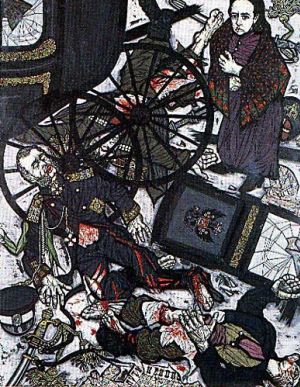
It is worth remembering in these days that the State has always tried to pass off attacks against its own commanding and military forces (Czars, Kings, soldiers in the field, etc.) as acts of terrorism.
That is, in fact, what almost every so-called act of terrorism
attributed to 19th century anarchists happened to be: direct attacks on the commanders of the State's repressive forces. The linguistic bait-and-switch is a way of trying to get moral sympathy on the cheap, in which the combat deaths of trained fighters and commanders are fraudulently passed off, by a professionalized armed faction sanctimoniously playing the victim, as if they were just so many innocent bystanders killed out of the blue. Tyrannicide Day is a day to expose this for the cynical lie that it is. As many reasons as there are to criticize the strategy behind the assassinations of Czars, Princes, and Dictators Perpetual, the fact that the brutal absolute monarch of a monster State lay dead at the end is not among them.
There are in fact lots of good reasons to rule out tyrannicide as a political tactic — after all, these two famous cases each ended a tyrant but not the tyrannical regime; Alexander II was replaced by the even more brutal Alexander III, and Julius Caesar was replaced by his former running-dogs, one of whom would emerge from the abattoir that followed as Augustus Caesar, to begin the long Imperial nightmare in earnest. But it’s important to recognize that these are strategic failures, not moral ones, and what should be celebrated on the Ides of March is not the tyrannicide as a strategy, but rather tyrannicide as a moral fact. Putting a diadem on your head and wrapping yourself in the blood-dyed robes of the State confers neither the virtue, the knowledge, nor the right to rule over anyone, anywhere, for even one second, any more than you had naked and alone. Tyranny is nothing more and nothing less than organized crime executed with a pompous sense of entitlement and a specious justification; the right to self-defense applies every bit as much against the person of some self-proclaimed sovereign
as it does against any other two-bit punk who might attack you on the street.
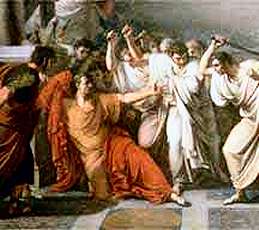
Every victory for human liberation in history — whether against the crowned heads of Europe, the cannibal-empires of modern Fascism and Bolshevism, or the age-old self-perpetuating oligarchies of race and sex — has had these moral insights at its core: the moral right to deal with the princes and potentates of the world as nothing more and nothing less than fellow human beings, to address them as such, to challenge them as such, and — if necessary — to resist them as such.
I have been informed that March 15th is also commemorated as the International Day Against Police Brutality. Make of that what you will; what the Ministry of Culture will make of it is an excellent opportunity for a program of commemorative song.
Our first piece is a skolion for the Athenian lovers Aristogeiton and Harmodius, who assassinated the tyrant Hipparchus in 514 BCE, using swords they had concealed in ceremonial myrtle wreaths. In the Athenian democracy, the couple were celebrated as martyrs for liberty, and often remembered in hymns and songs sung before banquets. This is Edgar Allan Poe’s 1827 translation of the most famous surviving Hymn to Aristogeiton and Harmodius; feel free to sing it at your Tyrannicide Day holiday dinner:
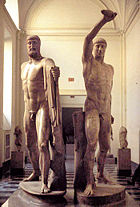
Wreathed in myrtle, my sword I’ll conceal
Like those champions devoted and brave,
When they plunged in the tyrant their steel,
And to Athens deliverance gave.Beloved heroes! your deathless souls roam
In the joy breathing isles of the blest;
Where the mighty of old have their home
Where Achilles and Diomed restIn fresh myrtle my blade I’ll entwine,
Like Harmodius, the gallant and good,
When he made at the tutelar shrine
A libation of Tyranny’s blood.Ye deliverers of Athens from shame!
Ye avengers of Liberty’s wrongs!
Endless ages shall cherish your fame,
Embalmed in their echoing songs!— Hymn to Aristogeiton and Harmodius, trans. Edgar Allan Poe (1827)
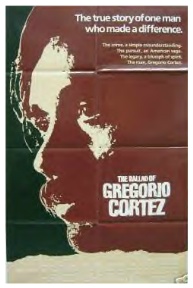
Our second piece, in honor of the combined occasions for the day, is one of the most famous outlaw corridos from the south Texas borderlands, The Ballad of Gregorio Cortez, a cowboy and small-time farmer in Karnes County, Texas, who became a legal cause celebre, and a folk hero for many Tejan@s, after he fought back against a racist sheriff in June 1901. Sheriff W. T. Brack
Morris was interrogating Cortez and his brother, and accused them of horse-thieving — based on nothing more than the fact that they did have a horse, and Cortez met the description of the suspect in a recent horse-theft — a suspect who had been described only as a middle-sized Mexican.
Morris tried to arrest Cortez; Cortez told him off, and said that Morris had no reason to arrest him. The deputy who was translating mistakenly claimed that Cortez had said No white man can arrest me;
that was enough for Morris, who pulled his gun and shot down Cortez’s brother. Cortez fired back, killing Morris, and then fled across the state on foot. He managed to elude capture for ten days, repeatedly making daring and close escapes when surrounded and outnumbered by sheriffs, posses, and the rinches (Texas Rangers). The cops threw his wife, his mother, and his children into jail. Anglo papers called for him to be lynched, and Anglo mobs rioted against Latin@s in Gonzales, Refugio, and Hayes counties. After Cortez was finally captured and put on trial for murder, his supporters organized legal defense campaigns, arguing that Cortez had killed only in to defend himself and his family; eventually they got all but one of the murder convictions reversed on appeal. In 1913, they convinced governor Oscar Colquitt to grant Cortez a conditional pardon. Meanwhile, his fame spread in the countryside through this ballad.
Like all corridos, there as many different versions of Gregorio Cortez as there are performances of it. This version is stitched together from my favorite parts of some of the several variants transcribed by Américo Paredes; cf., for example 1, 2, 3.
Gregorio Cortez
Traditional (1900s–1920s).
En el condado de El Carmen
miren lo que ha sucedido,
muri?@c3;b3; el Cherife Mayor
quedando Román herido.Se anduvieron informando
como media hora después
supieron que el malhechor
era Gregorio Cortez.Decía Gregorio Cortez
Con su pistola en la mano:
–No siento haberlo matado,
lo que siento es a mi hermano.–Soltaron los perroes jaunes
pa’ que siguieran la huella,
pero alcanzar a Cortez
era seguir a una estrella.Tir?@c3;b3; con rumbo a Gonzales
sin ninguna timidez:
–Síganme, rinches cobardes,
yo soy Gregorio Cortez.–Y en el condado del Kiansis
lo llegaron a alcanzar
y a pocos más de trescientos
allí les brinc?@c3;b3; el corral.Decía Gregorio Cortez,
con pistola en la mano:
–¡Ay, cuánto rinche cobarde
para un solo mexicano!–Cuando les brinc?@c3;b3; el corral,
seg?@c3;ba;n lo que aquí se dice,
se agarraron a balazos
y les mat?@c3;b3; otro cherife.Decían Gregorio Cortez
con su alma muy encendida:
–No siento haberlo matado,
la defensa es permitida.Sali?@c3;b3; Gregorio Cortez,
sali?@c3;b3; con rumbo a Laredo,
no lo quisieron seguir
porque le tuvieron miedo.Decían Gregorio Cortez:
¿Pa’ qué se valen de planes?
No me pueden agarrar
ni con esos perros juanes.Decían los americanos:
–Si lo alcanzamos ¿qué hacemos?
Si le entramos por derecho
muy poquitos volveremos.–Allá por El Encinal,
Seg?@c3;ba;n lo que aquí se dice,
le formaron un corral
y les mat?@c3;b3; otro Cherife.Ya se encontr?@c3;b3; a una mexicana,
le dice con altivez:
–Platícame qué hay de nuevo,
yo so Gregorio Cortez.–Dicen que por culpa mía
han matado mucha gente,
pues ya me voy a entregar
porque eso no es conveniente.–Venían todos los rinches,
por el viento volaban,
porque se querían ganar
diez mil pesos que les daban.Cuando rodearon la casa
Cortez se les present?@c3;b3;:
–Por la buena sí me llevan
porque de otro modo no.Deciá el Cherife Mayor,
como queriendo llorar:
–Cortez, entrega tus armas,
no te vamos a matar.–Decía Gregorio Cortez,
gritaba en alta voz:
–Mis armas no las entrego
hasta estar en calaboz’.–Ya agarraron a Cortez,
ya termin?@c3;b3; la cuesti?@c3;b3;n,
la probre de su familia
lo lleva en el coraz?@c3;b3;n.Ya con ésta me despido
a la sombra de un ciprés;
aquí se acaba el corrido
de don Gregorio Cortez.Gregorio Cortez
Trans. (2008) Charles Johnson.
In the county of El Carmen,
Look what’s gone down
The Big Ol’ Sheriff is dead,
Leaving Roman dying on the ground.They walked around asking questions
and in half an hour or so
they found out the man who did it
was Gregorio Cortez.And so said Gregorio Cortez,
with his pistol in his hand,
I don’t feel sorry that I killed him;
what I feel sorry about is my brother.They unleashed the hound dogs,
to follow on his trail,
but chasing after Cortez
was like following a star.
He tore off down toward Gonzales
Not timid in the least;
Come after me, cowardly rinches;
I am Gregorio Cortez.And in the county of Kiansis,
They showed up to try and grab him,
A bit more than three hundred
There, and he jumped out of their corral.And so said Gregorio Cortez,
With his pistol in his hand:
Man, look how many cowardly rinches
For just one Mexican!But when he jumped the corral,
What they say around here is,
The bullets started flying,
And he killed them another sheriff.And so said Gregorio Cortez,
With his soul burning bright,
I don’t feel sorry that I killed him.
A man’s got a right to defend his life.Then Gregorio Cortez got away,
got away down the way to Laredo;
they wouldn’t have wanted to follow,
Now he had them scared to.And so said Gregorio Cortez:
What’s the good of your plots?
You can’t get your hands on me,
Not even with those hound dogs.And so said the Americanos:
If we catch up to him, what can we do?
If we go after him in a straight-up fight,
There won’t be many coming back.Out there by El Encinal,
What they say around here is,
They got him in another corral
And he killed them another sheriff.Then he met another Mexican,
And he said with some arrogance,
What’s the news? Tell me–
I am Gregorio Cortez.
They say that because of me,
They’re killing lots of folks
So now I’ll turn myself in,
because that ain’t fit at all.Down came all the rinches,
Flying through the wind,
Because they wanted to get ahold of
Ten thousand pesos like they were offered.When they surrounded his house
Cortez showed himself to say:
You’ll take me in by my own will,
And not any other way.And so said the Big Ol’ Sheriff,
like he was about to cry:
Cortez, hand over your guns,
and you won’t have to die.And so said Gregorio Cortez,
With a great big yell,
I’m not handing my guns over
Until you’ve locked me in my cell.And so they took in Cortez,
And that’s where it came to an end.
His poor family
Carry him in their hearts.And with that I’ll say my goodbye
In the shade under a cypress;
Here I’ll finish off the ballad
Of Don Gregorio Cortez.
Thus always to tyrants. Beware the State. Celebrate the Ides of March!

terrorism