Rad Geek People's Daily

official state media for a secessionist republic of one

Posts filed under Politics

The State of the Debate

Las Vegas is having a city government election soon, and one of the noxious byproducts of the process are the debates among the ranting power-trippers who are scrapping for the jobs, which completely took over a perfectly good local news-talk program pretty much every singe day last week. The discussions are boring, and depressing, and mostly pointless, but they occasionally offer a bit of insight into the kind of a policy debate that electoral politics allows. For example, here’s an excerpt from Tuesday’s show, in which we hear from Jennifer Taylor (the challenger for the seat in Ward 6) and Steve Ross (the sleazebag currently in charge). Here they work out the range of politically acceptable debate over development in the desert around Las Vegas (which is to say, government hand-outs to politically-connected multimillionaire developers, and government land-grabs in which they arbitrarily dictate to landowners what sorts of things we do or do not need to put on their land).

Taylor leads off by proposing that she knows better than you do what sort of neighborhood you might like to live in, and that the city government ought to deal with this by forcing the developer to do what she wants rather than what they think their homebuyers will want.

JENNIFER TAYLOR: Let’s start specifically with some of the issues that I think Steve needs to address.

And of them is the absolute failure to work aggressively to truly diversify this economy. Two years ago, a group of us were down in front of Steve at City Council arguing about the Kyle Canyon development agreement, which would have allowed the construction of 16,000 homes on the eve of the foreclosure crisis. we said we really don’t need that kind of glut on the supply of homes because we were already seeing that there were problems. It would have also centered on a neighborhood casino, and I think it’s been pretty clear that when you lean solely on one industry that you end up in the type of quagmire that we are in now. We are suffering so much more than so many other cities who have taken proactive roles to diversify their economy….

DAVE BERNS: Back this up even more. When you talk about Kyle Canyon, and I hear you talking about homes out there and development… The 1,700 acre Kyle Canyon project would have put homes, shopping, offices, a casino, at the southwest corner of US95 and Kyle Canyon Rd, pretty much at the base of Mt Charleston. The developer, Focus Property Group, paid $510,000,000 for the land. In October of last year, Wachovia Bank foreclosed on the property after Focus Property defaulted on the loan. One of the criticisms that we heard of this project was that it was inappropiate. It didn’t belong at the base of Mt. Charleston.

JENNIFER TAYLOR: No it didn’t. It was just a basic, cookie-cutter repeat of projects that we had seen throughout the Valley, and really worse than that Dave, was that the contract was so poorly vetted and provided so little benefit to the citizens of Ward 6 compared to what Clark County and the city of Henderson had forced folks to do in Inspirada and Mountain’s Edge.

DAVE BERNS: Such as what?

JENNIFER TAYLOR: Such as open space. We had significantly less percentage of open space in that project; the density was significantly higher than those other projects; there was not as much public and service funding in the Kyle Canyon development agreement as there was for Inspirada and for Mountain’s Edge. And again, it centered on this whole concept of anchoring it around a neighborhood casino.

Of course, the real problem is not that the city government in Las Vegas has somehow failed to force developers to do the right things; the problem is the fact that the city government of Las Vegas controls who does and who does not get access to unused land in the first place. There was no right way for such a planned community development contract to be written, because there is no way to fake freed-market results through government monopoly on sales or politically-allocated ownership. So the solution is certainly not more aggressive government thuggery, but rather giving up entirely on the idea of half-billion-dollar politically-determined land sales for state-capitalistically planned communities.

Of course, Steve Ross is often referred to as a defender of private property rights and a friend of developers. No doubt he will point out the destructive thuggery of Taylor’s position, right? Well, here he goes: check out this principled defense of private property. (Emphasis is mine.)

DAVE BERNS: Let’s start off… let’s back up a step and then we’ll come to the campaign contributions. First of all, your position position on Kyle Canyon. Spell it out.

STEVE ROSS: You know, it’s a great thing that we live in America, where if someone wants to do something with property, they’re allowed to apply to do whatever they want with their property.

— knpr’s State of Nevada (2009-03-31)

Wait.

I’m not sure I heard that right.

You mean, they’re allowed to do whatever they want with their property, right?

STEVE ROSS: When somebody owns a piece of property they have the right to apply and do what they want with it. My role as a city councilman in the northwest is to ensure that development in that project is right for this city. Somebody owns the land at Kyle Canyon road and US95, they’re allowed to apply to do something with it. They want to build something, they’re allowed to do that. And that’s how our laws are.

— knpr’s State of Nevada (2009-03-31)

Oh.

Right.

So that’s your freedom, fellow citizen — and such an important freedom that Steve Ross had to make sure he repeated it three times within a few minutes: that, when you want to put something up on your own damn land, you have the precious right to apply to the government to do something with it.

This may be the purest expression I have ever heard of the only kind of debate that’s allowed in city politics, here in Vegas and in countless other cities across the country, when it comes to private property and land use: the Smart Growth tools who figure that you can somehow force government-privileged monopolists to do the right thing, and, on the other hand, the Growth Machine tools who will stand up resolutely and defend, come hell or high water, your freedom to apply for permission to do whatever you want on your own land.

In case you were wondering, here’s an example of why Steve Ross, by the grace of Law Warden of 6 and Vaquero Supreme of the Vegas Valley, might decide that your plans to do something peacefully on your own property just isn’t right for this city of his: it might interfere with neighboring property owners’ wishes to make sure that land that doesn’t belong to them gets subdivided into equestrian estates instead of affordable family homes.

DAVE BERNS: Can you think of a residential development where somebody owns some property — Focus Group, Olympic Group, whatever it may be — that you would vote No on. As you say, if they own the land, they have the right to do with it as they may, as long as they follow our laws. Can you think of any project, Steve Ross, that you would reject, as a member of the city council?

STEVE ROSS: Oh, absolutely.

DAVE BERNS: A residential project?

STEVE ROSS: Yeah, let me give you a heads up here.

DAVE BERNS: Give us an example of why you would.

STEVE ROSS: Well, let me give you an example of actually something that did get approved, but not according to how the homebuilder want to build them.

DAVE BERNS: Please.

STEVE ROSS: There was a project out in the northwest, on the north end of Jones Blvd. The developer wanted to build a highly dense community in basic ranch land. I mean, there are 2 to 10 acre ranches out there in the northwest, and it didn’t fit. This neighborhood was going to be next to a proposed 300 acre equestrian facility that’s still proposed for the northwest, one day when we have the funds to do it. The developer, again, I had the developer go meet with those neighbors out there long before it came to city council. Interest enough–projects are vetted out in the neighborhoods long before they get to the council level. And projects don’t make it to the council level if the neighborhoods don’t like them. And that’s just the nature of how it works. This one particular neighborhood, they wanted half-acre equestrian estates on this property. And the developer bent over and said, OK, I will do that. I will build half-acre equestrian estates, because it’s in a rural neighborhood; we want to maintain the rural nature of this area, and that’s what they did. And not because of me, but because of the neighborhood.

— knpr’s State of Nevada (2009-03-31)

When I tell people that I don’t see the use of lobbying or electoral politics as a means to social change, the first response that I get is typically some kind of complaint that I’m out of touch with the real world; that if I want to make a practical change, I have to jump in and try to intervene in the power-games of the existing political aparat. This kind of complaint is the worst sort of nonsense — the kind of dogmatic practicality that you constantly get from people who are unwilling to actually think about what gets the goods, rather than what the tiny minority of professional politicians and media professionals have decided to dignify as proper political etiquette. In the real world, the debate is perpetually, structurally locked into a very limited range of positions, oriented around two poles that are themselves fixed by the platforms of the two established political parties, and if you want to try proposing anything outside of that range of politically-acceptable debate — like, say, a genuine notion of personal freedom, or a principled opposition to government planning and privateering corporate development scams — you will quickly find that such arguments find no purchase, and no interest within any of the political parties. The message won’t fit through the channels that electoral politics makes available. If you want to advance the ideas, you are going to have to do so through other means, that aren’t filtered by the conventional idiocies, or constrained by the structural barriers, of electoral politics, because as long as you’re subject to those filters and that structure, you’re not going to get much out other than a debate like this, between the virtue of force and the importance of your God-given right to apply to the government to do whatever you want on your own property, as long as the neighbors don’t want equestrian estates, instead.

Good night, and good luck.
See also:

It doesn’t take much imagination.

Here is Ron Paul, speaking about an occupation.

Imagine an Occupied America

Imagine for a moment that somewhere in the middle of Texas there was a large foreign military base, say Chinese or Russian. Imagine that thousands of armed foreign troops were constantly patrolling American streets in military vehicles. Imagine they were here under the auspices of keeping us safe or promoting democracy or protecting their strategic interests.

Imagine that they operated outside of U.S. law, and that the Constitution did not apply to them. Imagine that every now and then they made mistakes or acted on bad information and accidentally killed or terrorized innocent Americans, including women and children, most of the time with little to no repercussions or consequences. Imagine that they set up checkpoints on our soil and routinely searched and ransacked entire neighborhoods of homes. Imagine if Americans were fearful of these foreign troops and overwhelmingly thought America would be better off without their presence.

Imagine if some Americans were so angry about them being in Texas that they actually joined together to fight them off, in defense of our soil and sovereignty, because leadership in government refused or were unable to do so. Imagine that those Americans were labeled terrorists or insurgents for their defensive actions, and routinely killed or captured and tortured by the foreign troops on our land. Imagine that the occupiers’ attitude was that if they just killed enough Americans, the resistance would stop, but instead, for every American killed, 10 more would take up arms against them, resulting in perpetual bloodshed. Imagine if most of the citizens of the foreign land also wanted these troops to return home. Imagine if they elected a leader who promised to bring them home and put an end to this horror.

Imagine if that leader changed his mind once he took office.

The reality is that our military presence on foreign soil is as offensive to the people that live there as armed Chinese troops would be if they were stationed in Texas. We would not stand for it here, but we have had a globe-straddling empire and a very intrusive foreign policy for decades that incites a lot of hatred and resentment toward us.

— Ron Paul, Antiwar.com (2009-03-10): Imagine an Occupied America. Hyperlinks mine.

That’s one reality. The other reality is all this imagining doesn’t actually take much imagination. The occupation is already here; the uniforms are different, but the practices are the same. The problem here is not us — it is U.S. And if us means you and me and our neighbors, then it’s important to keep in mind that, so long as I have no way of vetoing the acts or withdrawing my material support from projects done on my dime and supposedly in my name, all of us have much more in common with the other victims of Washingtonian command and control than we do with the commanders and controllers.

See also:

Men in Uniform #2

(Via Austro-Athenian Empire 2009-03-21.)

The office at the Adiv fabric-printing shop in south Tel Aviv handles a constant stream of customers, many of them soldiers in uniform, who come to order custom clothing featuring their unit’s insignia, usually accompanied by a slogan and drawing of their choosing. Elsewhere on the premises, the sketches are turned into plates used for imprinting the ordered items, mainly T-shirts and baseball caps, but also hoodies, fleece jackets and pants. A young Arab man from Jaffa supervises the workers who imprint the words and pictures, and afterward hands over the finished product.

Dead babies, mothers weeping on their children’s graves, a gun aimed at a child and bombed-out mosques — these are a few examples of the images Israel Defense Forces soldiers design these days to print on shirts they order to mark the end of training, or of field duty. The slogans accompanying the drawings are not exactly anemic either: A T-shirt for infantry snipers bears the inscription Better use Durex, next to a picture of a dead Palestinian baby, with his weeping mother and a teddy bear beside him. A sharpshooter’s T-shirt from the Givati Brigade’s Shaked battalion shows a pregnant Palestinian woman with a bull’s-eye superimposed on her belly, with the slogan, in English, 1 shot, 2 kills. A graduation shirt for those who have completed another snipers course depicts a Palestinian baby, who grows into a combative boy and then an armed adult, with the inscription, No matter how it begins, we’ll put an end to it.

. . . A few of the images underscore actions whose existence the army officially denies – such as confirming the kill (shooting a bullet into an enemy victim’s head from close range, to ensure he is dead), or harming religious sites, or female or child non-combatants. In many cases, the content is submitted for approval to one of the unit’s commanders. The latter, however, do not always have control over what gets printed, because the artwork is a private initiative of soldiers that they never hear about. Drawings or slogans previously banned in certain units have been approved for distribution elsewhere. For example, shirts declaring, We won’t chill 'til we confirm the kill were banned in the past (the IDF claims that the practice doesn’t exist), yet the Haruv battalion printed some last year.

The slogan Let every Arab mother know that her son’s fate is in my hands! had previously been banned for use on another infantry unit’s shirt. A Givati soldier said this week, however, that at the end of last year, his platoon printed up dozens of shirts, fleece jackets and pants bearing this slogan.

It has a drawing depicting a soldier as the Angel of Death, next to a gun and an Arab town, he explains. The text was very powerful. The funniest part was that when our soldier came to get the shirts, the man who printed them was an Arab, and the soldier felt so bad that he told the girl at the counter to bring them to him.

— Uri Blau, Ha'aretz (2009-03-20): Dead Palestinian babies and bombed mosques – IDF fashion 2009

One of the most consistent themes running through the designs for these t-shirts is the use of sexualized violence — in particular, cartoons of rape and verbal threats of rape against women and men identified with the enemy — as the punchline and the basis for bonding among the men in uniform.

There are also plenty of shirts with blatant sexual messages [sic –R.G.]. For example, the Lavi battalion produced a shirt featuring a drawing of a soldier next to a young woman with bruises, and the slogan, Bet you got raped!

. . . After Operation Cast Lead [the Israeli government’s invasion of Gaza from December 2008 – January 2009], soldiers from that battalion printed a T-shirt depicting a vulture sexually penetrating Hamas’ prime minister, Ismail Haniyeh, accompanied by a particularly graphic slogan. S., a soldier in the platoon that ordered the shirt, said the idea came from a similar shirt, printed after the Second Lebanon War, that featured Hassan Nasrallah instead of Haniyeh. . . .

[Ha'aretz:] What’s the problem with this shirt?

S.: It bothers some people to see these things, from a religious standpoint …

. . .

[IDF veteran Yossi] Kaufman has also been exposed to T-shirts of the sort described here. I know there are shirts like these, he says. I’ve heard and also seen a little. These are not shirts that soldiers can wear in civilian life, because they would get stoned, nor at a battalion get-together, because the battalion commander would be pissed off. They wear them on very rare occasions. There’s all sorts of black humor stuff, mainly from snipers . . . . There’s a Golani or Givati shirt of a soldier raping a girl, and underneath it says, No virgins, no terror attacks. I laughed, but it was pretty awful. When I was asked once to draw things like that, I said it wasn’t appropriate.

. . .

Sociologist Dr. Orna Sasson-Levy, of Bar-Ilan University, author of Identities in Uniform: Masculinities and Femininities in the Israeli Military, said that the phenomenon is part of a radicalization process the entire country is undergoing, and the soldiers are at its forefront. I think that ever since the second intifada there has been a continual shift to the right. The pullout from Gaza and its outcome — the calm that never arrived — led to a further shift rightward.

This tendency is most strikingly evident among soldiers who encounter various situations in the territories on a daily basis. There is less meticulousness than in the past, and increasing callousness. There is a perception that the Palestinian is not a person, a human being entitled to basic rights, and therefore anything may be done to him. [sic –R.G.]

Could the printing of clothing be viewed also as a means of venting aggression?

Sasson-Levy: No. I think it strengthens and stimulates aggression and legitimizes it. What disturbs me is that a shirt is something that has permanence. The soldiers later wear it in civilian life; their girlfriends wear it afterward. It is not a statement, but rather something physical that remains, that is out there in the world. Beyond that, I think the link made between sexist views and nationalist views, as in the Screw Haniyeh shirt, is interesting. National chauvinism and gender chauvinism combine and strengthen one another. It establishes a masculinity shaped by violent aggression toward women and Arabs; a masculinity that considers it legitimate to speak in a crude and violent manner toward women and Arabs.

Col. (res.) Ron Levy began his military service in the Sayeret Matkal elite commando force before the Six-Day War. He was the IDF’s chief psychologist, and headed the army’s mental health department in the 1980s.

Levy: I’m familiar with things of this sort going back 40, 50 years, and each time they take a different form. Psychologically speaking, this is one of the ways in which soldiers project their anger, frustration and violence. It is a certain expression of things, which I call below the belt. [sic –R.G.]

— Uri Blau, Ha'aretz (2009-03-20): Dead Palestinian babies and bombed mosques – IDF fashion 2009

See also:

Standard Operating Procedure #2

It's done a lot. We have a lot of prisoners in there totally naked. — Timothy Swanson, Sheriff of Stark County, Ohio.

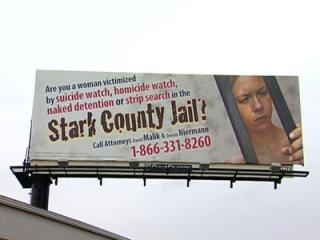
STARK COUNTY — A story that already has people talking nationwide is certain to get more attention with a billboard that encourages former female inmates to report jail abuse.

The billboard along Route 62 near Root Avenue in Stark County was put up as a result of the civil lawsuit brought by Hope Steffey against Stark County Sheriff Tim Swanson.

Steffey’s clothes were forcibly removed by both male and female deputies and she was left completely naked inside the Stark county jail for six hours.

Sheriff Swanson says Steffey was considered suicidal so her clothes had to be removed for her own safety. Steffey has denied she was suicidal.

The woman’s lawyers discovered during the lawsuit that at least 128 women between 1999 and 2007 were strip-searched or forced to remove their clothing or placed on suicide watch, homicide watch or naked detention.

The lawyers were unable to obtain the names of these women due to privacy rights. They are using a billboard along a busy four lane road to encourage these women to come forward and to tell their stories.

— Tom Meyer, WKYC (2009-03-12): Investigator Exclusive: Billboard encourages women to report jail abuse

What is becoming clear is that Sheriff Tim Swanson and his goon squad not only have convinced themselves that this kind of brutality is sometimes acceptable, but also that they have an especially broad understanding of the sort of situation that calls for it, and that they are especially willing to use it as a form of humiliating retaliation, in order to teach uppity or unruly women a lesson, under color of the law. And then, to crown all, to further insult the victim by proclaiming that they did it all For Her Own Good. The Stark County sherriff's office are nothing more and nothing less than a pack of dangerous sexual predators, and their uniforms and badges don't make them any better than any other gang of serial rapists.

— GT 2008-05-10: Rapists in uniform #3: A sixth woman comes forward

See also:

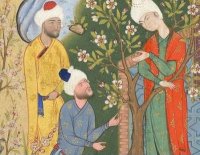
On traditionalism: how homoeroticism flourished in medieval Persia, and how political homophobia came to be imported from the West

One of the difficulties in having serious conversations about cultural conservatism — both here and abroad — is how often it turns out that what the so-called conservative wishes to preserve or to restore the conditions of a past that never existed. When this kind of mythistory is used to pass off modern authoritarian’s political desiderata as if they were accurate representations of history, both the pseudotraditionalists, and their self-styled progressive opponents, tend to take for granted that history must have been whatever modern political conservatives want it to have been; they just argue over whether that history is a good thing or a bad thing, and so whether to join in the march of Progress or to stand athwart history yelling Stop! In reality, though, antiquity is always a much more complicated affair than simple-minded political progress narratives would make it. And often it is exactly the opposite. Take, for instance, the story of queer eroticism in Iran, where — setting aside the propaganda of the Ayatollahs and the colonialist liberals both — it becomes clear that medieval Iran was full of passionate expressions of same-sex eroticism and same-sex romantic love, and that political homophobia, far from being an ingrown feature of traditional culture or religion, is in fact a colonial import, which came into Iranian political culture mainly through the modernizing ideologies of Marxism and Westernizing progressive nationalism.

When Iranian President Mahmoud Ahmadinejad made his infamous claim at a September 2007 Columbia University appearance that In Iran, we don’t have homosexuals like in your country, the world laughed at the absurdity of this pretense.

Now, a forthcoming book by a leading Iranian scholar in exile, which details both the long history of homosexuality in that nation and the origins of the campaign to erase its traces, not only provides a superlative reply to Ahmadinejad, but demonstrates forcefully that political homophobia was a Western import to a culture in which same-sex relations were widely tolerated and frequently celebrated for well over a thousand years. Sexual Politics in Modern Iran, [by Janet Afary,] to be published at the end of next month by Cambridge University Press, is a stunningly researched history and analysis of the evolution of gender and sexuality that will provide a transcendent tool both to the vibrant Iranian women’s movement today fighting the repression of the ayatollahs and to Iranian same-sexers hoping for liberation from a theocracy that condemns them to torture and death.

In her new book, Afary’s extensive section on pre-modern Iran, documented by a close reading of ancient texts, portrays the dominant form of same-sex relations as a highly-codified status-defined homosexuality, in which an older man — presumably the active partner in sex — acquired a younger partner, or amrad. . . . Afary dissects how classical Persian literature (twelfth to fifteenth centuries)…overflowed with same-sex themes (such as passionate homoerotic allusions, symbolism, and even explicit references to beautiful young boys.) This was true not only of the Sufi masters of this classical period but of the poems of the great twentieth-century poet Iraj Mirza (1874-1926)… Classical poets also celebrated homosexual relationships between kings and their pages.

Afary also writes that homosexuality and homoerotic expressions were embraced in numerous other public spaces beyond the royal court, from monasteries and seminaries to taverns, military camps, gymnasiums, bathhouses, and coffeehouses… Until the mid-seventeenth century, male houses of prostitution (amrad khaneh) were recognized, tax-paying establishments.

. . . Unmistakably lesbian sigeh courtship rituals, which continued from the classical period into the twentieth century, were also codified: Tradition dictated that one [woman] who sought another as sister approached a love broker to negotiate the matter. The broker took a tray of sweets to the prospective beloved. In the middle of the tray was a carefully placed dildo or doll made of wax or leather. If the beloved agreed to the proposal, she threw a sequined white scarf (akin to a wedding veil) over the tray… If she was not interested, she threw a black scarf on the tray before sending it back. As late as the last half of the 19th century and the early years of the 20th, Iranian society remained accepting of many male and female homoerotic practices… Consensual and semi-open pederastic relations between adult men and amrads were common within various sectors of society. What Afary terms a romantic bisexuality born in the classical period remained prevalent at court and among elite men and women, and a form of serial love (‘eshq-e mosalsal) was commonly practiced [in which] their love could shift back and forth from girl to boy and back to girl.

In a lengthy section of her book entitled Toward a Westernized Modernity, Afary demonstrates how the trend toward modernization which emerged during the Constitutional Revolution of 1906 and which gave the Persian monarchy its first parliament was heavily influenced by concepts harvested from the West.

One of her most stunning revelations is how an Azeri-language newspaper edited and published in the Russian Caucuses, Molla Nasreddin (or MN, which appeared from 1906 to 1931) influenced this Iranian Revolution with a significant new discourse on gender and sexuality, sharing Marx’s well-documented contempt for homosexuals. With an editorial board that embraced Russian social democratic concepts, including women’s rights, MN was also the first paper in the Shi’i Muslim world to endorse normative heterosexuality, echoing Marx’s well-documented contempt for homosexuality. Afary writes that this illustrated satirical paper, which circulated among Iranian intellectuals and ordinary people alike, was enormously popular in the region because of its graphic cartoons.

MN conflated homosexuality and pedophilia, and attacked clerical teachers and leaders for molesting young boys, played upon feelings of contempt for passive homosexuals, suggested that elite men who kept amrad concubines had a vested interested in maintaining the (male) homosocial public spaces where semi-covert pederasty was tolerated, and mocked the rites of exchanging brotherhood vows before a mollah and compared it to a wedding ceremony. It was in this way that a discourse of political homophobia developed in Europe, which insisted that only heterosexuality could be the norm, was introduced into Iran.

MN‘s attacks on homosexuality would shape Iranian debates on sexuality for the next century, and it became a model for several Iranian newspapers of the era, which echoed its attacks on the conservative clergy and leadership for homosexual practices. In the years that followed, Iranian revolutionaries commonly berated major political figures for their sexual transgressions, and revolutionary leaflets accused adult men of having homosexual sex with other adult men, of thirty-year-olds propositioning fifty-year-olds and twenty-year-olds propositioning forty-year-olds, right in front of the Shah. Some leaflets repeated the old allegation that major political figures had been amrads in their youth.

. . . The expansion of radio, television, and print media in the 1940s — including a widely read daily, Parcham, published from 1941 by Kasravi’s Pak Dini movement — resulted in a nationwide discussion about the evils of pederasty and, ultimately, in significant official censorship of literature. References to same-sex love and the love of boys were eliminated in textbooks and even in new editions of classical poetry. Classical poems were now illustrated by miniature paintings celebrating heterosexual, rather than homosexual, love and students were led to believe that the love object was always a woman, even when the text directly contradicted that assumption, Arafy writes.

In the context of a triumphant censorship that erased from the popular collective memory the enormous literary and cultural heritage of what Afary terms the ethics of male love in the classical Persian period, it is hardly surprising as Afary earlier noted in Foucault and the Iranian Revolution that the virulence of the current Iranian regime’s anti-homosexual repression stems in part from the role homosexuality played in the 1979 revolution that brought the Ayatollah Khomeini and his followers to power.

In that earlier work, she and her co-author, Kevin B. Anderson, wrote: There is… a long tradition in nationalist movements of consolidating power through narratives that affirm patriarchy and compulsory heterosexuality, attributing sexual abnormality and immorality to a corrupt ruling elite that is about to be overthrown and/or is complicit with foreign imperialism ….

— Doug Ireland, Direland (2009-02-27): Iran’s Hidden Homosexual History

Read the whole thing.

(Via Jesse Walker 2009-03-09.)

Anticopyright. All pages written 1996–2026 by Rad Geek. Feel free to reprint if you like it. This machine kills intellectual monopolists.